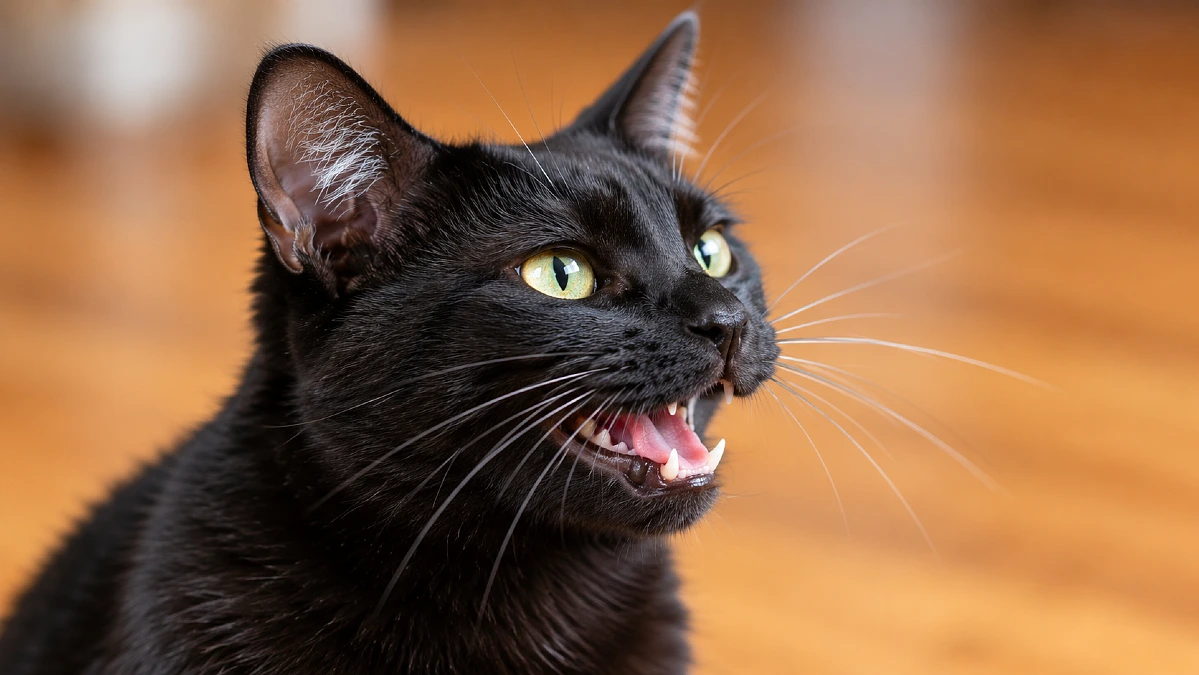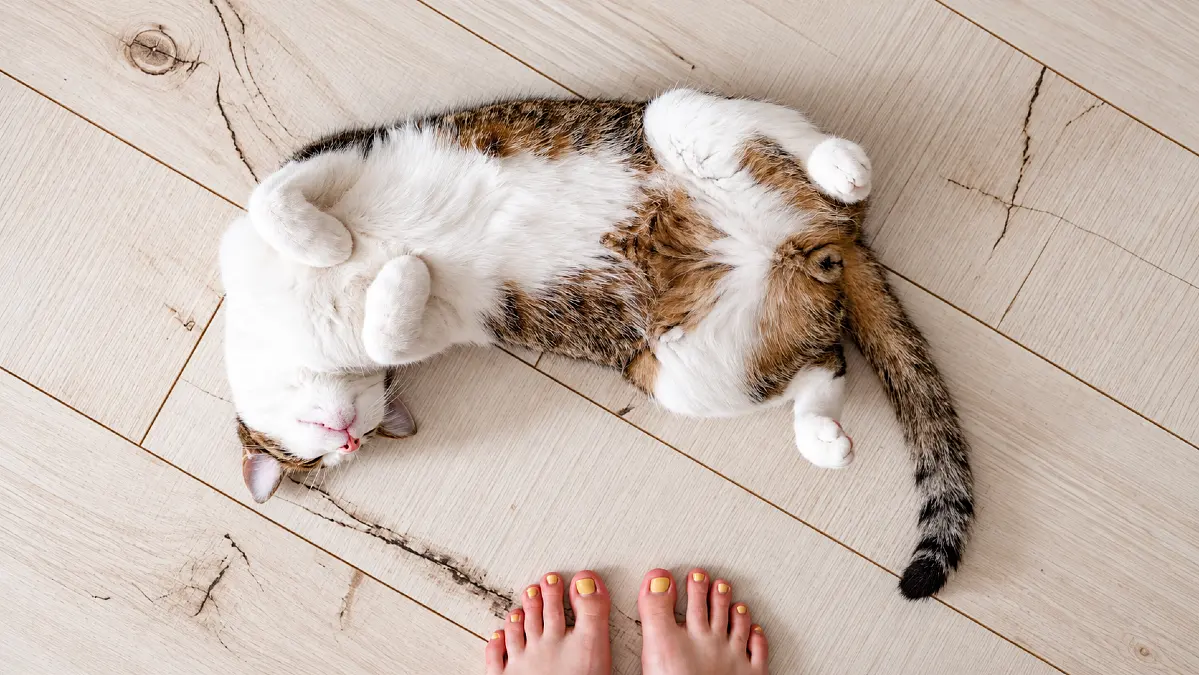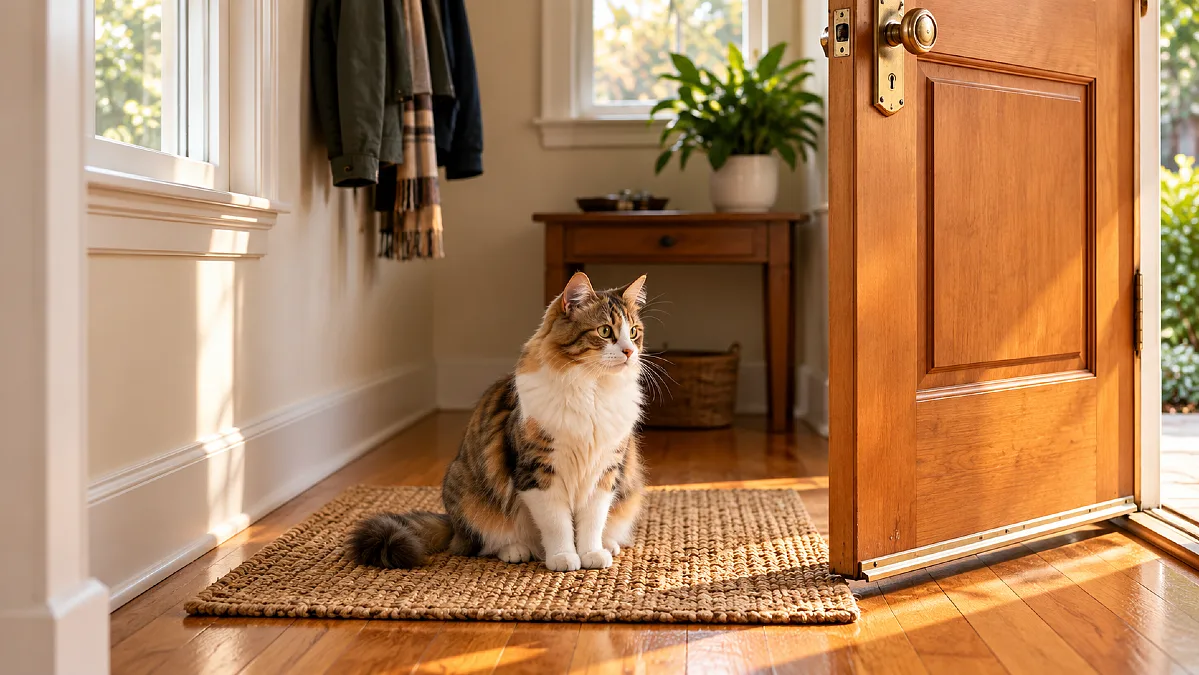
You close the front door, hear your cat meow behind you, and immediately feel guilty. Are they sitting there wondering why you left? Are they lonely, confused, or waiting for you to come back?
Many cat owners worry about what happens after they leave home. But what your cat actually does during your absence may be quite different from the sad story you picture in your head.
Cats notice changes in their surroundings, recognize familiar people, and learn daily routines. They also rely heavily on smell to make sense of their home, which means your presence can matter even when you are nowhere in sight.
And here’s what makes this interesting. Research suggests that cats can form strong emotional bonds with their owners, yet many remain calm and comfortable while those same people are away.
What Your Cat Really Knows When You Leave Home
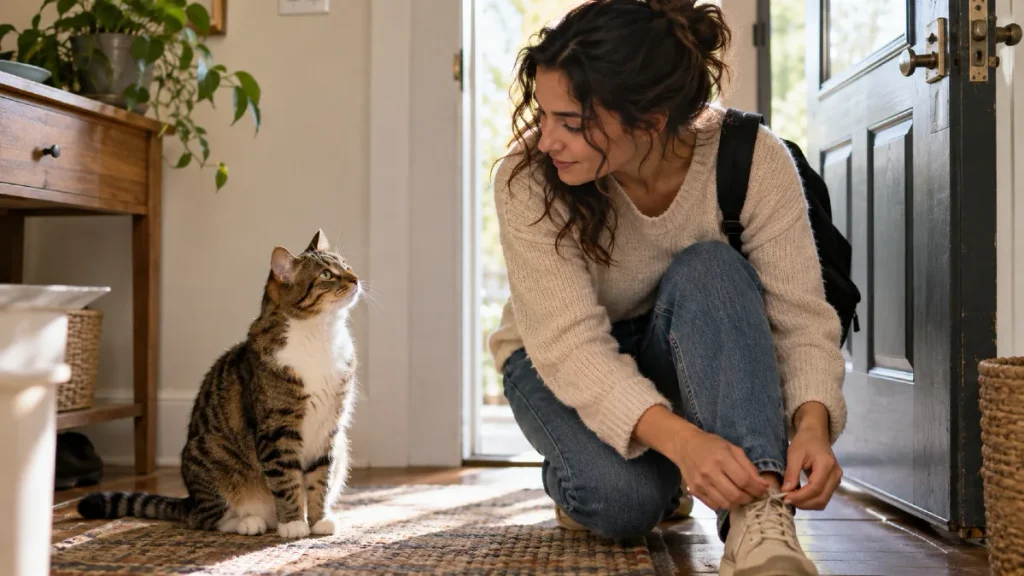
Your cat probably notices your departure long before you reach the front door. Picking up your keys, putting on shoes, and grabbing your bag are familiar actions that can become signals that something is about to change.
Cats are good at learning repeated events. If the same actions happen before you leave each morning, your cat may start to associate those actions with your absence.
But does your cat actually think you have abandoned them? Scientists cannot directly tell us what a cat is thinking, so there is no good reason to assume that every departure feels like abandonment.
What researchers have found is that cats can keep track of people even when those people are out of sight.
In a 2021 study published in PLOS ONE, researchers led by Saho Takagi tested how cats responded to recordings of their owners’ voices. The cats showed greater surprise when a familiar voice suddenly appeared to come from an unexpected location.
This suggests that cats can form a mental picture of where their owners might be. You do not have to be visible for your cat to keep track of you.
Your voice also carries information your cat can recognize. Research led by Atsuko Saito in 2019 found that household cats could tell their own names apart from other spoken words.
Of course, recognizing your voice or name does not mean your cat knows where you have gone. It simply shows that cats notice more about familiar people than their quiet behavior might suggest.
How Your Scent Keeps Home Familiar While You Are Away
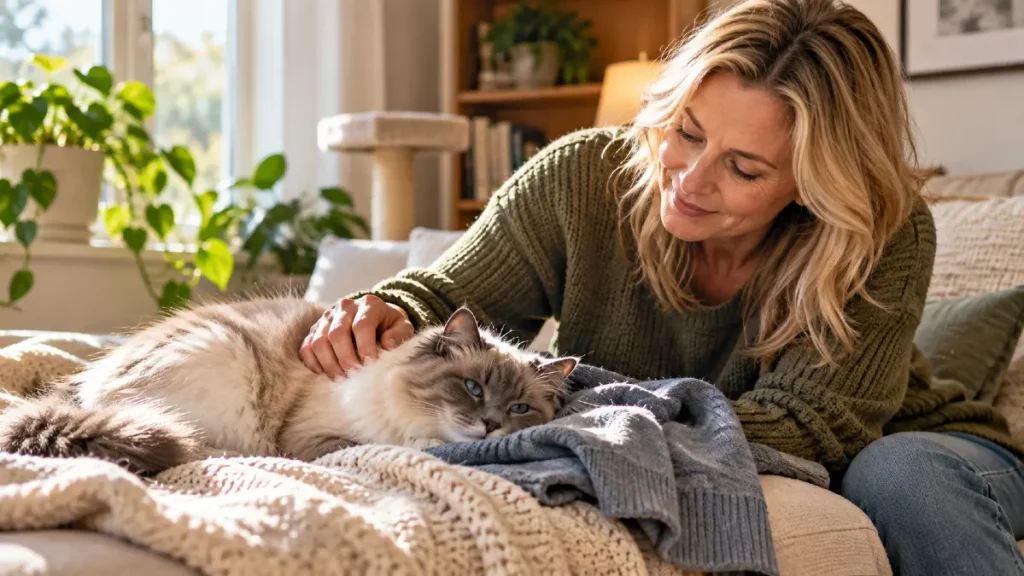
Have you ever found your cat sleeping on your sweater, resting against your pillow, or curling up in the chair you use every evening? Those places may be comfortable for several reasons, but familiar smells could be part of their appeal.
Cats depend heavily on scent to recognize and evaluate their surroundings. According to Battersea Dogs & Cats Home, cats use scent to communicate and make familiar spaces feel more secure.
Every time your cat rubs their cheeks against the sofa, a doorway, or your legs, they leave chemical signals from glands around their face. This helps create familiar scent marks throughout their environment.
Your own smell is also present on clothing, bedding, and furniture. It is reasonable that these smells can contribute to a familiar home environment, although researchers have not shown that cats use fading human scent to measure exactly how long someone has been gone.
Why Familiar Smells Matter
A familiar environment can help your cat feel more comfortable when household routines change. You can support that comfort without buying special products or making major changes to your home.
| Familiar scent source | Why it may help | What you can do |
|---|---|---|
| Favorite blanket | Provides familiar smells | Keep it in their resting spot |
| Your worn shirt | Carries your scent | Leave it where they can safely rest |
| Favorite scratching post | Holds familiar scent marks | Keep it in its usual place |
| Scent marked furniture | Maintains familiar surroundings | Avoid unnecessary deep cleaning |
| Strongly scented cleaners | May disturb familiar smells | Use mild, pet safe products |
You do not need to leave piles of clothing around the house. A comfortable resting area with familiar bedding is often enough to provide a reassuring space.
The Feline Veterinary Medical Association’s 2026 guidance recommends respecting a cat’s sense of smell. Keeping familiar objects available can be especially helpful when you expect changes in your daily schedule.
Why Your Cat Sleeps, Watches, or Checks the Door
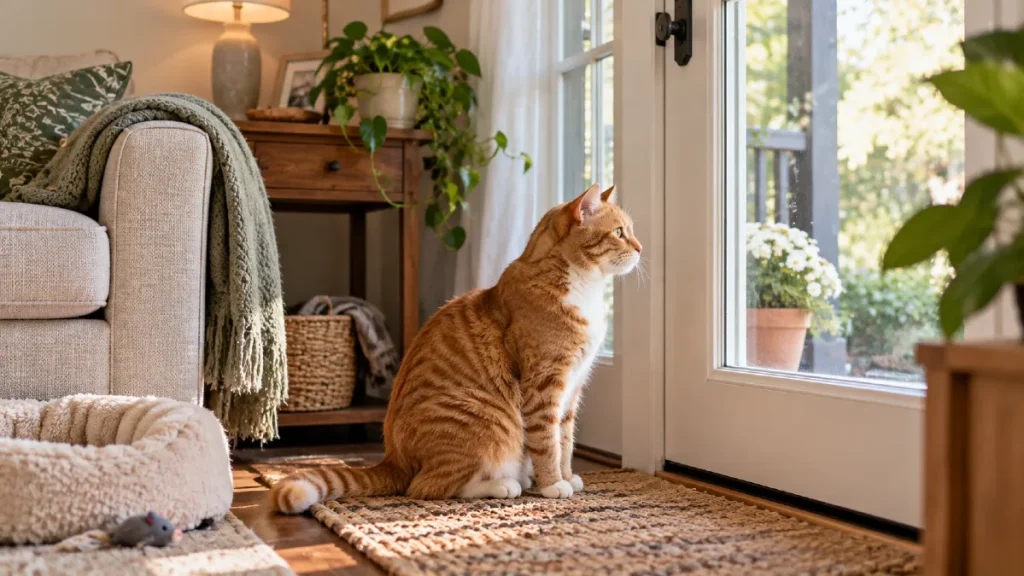
One of the biggest surprises for cat owners is how ordinary their cat’s day can be after they leave. Instead of spending every minute watching the entrance, many cats simply settle down and rest.
Your cat might sleep on the sofa, explore another room, groom themselves, or watch birds through the window. These activities do not mean your cat has forgotten you.
They are simply normal parts of feline behavior.
A study published in PLOS ONE in 2017 examined 14 cats during two periods of separation from their owners. Each cat was left alone at home for 30 minutes on one occasion and four hours on another.
The researchers did not find clear differences in the cats’ behavior near the end of those separation periods. However, they did notice differences in how cats behaved when their owners returned.
This tells us something useful. A cat can appear comfortable while alone and still respond differently when a familiar person comes back.
What About Cats That Wait Near the Door?
Some cats sit near the entrance because it gives them a good view of activity. Others may associate the door with meals, outdoor access, or the arrival of familiar people.
If your cat occasionally checks the doorway and then returns to resting, that is usually less concerning than constant pacing or crying.
The important thing is to watch the whole pattern. A cat sleeping peacefully for most of the day and greeting you at the door is showing very different behavior from one that spends hours unable to settle.
How Your Cat Learns When You Usually Come Home
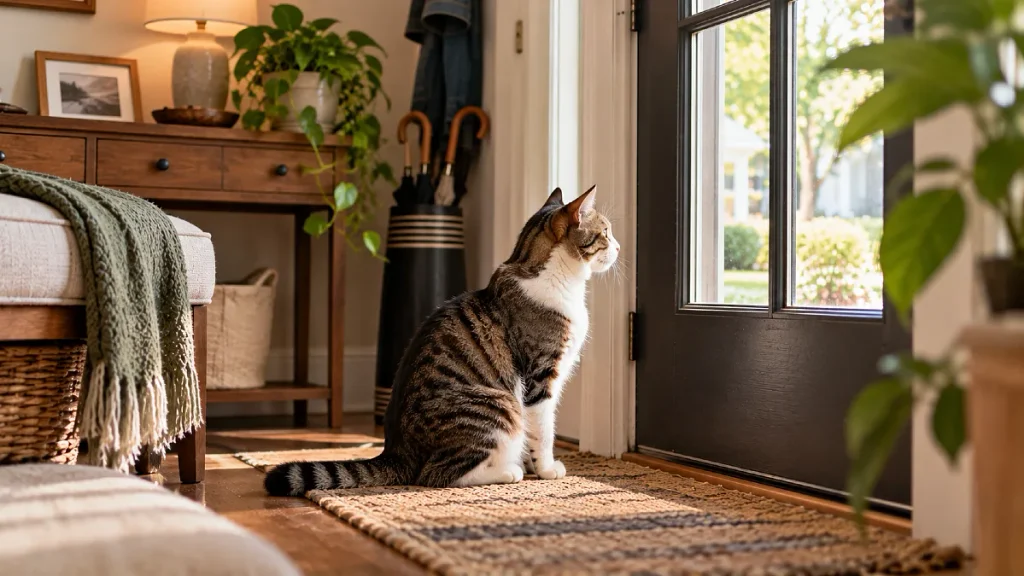
Does your cat seem to know when you are about to arrive, even before you put your key in the lock? This can feel almost mysterious, especially when someone at home tells you the cat was already waiting.
But cats do not need a human sense of clock time to recognize daily patterns. Repeated events can help them learn what usually happens next.
Your cat may notice changes in daylight, household activity, or sounds outside. Feeding times and regular play sessions can also become important parts of their daily routine.
For example, suppose you usually return from work and feed your cat soon afterward. Over time, your arrival may become closely associated with dinner.
That connection can encourage your cat to move toward the door or become more alert around the usual time. It does not prove that your cat has been counting down the minutes.
VCA Animal Hospitals explains that regular feeding schedules give cats a sense of predictability. Cornell’s Feline Health Center also recommends keeping feeding routines consistent.
This is why sudden schedule changes can sometimes affect your cat’s behavior.
If you normally return in the afternoon but begin working late into the evening, your cat may need time to adjust. They might become more vocal, demand attention at different hours, or change where they spend their time.
A stable routine cannot prevent every behavior problem. But it can give your cat a more predictable day, whether you are home or away.
What Your Cat’s Welcome Home Behavior Really Means
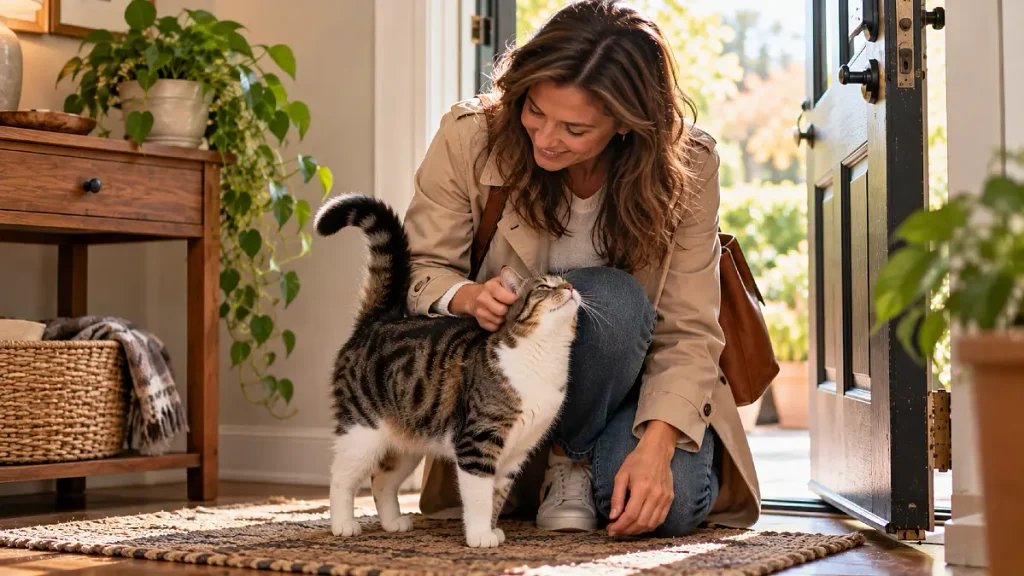
The moment you return home can reveal a lot about how your cat responds to you. Some cats rush toward the door, while others remain on the sofa and watch you walk inside.
Neither reaction tells the whole story about how much your cat cares.
One familiar greeting involves your cat walking toward you with their tail raised, then brushing their cheeks or body against your legs. This behavior can serve several purposes, including friendly contact and scent marking.
Cats have scent glands around their cheeks and other parts of their bodies. When they rub against you, they deposit scent while also making physical contact.
It is tempting to describe this as your cat repairing a shared scent that disappeared while you were gone. That is an interesting idea, but scientists have not shown that cats perform a specific scent repair ritual after every separation.
What is well established is that rubbing is a common part of friendly feline communication.
How to Read Your Cat’s Greeting
Your cat’s body language offers useful clues, especially when you consider several signals together. No single greeting action can tell you exactly what your cat is feeling.
| Greeting behavior | Possible meaning | What to notice |
|---|---|---|
| Tail held upright | Friendly approach | Relaxed body and movement |
| Cheek rubbing | Social contact and scent marking | Repeated gentle rubbing |
| Purring | Social contact or emotional arousal | Overall body language |
| Repeated meowing | Seeking food, contact, or attention | What happens next |
| Quiet greeting | A calm or reserved response | Normal eating and behavior |
The 2017 PLOS ONE study found that cats purred and stretched more after their owners returned from four hours away than after 30 minutes. Although the study was small, it suggests that the length of separation can influence reunion behavior.
So if your cat becomes especially affectionate after you return, that response may reflect the importance of your relationship. But if your cat barely lifts their head, it does not automatically mean the bond is weaker.
Does Your Cat Miss You Even When They Seem Fine?
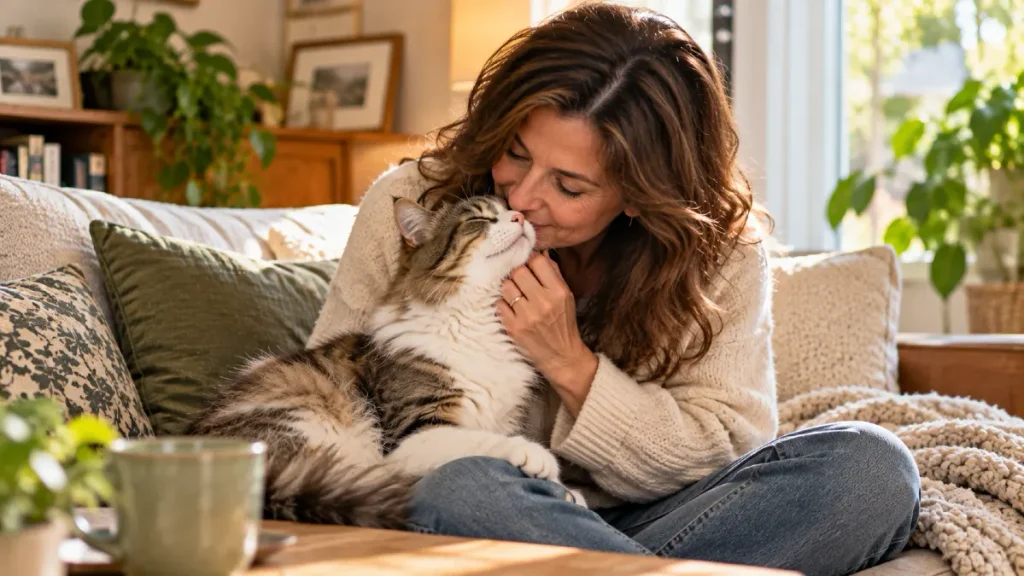
One of the most common questions cat owners ask is whether their cat misses them. The answer is that cats can form strong attachments to people, but attachment does not always look like sadness.
Research from Oregon State University provides evidence of this bond.
In 2019, researcher Kristyn Vitale and her colleagues studied attachment behavior in cats using a test similar to one developed for human infants. Cats spent time in an unfamiliar room with their caregiver, experienced a brief separation, and were then reunited.
Among 70 kittens whose behavior could be classified, 64.3% showed secure attachment patterns.
Cats showing secure attachment tended to use their caregiver as a source of comfort while also feeling able to explore their surroundings. This is important because a strong bond does not require constant physical contact.
A cat can enjoy your company, recognize you as familiar, and feel comfortable resting in another room. They can also spend time alone without showing obvious distress.
Why Some Cats Seem More Attached Than Others
Just like people, cats differ in personality and social preferences. Some regularly follow their owners from room to room, while others prefer to choose when contact happens.
Early experiences, household conditions, health, and individual temperament can all influence behavior.
Your cat might greet you by rubbing against your legs every evening. Another cat might prefer sitting nearby rather than being touched.
Both cats can have meaningful relationships with their owners.
What matters most is whether your cat appears relaxed, maintains normal habits, and is comfortable interacting with you. A healthy attachment gives your cat a sense of security, not a need to be beside you every minute.
How to Tell Normal Waiting From Separation Stress
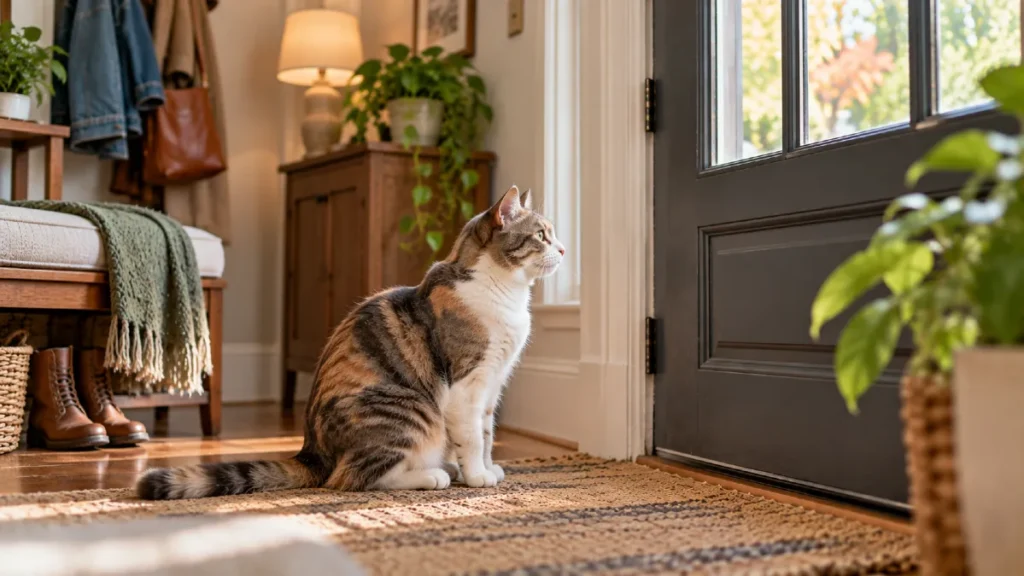
Most cat owners do not need to worry about every meow or every visit to the front door. However, some cats do struggle with changes in routine, boredom, or being left alone.
The key is recognizing when ordinary behavior becomes unusual or intense.
Cats Protection explains that behavior linked to time alone can have several causes. A cat may be frustrated, bored, unsettled by a schedule change, or experiencing a medical problem.
The American Animal Hospital Association also recognizes that cats can experience separation related distress.
Signs Worth Watching
These behaviors deserve different responses depending on how often they happen and whether they represent a change from your cat’s normal habits.
| What you notice | Possible explanation | What to do |
|---|---|---|
| Sleeping most of the day | Normal resting | Keep watching their routine |
| Brief meowing at departure | Communication or frustration | Check whether they settle |
| Persistent pacing or crying | Possible distress | Record behavior and seek advice |
| Reduced appetite | Stress or illness | Contact your veterinarian |
| Changes in litter box habits | Medical or behavior concern | Arrange a veterinary check |
| Excessive grooming | Possible stress or skin problem | Seek veterinary assessment |
One behavior by itself rarely tells you the full story. A cat that meows briefly when you leave may settle comfortably a few moments later.
A cat that cries continuously, repeatedly scratches at exits, or cannot settle may need closer attention.
The Simple Way to Check What Happens After You Leave
If you are concerned, try using a pet camera to observe your cat’s behavior. Watch what happens after the door closes and whether your cat returns to normal activities.
You can also keep a simple record of eating, drinking, litter box habits, grooming, and vocal behavior. This information can help your veterinarian look for patterns.
Never assume that sudden behavior changes are caused by loneliness. Medical problems can produce many of the same signs, and a veterinary check should come before treating a new problem as separation anxiety.
A cat that has stopped eating for 24 hours needs prompt veterinary care. Straining to urinate, especially without producing urine, is an emergency.
How to Help Your Cat Feel Safe When You Leave
You cannot always be home, and your cat does not need you beside them every second. What you can do is make their environment comfortable, predictable, and interesting.
The Feline Veterinary Medical Association recommends giving cats safe resting areas, chances to play, access to important resources, and positive contact with people.
These basic needs are particularly important when a cat spends part of the day alone.
Keep Your Daily Routine Predictable
Try to maintain regular feeding and play times whenever possible. If your working hours are changing, introduce the new routine gradually.
Before leaving, spend a little time playing with your cat using a wand toy or another suitable interactive toy. Give them a chance to chase and catch the toy, then put it away safely.
You do not need a dramatic goodbye. A calm departure is often easier for a cat that already feels comfortable with your routine.
Give Your Cat Something Safe to Do
Boredom can become a problem when a cat spends long periods without anything interesting to explore. Providing suitable enrichment helps them use their natural hunting and searching behaviors.
A Catit Senses Food Tree or PetSafe SlimCat Interactive Feeder can turn part of a meal into a food puzzle. Introduce these products while you are home first, and make sure they are safe for your individual cat to use.
A sturdy scratching post, comfortable climbing tower, or secure window perch can also give your cat more choices throughout the day.
Avoid leaving fishing rod toys, loose strings, ribbons, or other items that could cause entanglement or injury when nobody is watching.
Keep Familiar Resting Places Available
Your cat should have a quiet place where they can sleep without being disturbed. Their usual bed, blanket, or favorite chair may be more appealing than a completely new setup.
You can also leave a worn shirt in a safe resting spot if your cat enjoys lying near your clothing. Just make sure it does not have loose strings, buttons, or pieces they might chew or swallow.
For some cats dealing with environmental stress, a product such as FELIWAY Classic Diffuser may be worth discussing with a veterinarian. Such products do not replace appropriate care or treatment for serious behavior problems.
Make Sure Someone Checks on Your Cat During Longer Absences
Even a fairly independent cat needs reliable access to fresh water, suitable food, and a clean litter box. Your cat also needs someone who can recognize illness or injury.
If you will be away longer than usual, arrange appropriate care rather than relying entirely on an automatic feeder. A trusted pet sitter can provide meals, clean the litter box, check your cat’s health, and offer social contact when welcomed.
Most importantly, pay attention to your individual cat. Some need more interaction and enrichment than others, and their needs may change as they age.