
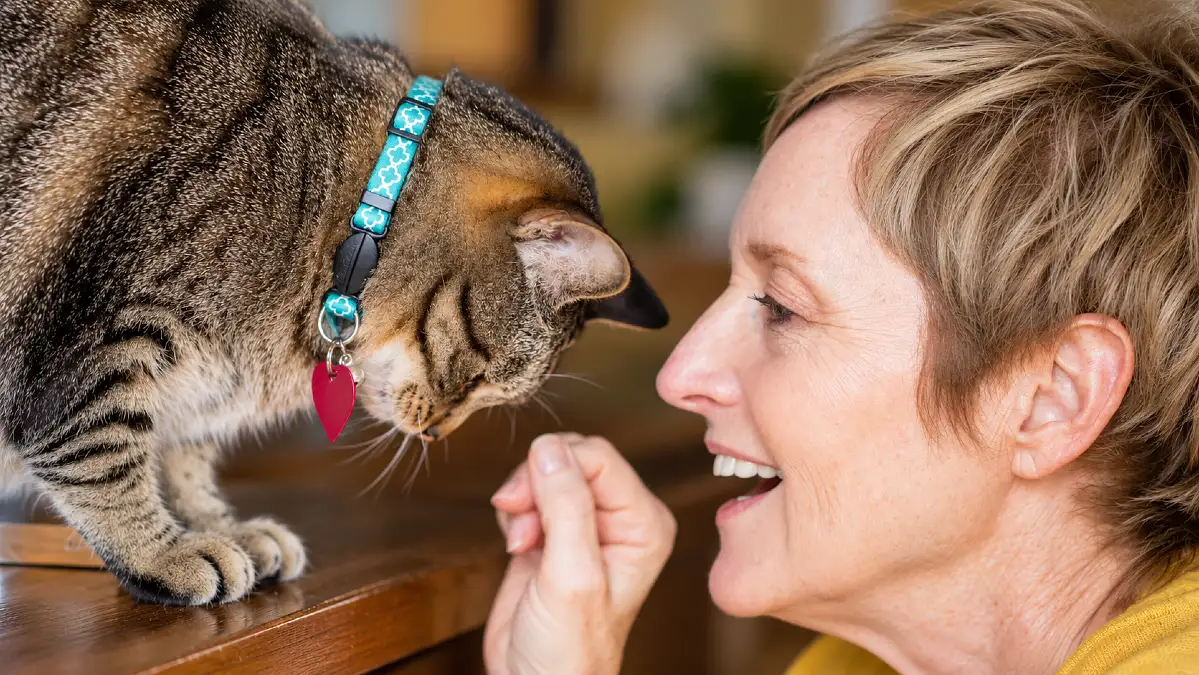
Have you ever talked to your cat about your day, only to have them stare at you like you’re speaking a strange language? Maybe they blink slowly, twitch an ear, or walk away while you’re still talking. Sometimes, they even meow back as if they have something important to say.
These reactions leave many cat owners wondering what their pets actually think when they hear human speech. Does your cat recognize your voice? Can they figure out what you’re saying, or are they simply reacting to the sounds coming from your mouth?
Scientists have discovered that cats pay more attention to human voices than their quiet behavior might suggest. Research shows that cats can recognize familiar voices, distinguish certain words, and notice differences in how people speak to them.
Does Your Cat Recognize Your Voice When You Speak?

Your cat probably knows your voice much better than you realize. Even when they appear completely uninterested, they may recognize who is speaking without needing to see that person.
A 2013 study by researchers Atsuko Saito and Kazutaka Shinozuka explored whether domestic cats could recognize their owners through sound alone. The researchers studied 20 cats and played recordings of familiar and unfamiliar people calling their names.
The results showed that cats could distinguish their owners’ voices from those of strangers. However, recognizing a voice didn’t always lead to an obvious greeting.
Why Your Cat Might Recognize You Without Coming Over
Cats often respond in subtle ways. Instead of running across the room, your cat might turn an ear, move their head, or briefly look in your direction.
For example, suppose you’re sitting on the sofa and call your cat while they’re resting near a window. They may turn one ear toward you and continue looking outside.
That small movement could show that your cat heard something worth noticing. It doesn’t prove exactly what they’re thinking, but it may be a sign of recognition.
Recognizing your voice and choosing to approach you are two different things.
Your cat might know you’re calling but feel more interested in watching birds or enjoying a comfortable resting spot.
So, the next time your cat seems to ignore you, pay attention to their ears and head before assuming they haven’t noticed you.
Does Your Cat Know When You’re Talking Directly to Them?

You probably don’t speak to your cat the same way you speak to another adult. Your voice may become softer, slightly higher, or more expressive when you address your pet.
Researchers have found that this difference can matter.
In a study first published online in 2022, researcher Charlotte de Mouzon and her colleagues investigated whether cats could tell the difference between speech directed at them and speech directed at people.
The researchers studied 16 companion cats. They found that the cats responded differently to these speaking styles when the recordings came from their owners.
Interestingly, the same difference was not clear when unfamiliar people spoke.
Your Cat May Learn Your Special Speaking Style
This suggests that cats can become familiar with the particular way their owners address them.
Think about how you say your cat’s name when you come home. You might use a cheerful voice that sounds different from your normal conversations.
After hearing that greeting many times, your cat may learn that the sound is directed at them.
The important point is that your cat may notice how you speak to them, even without knowing the meaning of every word.
This doesn’t mean that speaking in a higher voice is always better. Some cats may prefer quieter conversations, especially if they’re sensitive to noise.
What matters is using a comfortable speaking style that your cat has learned to recognize.
How Much of Your Everyday Speech Can Your Cat Learn?

Your cat doesn’t need to speak your language to recognize certain sounds. Through everyday experience, they can learn that familiar words often come before familiar events.
One of the clearest examples involves their name.
In 2019, researchers led by Atsuko Saito published a study in Scientific Reports showing that domestic cats can distinguish their own names from other spoken words.
Some cats also distinguished their names from the names of other cats living in the same home.
However, recognizing a name doesn’t necessarily mean a cat thinks of that name the way a person does.
Your Cat May Connect Words With What Happens Next
Your cat might learn that a certain sound comes before dinner, playtime, or another enjoyable activity.
For example, if you always say “dinner” before filling the food bowl, your cat may begin reacting to that word.
A 2024 study led by Saho Takagi found that cats could quickly form associations between sounds and pictures in a controlled experiment.
This supports the idea that cats have useful learning abilities related to sounds. It does not mean they can follow full human conversations.
Everyday Words Your Cat May Learn
The following examples show how familiar speech could become meaningful through repeated experiences. These are possible learned associations, not a fixed vocabulary that every cat knows.
| Spoken phrase | Possible association | What to observe |
|---|---|---|
| Their name | Someone wants attention | Ears or head turn |
| Dinner | Food may arrive | Moves toward bowl |
| Treat | A reward may appear | Approaches you |
| Playtime | A toy may appear | Looks toward toys |
| Come here | A familiar invitation | Walks closer |
Your cat may learn some of these associations and show no interest in others. Their response will depend on previous experiences, motivation, and what they’re doing.
Consistency helps your cat connect sounds with events. Using the same short phrase before a familiar activity gives them a clearer opportunity to learn it.
What Does Your Tone of Voice Tell Your Cat?

When you talk to your cat, the sound of your voice can matter as much as the words themselves.
Cats can hear changes in how people speak. Volume, pitch, and familiar speaking patterns may all affect whether your cat pays attention.
A gentle greeting may encourage a relaxed cat to approach. A sudden shout, however, could startle them and make them move away.
This doesn’t mean cats identify every human emotion from speech. Research has not established that cats interpret human feelings exactly as people do.
Instead, cats may learn to associate certain speaking styles with familiar experiences.
Why Speaking Loudly Can Make Things Worse
Suppose your cat jumps onto the kitchen counter, and you suddenly shout. They might jump down, but that doesn’t necessarily mean they’ve learned why the counter is off limits.
Your loud voice may simply have frightened them.
Repeated frightening interactions can make your cat less comfortable around you. Calm redirection and suitable alternatives are generally better ways to manage unwanted behavior.
How Different Voice Styles May Affect Your Cat
| Speaking style | Possible response | Better approach |
|---|---|---|
| Gentle, familiar voice | Relaxed attention | Use for greetings |
| Cheerful, playful voice | Curiosity or excitement | Pair with play |
| Sudden shouting | Startle or fear | Avoid when possible |
| Repeated loud calling | Stress or withdrawal | Pause and give space |
| Quiet, steady speech | May be less startling | Use during calm contact |
Your cat’s reaction is more important than choosing a particular voice pitch. If they relax or approach, that style may suit the situation.
If they hide, flatten their ears, or move away, lower the noise and allow them to settle. A familiar, comfortable voice is often more useful than a louder one.
How Can You Tell What Your Cat Thinks While You’re Talking?

Your cat cannot explain how they feel about your conversations. However, their body language can provide helpful clues.
Cats communicate through their ears, eyes, tails, posture, and vocal sounds. These signals often tell you more about their current mood than a single meow.
The RSPCA explains that relaxed cats often show soft eyes, comfortable body positions, and friendly tail movements.
Cats Protection also notes that stressed cats may show flattened ears, tense body positions, hiding, or changes in normal behavior.
Small Body Movements That Deserve Your Attention
If your cat sits near you with relaxed ears and half closed eyes while you speak, they may feel comfortable in your presence.
A slow blink can be another friendly signal.
Research led by Tasmin Humphrey in 2020 examined slow blinking between humans and cats. The findings support the idea that these eye movements play a role in positive communication.
You can try slowly narrowing your eyes and blinking gently while sitting near your cat. Let your cat choose whether to look back or approach.
However, a slow blink doesn’t prove your cat understands the topic of your conversation.
What Your Cat’s Body Language May Mean
| Body signal | Possible meaning | What you should do |
|---|---|---|
| Ears facing you | Listening or alert | Speak normally |
| Slow blinking | Relaxed, friendly state | Blink gently back |
| Tail held upright | Friendly confidence | Offer a greeting |
| Loose, relaxed body | Feeling comfortable | Continue calmly |
| Ears flattened | Fear or discomfort | Give space |
| Tense body and tail lashing | High arousal or irritation | Stop unwanted contact |
These signals should always be read together. For example, a moving tail can mean different things depending on whether your cat is playing, watching prey, or becoming irritated.
Look at your cat’s whole body rather than judging one movement. This helps you decide whether they welcome the interaction or would rather be left alone.
Why Does Your Cat Sometimes Meow Back or Ignore You?

Some cats seem eager to have conversations with their owners. You say something, they meow, and suddenly it feels like you’re exchanging opinions.
Other cats remain completely silent, even when you speak directly to them.
Both responses can be normal.
Cats differ in personality, past experiences, and how often they use vocal sounds. Some are naturally more talkative, while others communicate mainly through movement and posture.
Your Cat’s Meow May Be a Request Rather Than an Answer
When your cat meows after you speak, they may be seeking attention, food, play, or access to another room.
For example, you might say good morning, and your cat immediately walks toward their food bowl while meowing.
The timing makes it seem like they’re answering your greeting. But they could simply be using a familiar opportunity to ask for breakfast.
You may also notice that your cat meows more often when their vocal sounds lead to a response from you.
If meowing regularly results in attention, that pattern can become part of your daily routine.
Why Silence Doesn’t Mean Your Cat Dislikes You
A quiet cat may still enjoy sitting near you while you talk. They might show comfort through relaxed posture, gentle head rubbing, or choosing to stay beside you.
Some cats simply have little reason to vocalize during peaceful moments.
The best way to judge your cat’s response is to consider what they’re doing before, during, and after you speak.
A cat who stays nearby looking relaxed may be perfectly content without making a sound.
How Should You Talk to Your Cat to Build Trust?
You don’t need to have long conversations with your cat to make your interactions pleasant. A few simple habits can make everyday communication clearer and more comfortable.
Start by using a calm, familiar voice when greeting your pet.
If your cat approaches, allow them to decide whether they want attention. Some cats enjoy being stroked, while others prefer to sit nearby without being touched.
Use Familiar Words During Daily Activities
Choose a few simple phrases for activities that happen regularly.
For example, you might say “time to play” before bringing out a wand toy. Using the same phrase can help your cat connect the sound with the activity.
You can also speak gently while preparing food or sitting beside your cat during a quiet evening.
Try to keep each interaction pleasant and predictable. Avoid forcing your cat to remain beside you if they want to leave.
Let Your Cat Choose How Much Attention They Want
One of the easiest ways to build trust is to respect your cat’s decision to approach or move away.
If your cat rubs against your legs while you speak, you can offer your hand and see whether they want contact.
If they walk away, allow them to go without following or repeatedly calling them.
You can also give your cat opportunities to interact without touching them. Gentle play with a wand toy or simply sitting together can provide positive shared experiences.
Try a Simple Daily Conversation Routine
Choose a quiet moment when your cat is awake and comfortable. Sit nearby, speak gently, and give them time to respond.
Watch whether they turn toward you, relax, move closer, or continue their current activity.
Keep the interaction brief if your cat seems uninterested. There’s no need to test them repeatedly.
Over time, you may notice which speaking styles your cat responds to most comfortably.
The goal isn’t to make your cat listen every time. It’s to make your voice part of safe, familiar experiences.
When Could Your Cat’s Reaction to Your Voice Signal a Problem?

Sometimes, a cat’s response to human speech changes for reasons that have little to do with communication preferences.
A normally responsive cat might stop turning toward familiar voices. Another cat may suddenly start meowing much more than usual.
These changes deserve attention, particularly when they appear alongside other unusual behaviors.
According to Cornell Feline Health Center, older cats may experience hearing loss, changes in behavior, and health conditions that affect how they interact with people.
The ASPCA also explains that increased vocalization in older cats can sometimes be connected to pain, sensory changes, anxiety, or illness.
When Changes in Your Cat’s Response Need Attention
| Behavior change | Possible concern | Next step |
|---|---|---|
| Stops reacting to familiar sounds | Hearing or health changes | Arrange a vet visit |
| Sudden loud meowing | Pain, stress, or illness | Contact your vet |
| Hides when approached | Fear or discomfort | Give space and assess changes |
| More meowing at night | Several possible health causes | Schedule an examination |
| Less interested in interaction | Stress or illness | Check for other symptoms |
| Confusion with unusual behavior | Sensory or cognitive changes | Seek veterinary advice |
Not every change means something serious is wrong. However, sudden or persistent differences should never be dismissed as a cat simply getting older.
PetMD veterinarian Hannah Hart also explained in a 2026 article that stress in cats can show up through increased vocal sounds, hiding, and changes in ordinary routines.
Don’t Assume Your Cat Is Simply Ignoring You
If your cat usually responds to their name but suddenly stops, avoid assuming they’re being stubborn.
Observe whether they’re also eating less, sleeping differently, hiding, or showing signs of discomfort.
Arrange a veterinary examination if the change is sudden, unexplained, or continues. If your cat has trouble breathing, collapses, or cannot urinate, seek emergency veterinary care.
The most helpful response is to pay attention to changes in your cat’s usual behavior, rather than focusing on a single reaction.