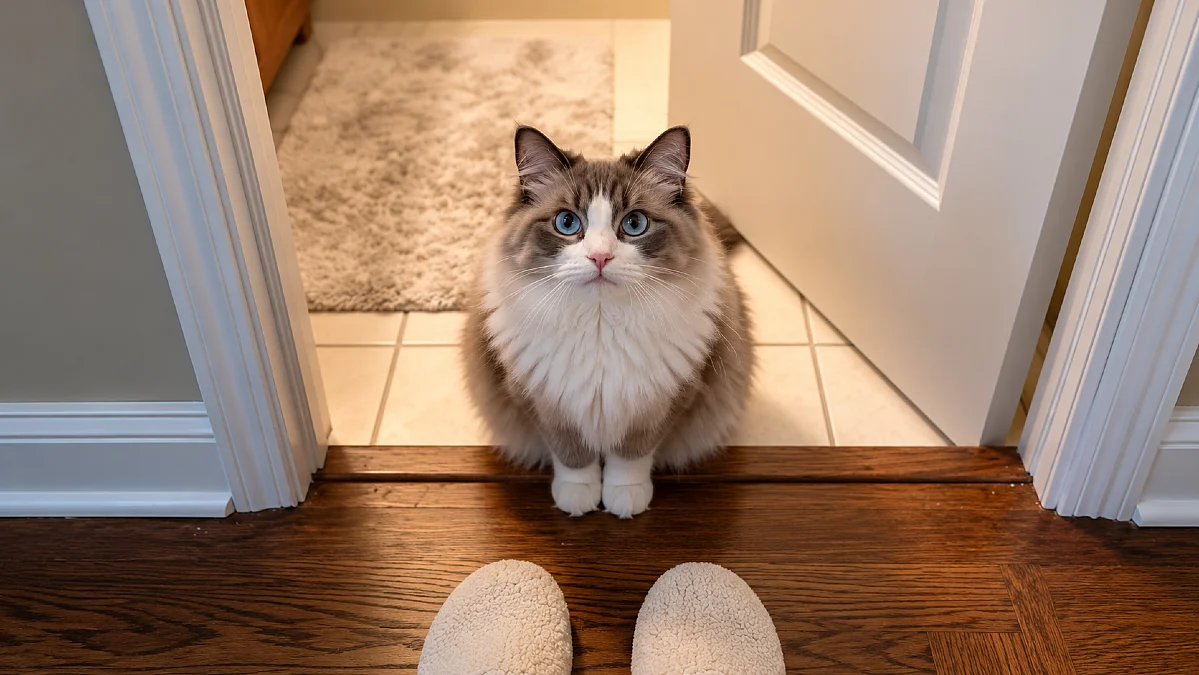
You walk toward the bathroom, and suddenly, your cat appears right behind you. Before you can close the door, they’re already slipping inside, rubbing against your legs, or staring at you like they have important business there.
And when you try to enjoy a little privacy? You might hear scratching, meowing, or tiny paws reaching beneath the door.
If your cat follows you to the bathroom, you’ve probably wondered what makes this ordinary room so interesting to them. Are they protecting you, asking for attention, or simply refusing to let you out of their sight?
The answer is more interesting than it first appears.
Cats pay close attention to their surroundings, familiar routines, and the people they trust. Your bathroom visits can bring several things they enjoy together in one place.
Why Your Cat Follows You to the Bathroom in the First Place
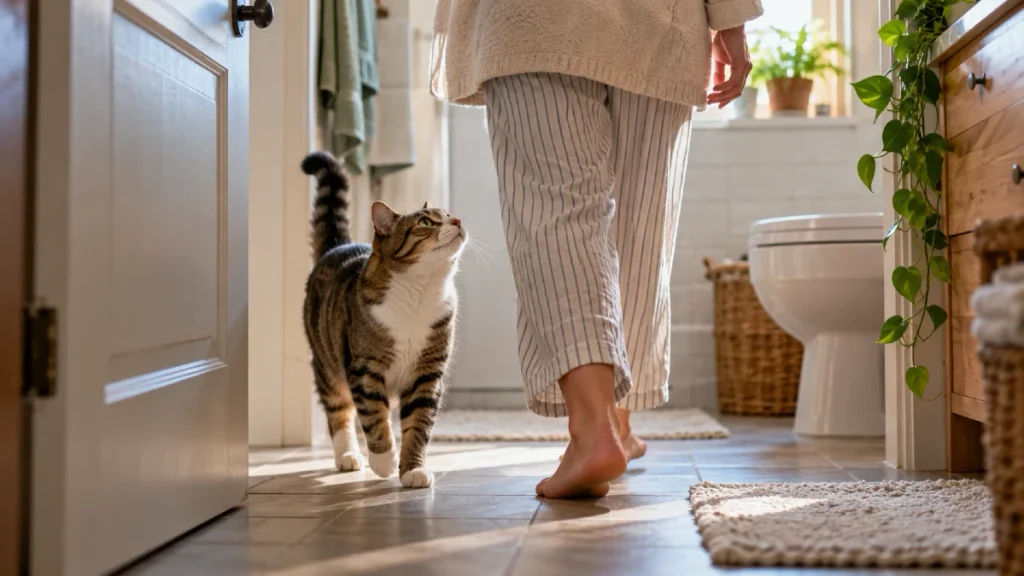
Your cat probably isn’t interested in your bathroom activities themselves. They’re more likely interested in where you’re going, what you’re doing, and whether they can join you.
Cats Protection explains that cats follow their owners for several reasons, including curiosity, companionship, food, and attention. Bathrooms offer another interesting place to explore, especially if your cat cannot always enter freely.
Think about everything inside a typical bathroom. There’s running water, unusual smells, soft towels, a sink to investigate, and sometimes a cool floor that feels comfortable.
Your cat may simply enjoy exploring these things while you’re there.
But there’s another possibility. Your cat may be following you because being near you is rewarding in itself.
Some cats enjoy sitting beside their favorite person without needing to be touched. Others want affection, play, or a chance to investigate whatever has caught your attention.
The easiest way to identify the likely reason is to watch what your cat does after entering.
| What your cat does | Possible reason | What to observe |
|---|---|---|
| Follows and sits nearby | Companionship | Relaxed body |
| Rubs against your legs | Social greeting | Raised tail |
| Jumps into the sink | Curiosity | Sniffing and exploring |
| Watches the faucet | Interest in water | Focus on movement |
| Meows and approaches | Wants a response | Repeated attention seeking |
These behaviors can overlap, so don’t expect one action to tell the entire story. Watch your cat across several bathroom visits to see whether the same pattern keeps appearing.
How Your Predictable Bathroom Routine Makes Your Cat Feel Safe
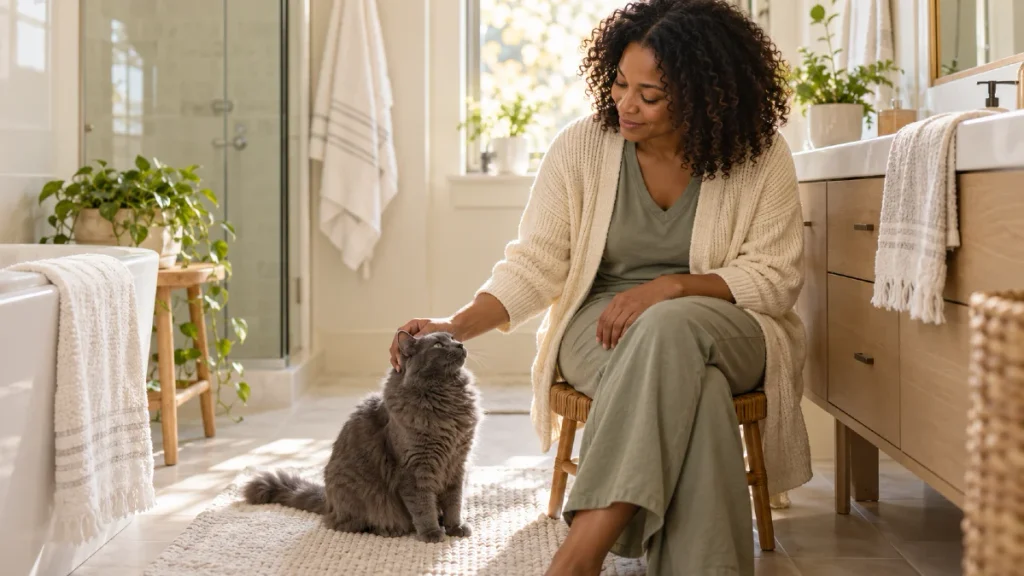
Have you noticed that your cat seems to know where you’re going before you even reach the bathroom?
That may happen because cats learn familiar household routines. They notice repeated movements, sounds, and events that become part of their daily lives.
Your bathroom routine may be especially easy to recognize. You walk down the same hallway, open the same door, and remain in one place for a little while.
For your cat, that can create a familiar opportunity to approach you.
The AAFP and ISFM Feline Environmental Needs Guidelines explain that cats benefit from positive, predictable interactions with people. Familiar routines can help them feel more secure in their surroundings.
Why Sitting Still Makes a Difference
Throughout the day, you might be cooking, cleaning, working, or moving between rooms. Your cat may approach you during these activities, only to watch you walk away.
Bathroom visits are different because you often stop moving. That gives your cat an opportunity to approach without having to follow your changing movements.
A shy cat might find this especially appealing. Rather than chasing after you for attention, they can simply walk over and settle nearby.
This doesn’t mean the bathroom is the only place your cat trusts you. It means that a familiar routine can make an ordinary interaction easier.
And when that interaction regularly feels pleasant, your cat may choose to repeat it.
Why Your Cat Loves Getting Your Attention in the Bathroom
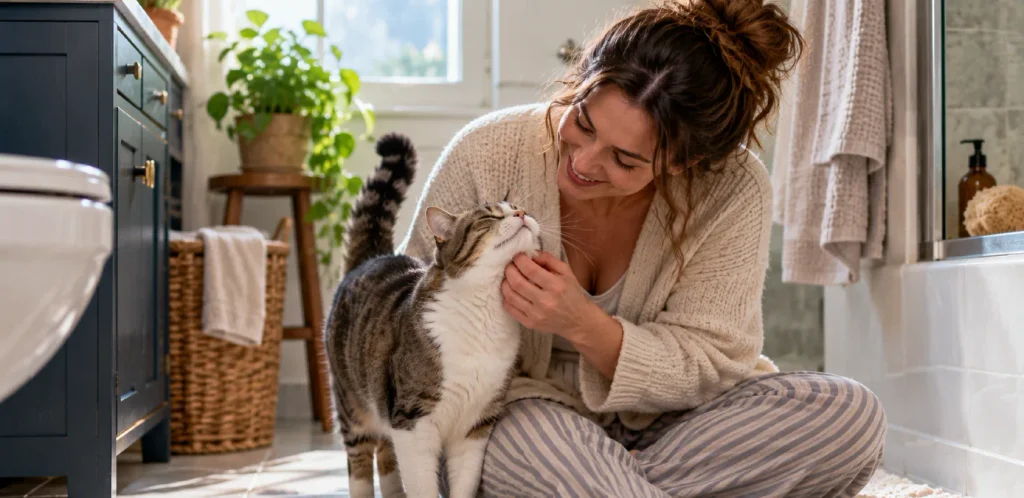
Here’s something you might be doing without realizing it. Every time your cat follows you into the bathroom, you may be giving them a small reward.
Maybe you smile when they appear. Perhaps you speak softly, scratch behind their ears, or let them rub against your hand.
Those little moments can matter to a cat.
Cats learn from the results of their actions. When following you leads to something pleasant, they may become more likely to follow you again.
Cats Protection notes that owners can accidentally encourage following behavior through repeated rewards. A cat that learns certain activities lead to food or attention may begin waiting for those moments.
Your Cat May Prefer Attention on Their Own Terms
Some cats enjoy brief moments of affection more than long cuddle sessions. They may approach, ask for a little attention, and leave once they’ve had enough.
A quiet bathroom visit can provide that kind of interaction.
Your cat might jump onto a nearby mat, look up at you, and wait. When you speak or offer a gentle stroke, they get the social contact they were seeking.
If your cat appears comfortable, there’s nothing wrong with enjoying these moments together. Let them approach and decide whether they want to be touched.
You can also offer affection in other rooms. That way, the bathroom doesn’t become the only place where your cat expects your full attention.
The important clue is whether your cat looks relaxed and chooses to stay. A cat that approaches freely, enjoys a little affection, and leaves calmly is often showing normal social behavior.
What Rubbing Against Your Legs Says About Shared Territory
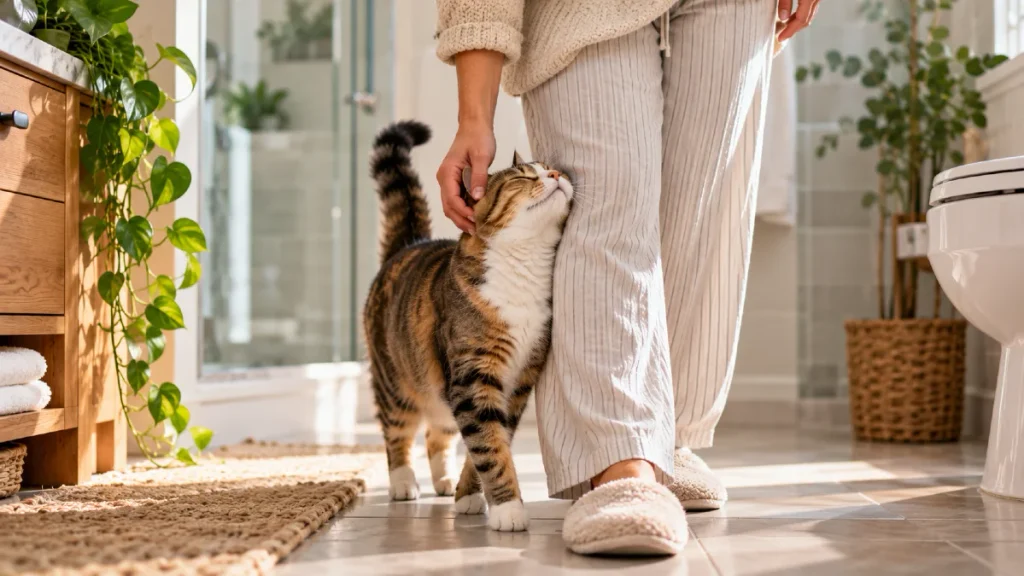
Have you ever noticed your cat weaving around your ankles the moment you enter the bathroom?
That familiar movement is more meaningful than it might appear.
Cats have scent glands around their faces and other parts of their bodies. When they rub their cheeks or sides against people and objects, they leave scent signals behind.
The Cornell Feline Health Center and Merck Veterinary Manual both describe rubbing as part of normal feline scent communication.
These scents help cats interact with their surroundings and familiar individuals. Rubbing can also be a friendly social greeting.
Why Familiar Smells Matter to Your Cat
Cats rely heavily on smell when exploring their environment. Familiar scent signals can help them recognize places they regularly use.
Your bathroom already contains many familiar smells. When your cat rubs against the door frame, cabinet, or your legs, they’re taking part in normal scent marking.
This doesn’t necessarily mean they’re trying to claim ownership of the bathroom or control where you go.
Instead, rubbing can reflect familiarity, comfort, or a desire for contact.
Watch how your cat behaves during these moments. A relaxed body, upright tail, and gentle cheek rubbing are generally encouraging signs.
If your cat circles your legs, offer a gentle touch if they seem interested. Just be careful when walking, since a cat moving between your feet can create a tripping risk.
That little greeting may be one of the simplest ways your cat chooses to connect with you.
Is Your Cat Guarding You or Simply Watching the Door?
This is one of the most interesting theories about cats following people into bathrooms.
You sit down, and your cat immediately takes a position near the doorway. They look into the hallway, listen to small sounds, and occasionally turn back toward you.
It can look remarkably like they’re standing guard.
Cats are alert animals that pay attention to changes in their surroundings. They use their hearing, smell, and vision to track activity around them.
So a cat sitting by the door may simply be watching a busy part of the home.
Does Your Cat Think You’re Vulnerable?
Some people believe cats guard their owners during bathroom visits because using the toilet leaves a person distracted.
It’s an appealing explanation, but there isn’t strong evidence proving that bathroom following is a deliberate act of protection.
A cat may choose the doorway because it offers a clear view of the hallway. They may also prefer sitting where they can leave whenever they want.
Rather than assuming your cat is protecting you, look at their body language.
Cats Protection and the RSPCA describe several signals that can help distinguish relaxed behavior from discomfort.
| Body signal | Possible meaning | What to do |
|---|---|---|
| Tail held upright | Friendly approach | Allow contact |
| Ears relaxed | Comfortable | Keep things calm |
| Soft, partly closed eyes | Relaxed | Give them space |
| Ears flattened | Fear or discomfort | Remove pressure |
| Crouched, tense body | Feeling unsafe | Offer an exit |
Your cat’s position alone cannot reveal their intention. A relaxed cat sitting near the doorway may simply enjoy sharing the space with you.
And if your cat watches the hallway while you use the bathroom, you can enjoy the company without assuming they’re on official guard duty.
Can Your Cat Tell When You Feel Sad or Stressed?
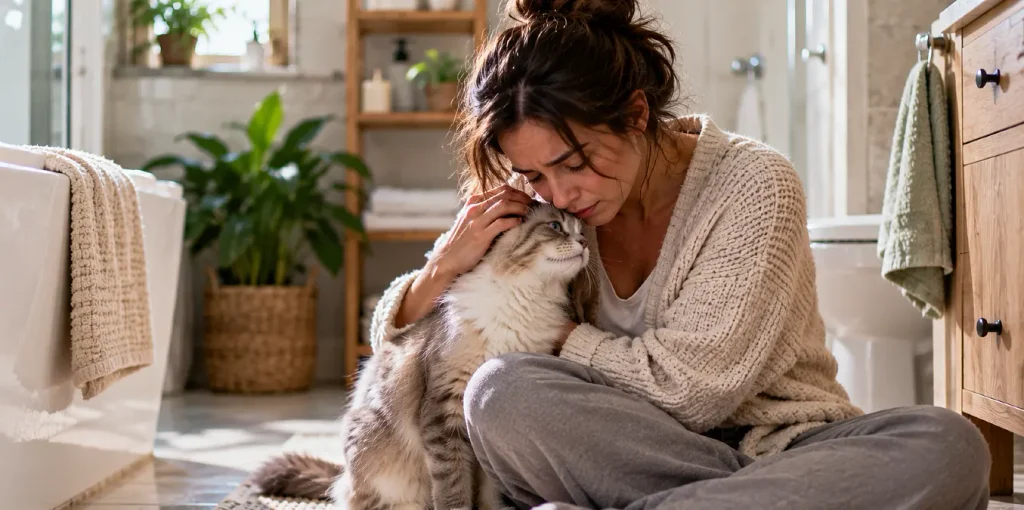
Have you ever noticed your cat coming closer when you’ve had a difficult day?
Perhaps you’re feeling tired, upset, or unusually quiet. Your cat appears, settles beside you, and stays longer than usual.
It’s tempting to believe they know exactly what you’re feeling.
Research suggests cats can recognize some human emotional signals, although that doesn’t mean they know what caused those emotions.
A 2020 study published in the journal Animals, titled Emotion Recognition in Cats, examined how cats responded to emotional sounds and facial expressions.
Researchers found evidence that cats could connect certain emotional vocalizations with matching facial expressions.
That suggests cats can notice more about people’s emotional signals than we once assumed.
Why Your Cat May Behave Differently When You’re Upset
Your voice, facial expression, movements, and daily habits may change when you’re stressed.
Your cat might notice some of these differences. However, noticing emotional signals is not the same as knowing that you’re sad or deciding to comfort you.
If your cat spends more time beside you on difficult days, several explanations are possible. They may respond to your quieter behavior, seek their own comfort, or simply enjoy being close.
Research by Kristyn Vitale and colleagues, published in Current Biology in 2019, also found evidence of attachment bonds between cats and humans.
These findings support the idea that cats can form meaningful relationships with the people who care for them.
So when your cat sits quietly beside you in the bathroom, it may reflect a comfortable relationship. You don’t need to assign a hidden emotional message to every visit.
Sometimes, choosing to be near you is meaningful enough.
Why Your Cat Scratches or Meows at a Closed Bathroom Door
You close the bathroom door, and almost immediately, the scratching begins.
A moment later, your cat starts meowing. Sometimes a tiny paw even appears beneath the door.
Why does closing one door suddenly become such a big event?
Your cat may want access to a room they normally explore. They could also want your attention or be curious about the sounds coming from inside.
Cats Protection points out that bathrooms can be especially interesting because cats sometimes have limited access to them.
And if your cat has learned that scratching makes you open the door, that response may encourage the behavior.
What Your Cat’s Reaction Might Tell You
Not every cat reacts to a closed bathroom door in the same way. The intensity and timing of the behavior can provide useful clues.
| Door behavior | Possible cause | Helpful response |
|---|---|---|
| Waits quietly | Wants company | Allow waiting |
| Meows briefly | Seeking attention | Keep a steady routine |
| Scratches repeatedly | Wants access | Reward calm behavior |
| Plays beneath door | Playful curiosity | Offer another toy |
| Panics or cannot settle | Possible distress | Seek veterinary advice |
A cat that meows briefly and then settles is different from one that becomes extremely distressed whenever you’re out of sight. The second situation deserves closer attention, especially if it happens in other rooms too.
How to Respond Without Making the Problem Worse
Avoid shouting, spraying water, or frightening your cat when they scratch the door. Punishment can increase stress and damage trust.
Instead, make your bathroom routine predictable.
Offer your cat a comfortable resting place nearby and reward calm behavior outside the bathroom. If necessary, practice closing the door for brief periods while your cat is relaxed, then increase the time gradually.
Try not to open the door at the exact moment your cat is scratching. When possible, wait for a calm pause so you don’t accidentally teach them that scratching always gets a response.
If your cat becomes very upset, don’t force longer separations. Ask a veterinarian or qualified feline behavior professional for help.
When Suddenly Following You More Could Signal a Problem
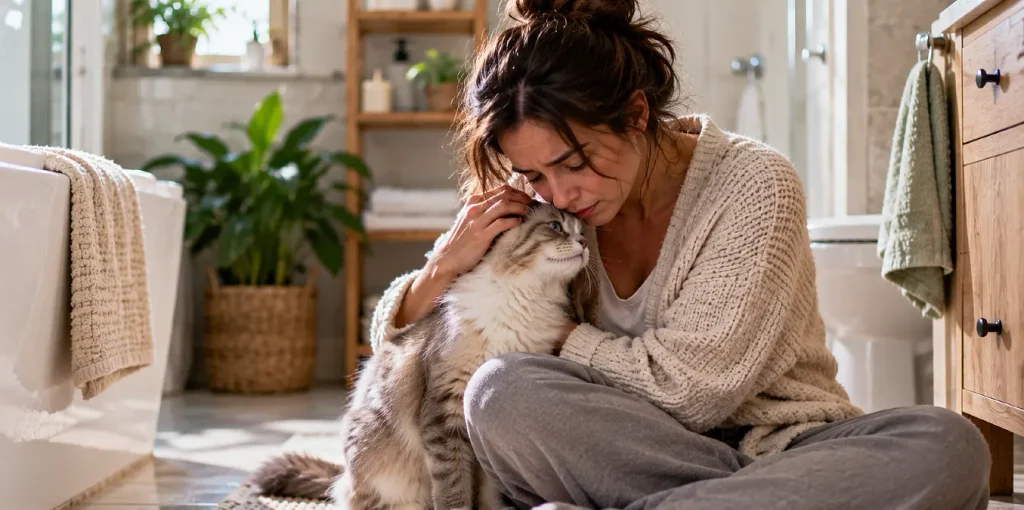
Most cats that follow their owners into the bathroom are behaving normally. But a sudden increase in following behavior can sometimes mean something has changed.
The key is knowing what’s normal for your individual cat.
If your cat has followed you everywhere since kittenhood, bathroom visits may simply be part of their personality.
But if an independent cat suddenly refuses to leave your side, pay closer attention.
Cats Protection and PetMD both advise checking for possible health or stress related causes when a cat becomes unusually clingy.
Changes You Should Never Ignore
Look for changes beyond bathroom following. Appetite, activity, litter box habits, and vocalization can provide important information.
| New behavior | What to check | Next step |
|---|---|---|
| Sudden constant following | Other behavior changes | Arrange a vet check |
| Eating less | Appetite and energy | Contact your vet |
| Drinking much more | Water and urination | Book a vet visit |
| Loud, unusual meowing | Pain or distress signs | Seek veterinary advice |
| Hiding or extreme restlessness | Stress or illness | Arrange an assessment |
| Straining without passing urine | Possible urinary blockage | Emergency vet care |
These symptoms can have different causes, and the table cannot identify which one applies to your cat. A veterinarian can help determine whether a medical problem, stress, or another issue is involved.
Could Separation Anxiety Be the Reason?
Some cats experience distress when separated from their owners. This can involve excessive vocalization, changes in elimination habits, or other behaviors that appear when a familiar person leaves.
But following you into the bathroom does not, by itself, prove separation anxiety.
A cat that calmly follows you, rests nearby, and continues normal activities is very different from a cat that becomes distressed whenever you leave.
Think about your cat’s overall behavior rather than one bathroom habit.
If your cat seems unusually anxious, a recent household change could be contributing. Moving furniture, welcoming another pet, or changing your daily schedule may affect their sense of security.
A sudden behavior change matters more than a familiar habit. When something feels unusual for your cat, a veterinary check is the safest place to start.
How to Keep Your Bathroom Private Without Upsetting Your Cat
You can love your cat and still want a few minutes alone.
Fortunately, setting bathroom boundaries does not mean ignoring your cat’s needs. The goal is to help them feel comfortable whether the door is open or closed.
Start by giving your cat positive attention throughout the day. Short play sessions, gentle affection, and time spent together can reduce the need to seek every interaction in the bathroom.
You can also make other areas of your home more interesting.
Create a Comfortable Spot Outside the Door
Choose a quiet place near the bathroom where your cat can rest. A soft washable mat or familiar cat bed may work well.
Allow your cat to explore the spot without forcing them to stay there. Reward them when they choose to settle calmly.
If your cat enjoys playing, offer a favorite toy before your bathroom visit. A puzzle feeder may also provide something interesting to do, provided it suits your cat’s normal feeding routine.
For cats that love running water, a suitable cat drinking fountain may offer another source of interest. Products such as Catit fountains are examples, but you don’t need to buy anything to change a bathroom habit.
Keep the Bathroom Safe for Curious Cats
If you allow your cat inside, check the room for possible hazards.
The ASPCA warns that household cleaning products can cause problems when pets are exposed to them improperly. Bathrooms often contain concentrated cleaners, medicines, and other products that should be stored securely.
Keep toilet lids closed, secure cleaning supplies, and avoid leaving small objects where your cat can swallow them.
Also be careful around bathtubs, showers, and wet floors. Your cat should always have a safe way to leave the room.
With consistent routines and a little patience, many cats can learn to wait comfortably outside.
The goal isn’t to stop your cat from loving your company. It’s to teach them that a closed bathroom door doesn’t mean anything bad is happening.