Your cat is sitting across the room, looking straight at you. Then something strange happens. Those bright eyes slowly close, stay shut for a brief moment, and gently open again. You might wonder whether your cat is sleepy, showing affection, or trying to tell you something.
It is a small gesture, but it can carry a message. Cats cannot explain their feelings with words, so they rely on their eyes, ears, tails, and body movements. A slow blink is one behavior that has caught the attention of animal researchers.
Scientists have found evidence that cat slow blinking can be part of friendly communication between cats and humans. But there is more to the story than simply saying your cat loves you.
What Is Your Cat Really Saying With a Slow Blink?
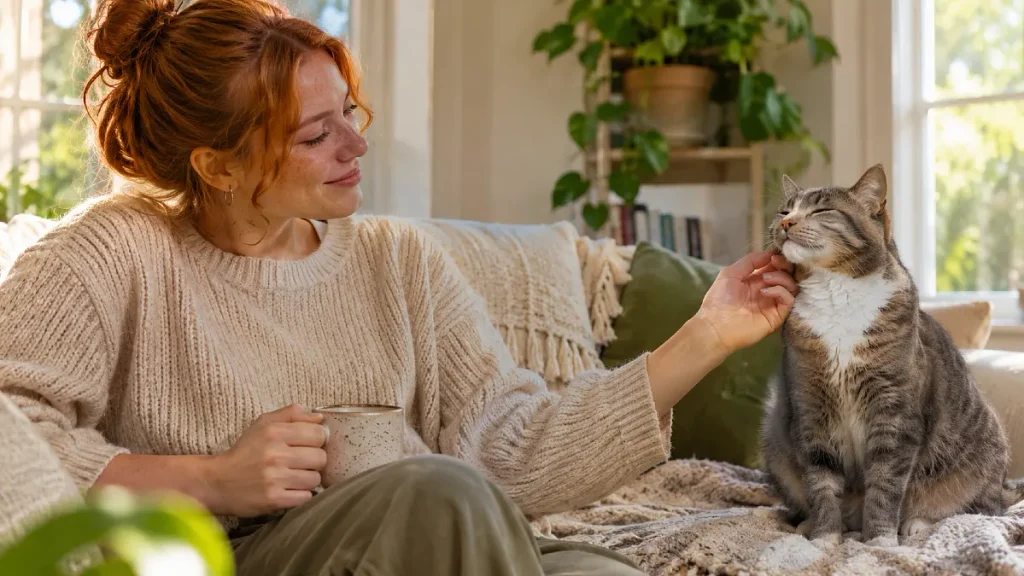
When your cat looks at you and slowly closes its eyes, it may be showing that it feels comfortable in your presence. This behavior is often called a cat kiss, although cats do not use kisses the way people do.
A typical slow blink involves gentle eye narrowing, sometimes followed by a full eye closure. The cat then opens its eyes again without looking alarmed or tense. You may see this while your cat rests on the couch, sits near your desk, or watches you from its favorite chair.
In a peaceful setting, the gesture can be a positive sign. Your cat may feel safe enough to relax its gaze rather than stay fully alert.
PetMD’s 2026 veterinary guidance describes slow blinking as a behavior that often appears when cats feel comfortable. However, Cats Protection explains that a slow blink alone cannot tell you exactly what a cat is feeling.
Different eye movements can look similar at first. Learning to tell them apart can help you respond more appropriately.
| Eye movement | Possible meaning | What to notice |
|---|---|---|
| Gentle slow blink | Comfort or friendly signal | Relaxed body |
| Quick ordinary blink | Normal eye protection | No other change |
| Long, fixed stare | Focus or tension | Overall posture |
| Soft, half closed eyes | Rest or relaxation | Calm surroundings |
The main difference is the setting and the rest of your cat’s behavior. A relaxed cat giving you a slow blink may be sharing a friendly moment, while the same eye movement in a tense cat deserves a closer look.
The important message is that a slow blink can suggest comfort, but it is not proof of affection on its own. Watching the whole cat gives you a much better answer.
What Did Scientists Find About Cat Slow Blinking?

There is real research behind this familiar cat behavior. In 2020, researchers from the University of Sussex and the University of Portsmouth published a study in Scientific Reports examining how cats respond to slow blinking from humans.
The research team included Tasmin Humphrey, Leanne Proops, Jemma Forman, Rebecca Spooner, and Karen McComb. Their work explored whether cats respond differently when people slowly narrow and close their eyes.
What happened when owners blinked first?
In the first experiment, researchers recruited 21 cats from 14 households. Owners interacted with their cats using slow blinking, and the researchers compared the responses with periods when the owners did not interact.
The results showed that cats made more eye narrowing movements when their owners slow blinked at them. This suggested that cats were responding to the human facial signal rather than simply blinking at random.
What happened with unfamiliar people?
The second experiment involved 24 cats and an unfamiliar researcher. The cats were more willing to approach the researcher after a slow blink interaction than after a neutral facial expression.
After exclusions, the final analysis in each experiment included 18 cats. These are promising findings, but the samples were small, and the researchers could not rule out every possible influence, including differences in where the person was looking.
The study did not prove that cats use slow blinking to say they love someone. It showed that slow blinking may help support positive communication between cats and people.
That is still useful for everyday cat care. It means a quiet exchange of eye movements may be more meaningful than it first appears.
How Can You Tell If a Slow Blink Means Trust or Stress?
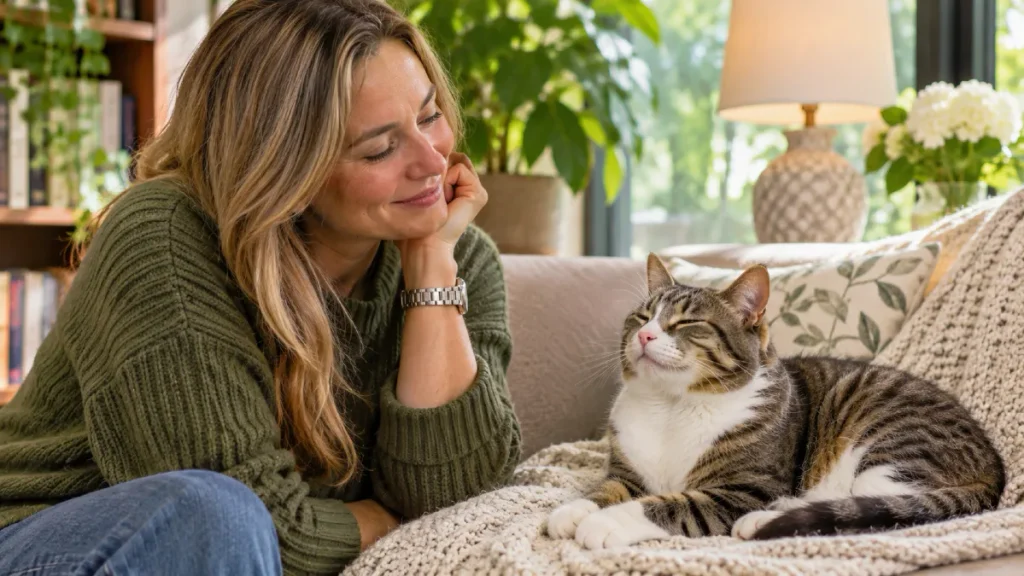
A slow blink can happen during a comfortable interaction, but it can also appear when a cat feels uneasy. That is why you should never judge your cat’s mood from its eyes alone.
Cats Protection made this distinction clear in its November 2025 guidance on cat blinking. The organization explains that some cats also blink slowly during stressful encounters, including interactions with unfamiliar cats.
Think about a cat resting on a sunny windowsill. Its body is loose, its ears are relaxed, and it slowly closes its eyes while you sit nearby. This is very different from a cat crouching beside a loud visitor with its ears pinned back.
Check these body language signals
Look at how your cat holds its body before deciding what the blink means. Its ears, muscles, tail, and behavior can provide helpful clues.
| Body signal | Possible mood | Best response |
|---|---|---|
| Ears relaxed and forward | Comfortable | Stay calm |
| Loose body and soft face | At ease | Allow interaction |
| Ears flattened backward | Fear or stress | Give space |
| Stiff, crouched posture | Uneasy | Avoid approaching |
| Hiding or pulling away | Wants distance | Leave undisturbed |
No single body signal tells the whole story. A cat may move its ears to follow a sound, for example, without feeling afraid.
The best clue comes from several behaviors happening together. If your cat is resting comfortably, breathing normally, and staying near you by choice, a slow blink is more likely to be a friendly signal.
But if your cat looks tense, avoids contact, or tries to hide, do not treat the blink as an invitation to touch it. Respecting your cat’s space is more helpful than trying to make it return your affection.
How Do You Slow Blink Back Without Making Your Cat Nervous?
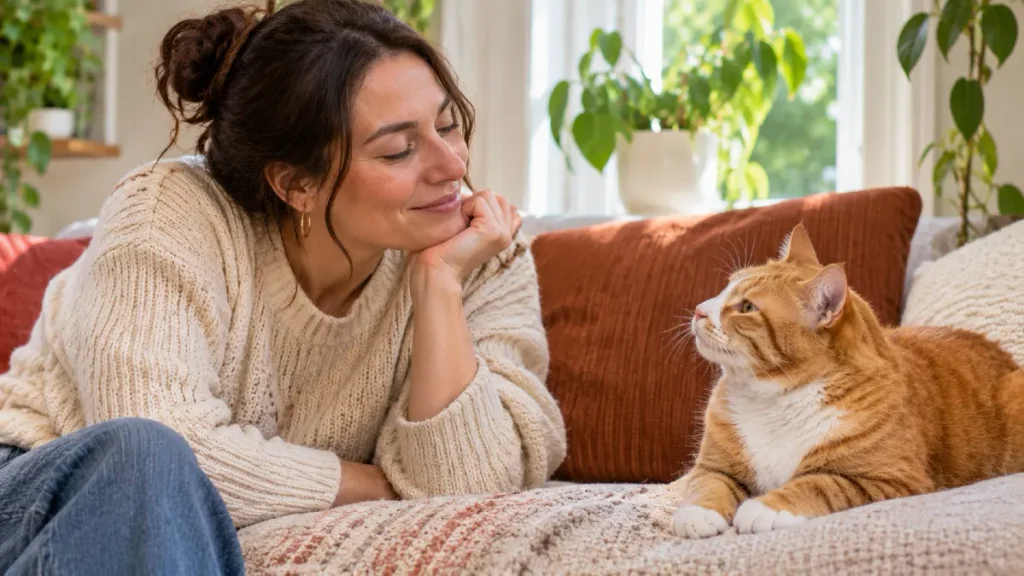
You can try returning your cat’s slow blink during a calm moment. Research suggests that cats can respond to this type of human facial movement, making it a simple way to interact without touching them.
Start when your cat is already relaxed. Avoid trying it while your pet is frightened, hiding, eating, or watching something that has caught its full attention.
Try this simple slow blink method
- Sit somewhere comfortable. Stay a little distance from your cat so it does not feel crowded.
- Look gently in its direction. Avoid a hard, fixed stare, which some cats may find threatening.
- Slowly narrow your eyes. Let your eyelids close in a relaxed, natural motion.
- Open your eyes gently. Keep your face soft and your body still.
- Look slightly away. Give your cat room to respond or return to what it was doing.
You do not need to repeat the gesture over and over. One or two gentle blinks are enough to offer a friendly signal.
Your cat might blink back, watch you quietly, walk closer, or turn away. Each response gives you information about how it wants to interact.
| Your cat’s response | Your next move | Why |
|---|---|---|
| Slowly blinks back | Remain relaxed | Keeps things calm |
| Looks away | Stop staring | Gives space |
| Walks closer | Let it approach | Allows choice |
| Stays still | Wait quietly | Avoids pressure |
| Backs away | End the interaction | Respects discomfort |
A returned slow blink can be a pleasant moment, but it is not a test your cat must pass. Some cats will respond more clearly than others, and that is normal.
The RSPCA and Cats Protection both recommend gentle eye contact rather than staring. You can also turn your head slightly away after blinking to make your body language less direct.
The goal is to help your cat feel comfortable, not to force a reaction. If your pet chooses to remain nearby or approach on its own, enjoy the moment without rushing to touch it.
Why Does Your Cat Slow Blink and Then Look Away?
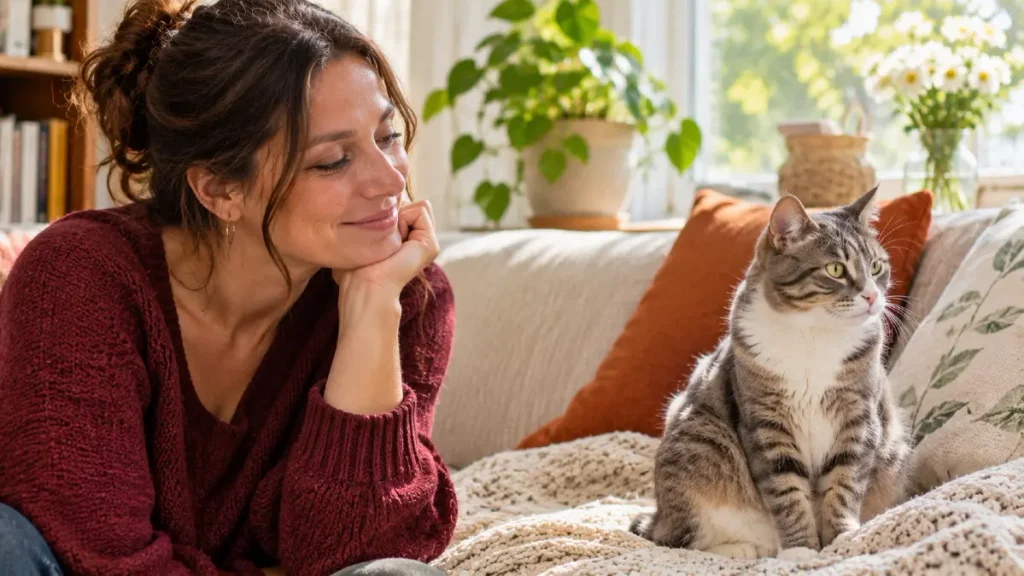
Your cat may slowly blink at you, turn its head, and suddenly seem interested in something else. This can feel confusing, especially when you were hoping for another affectionate response.
But looking away does not automatically mean your cat is rejecting you. Cats often shift their attention between people, sounds, movements, and nearby objects.
Direct eye contact can feel intense to some cats, particularly when it lasts too long. Cats Protection advises owners to avoid staring because cats may see prolonged eye contact as threatening.
A gentle blink followed by looking away can fit naturally into a calm interaction. Your cat may simply be comfortable enough to stop watching you.
However, the reason depends on the situation. A relaxed cat turning toward a window is different from a nervous cat quickly turning away and hiding.
What should you do next?
Allow your cat to decide whether it wants more attention. If it stays nearby with a loose body, you can continue sitting quietly without trying to catch its gaze again.
If it moves away, let it go. You do not need to call it back or follow it across the room.
The important lesson is that your cat does not need to keep looking at you to feel comfortable around you. Sometimes sharing a quiet space is already a positive interaction.
Can Cat Slow Blinks Help a Shy Cat Feel Safer?
A shy cat may hide under furniture, avoid visitors, or move away whenever someone approaches. In these situations, gentle communication can be more useful than reaching out for physical contact.
Slow blinking may help create a less intense interaction, but it cannot instantly remove fear. Your cat still needs a safe place, predictable routines, and the freedom to choose when to come closer.
The 2020 Scientific Reports study found that cats responded to slow blinking from both familiar owners and an unfamiliar person. This suggests that the gesture may have value even when the human and cat do not share a close relationship.
Still, that does not mean every frightened cat will feel safe after someone blinks at it. Some cats may be too stressed to engage at all.
Make the interaction feel safe
If you have recently adopted a shy cat, begin by spending quiet time nearby. Sit at a comfortable distance and let the cat see that you are not trying to grab or chase it.
You can try a gentle slow blink if the cat looks relaxed enough to notice you. Then turn your attention elsewhere rather than watching for an immediate response.
Keep these simple habits in mind:
- Give your cat access to safe hiding places.
- Avoid reaching into hiding spots to pull it out.
- Use a calm voice and predictable daily routines.
- Offer play or familiar treats when your cat wants to engage.
- Let the cat decide when physical contact begins.
You do not need special products for this approach. A quiet room, a familiar resting place, and patient behavior are the important parts.
If your cat approaches, allow it to sniff you before attempting to pet it. If it moves away, respect that decision and try another calm interaction later.
Trust grows through repeated experiences of safety and choice. Slow blinking may become one small part of that relationship, but it should never replace patience.
What If Your Cat Never Slow Blinks at You?
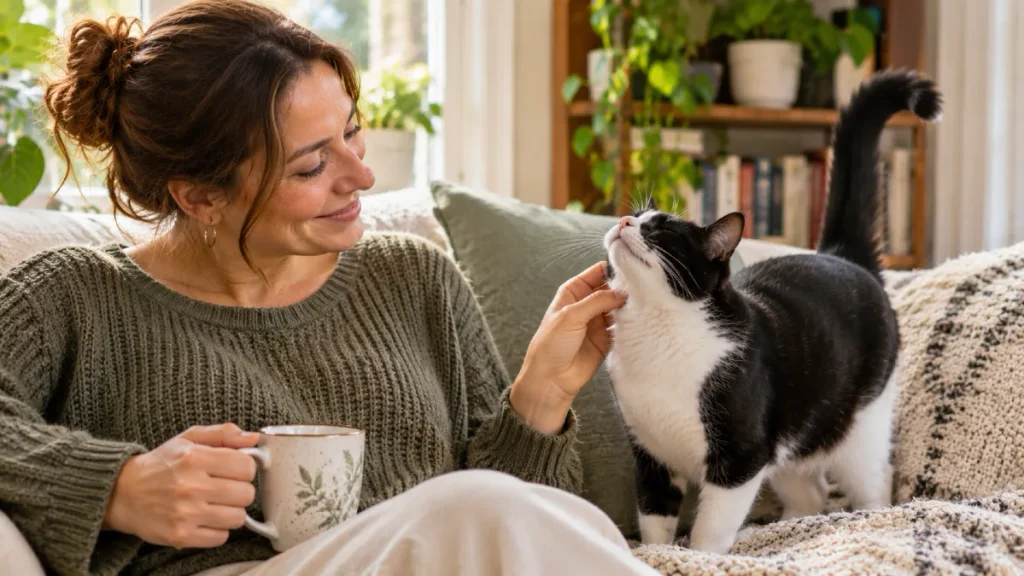
Some cats give their owners slow blinks almost every day. Others rarely seem to do it, even when they appear happy and comfortable at home.
If your cat never slow blinks at you, it does not mean your pet dislikes you. Cats have different habits, personalities, and ways of interacting with people.
Cats Protection explains that slow blinking is not something every cat does. A cat can feel secure around you without using this particular signal.
Look for other signs of comfort
Your cat may show a positive relationship through behaviors that have little to do with blinking. These can include choosing to rest near you, greeting you with an upright tail, or rubbing its cheeks against your legs.
Some cats enjoy sitting beside their owners without wanting much physical contact. Others actively seek gentle petting, play, or attention throughout the day.
The key is whether your cat chooses these interactions and appears comfortable during them. Even purring needs context, because cats can also purr when stressed or in pain.
For example, a cat that regularly settles beside you, eats normally, plays, and rests with a loose body may feel secure even if it never gives you an obvious slow blink.
Avoid comparing your cat with videos of other pets. A cat that dislikes being held may still have a strong relationship with its owner.
Pay attention to what your own cat repeatedly does when it feels safe. Those familiar habits can tell you more than waiting for one special eye movement.
When Is Cat Squinting an Eye Problem Instead of a Slow Blink?
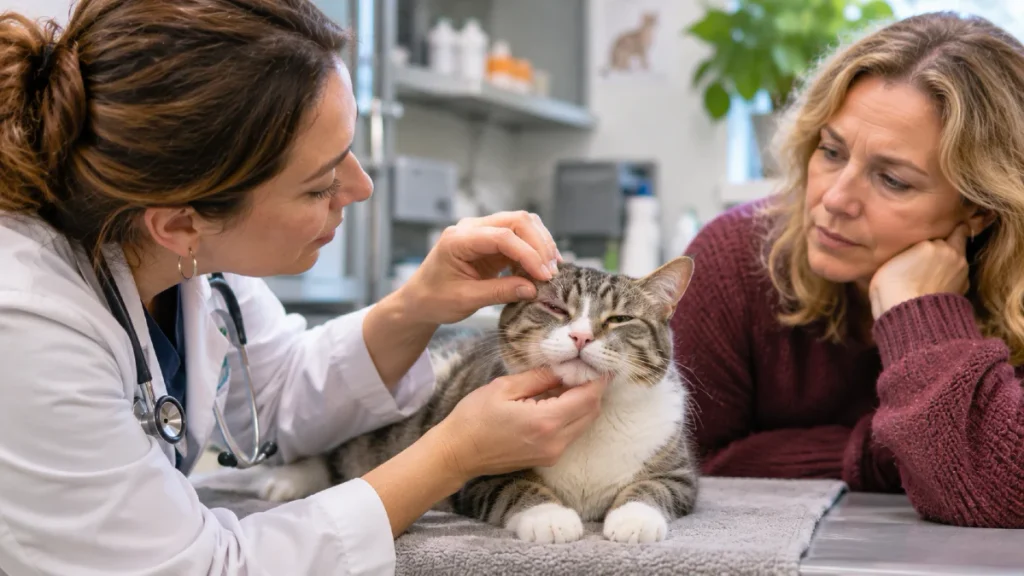
Sometimes a cat closes its eyes because something is wrong. That is why it is important to recognize the difference between a relaxed slow blink and signs of discomfort.
A healthy slow blink is usually a gentle, brief movement during a comfortable interaction. Painful squinting may be repeated or persistent, and your cat may keep one eye partly or fully closed.
PetMD’s September 2026 veterinary guidance explains that frequent blinking, squinting, and repeated closing of one eye can indicate an eye problem. These signs should not be dismissed as affection.
Cornell University College of Veterinary Medicine also identifies squinting, eye discharge, cloudiness, and sensitivity to light as possible signs of corneal ulcers. These injuries affect the clear surface of the eye and can become serious.
Warning signs you should never ignore
The following comparison can help you decide whether your cat is showing normal behavior or needs veterinary attention.
| What you notice | Possible concern | What to do |
|---|---|---|
| Gentle blink during rest | Normal behavior | Observe |
| One eye kept shut | Pain or injury | Prompt vet visit |
| Red or swollen eye | Irritation or disease | Prompt vet visit |
| Yellow or green discharge | Infection or inflammation | Prompt vet visit |
| Cloudy eye surface | Possible eye disease | Urgent vet care |
| Repeated eye rubbing | Pain or irritation | Prompt vet visit |
These symptoms can have several causes, and an owner cannot reliably identify the problem by looking at the eye. Veterinary examination may be needed to check for scratches, ulcers, infection, or other conditions.
If your cat suddenly develops a painful eye, keeps an eye closed, or has visible cloudiness or an injury, contact a veterinarian immediately. Eye problems can worsen quickly and sometimes threaten vision.
What should you avoid doing at home?
Do not try to treat a painful eye with human eye drops or leftover medication. VCA Animal Hospitals explains that some eye conditions require specific treatment based on the cause.
You should also avoid forcing the eye open or trying to remove a stuck object yourself. Such actions can make an injury worse.
A veterinary professional can examine the eye and decide whether special testing or medication is needed. If the eye problem began suddenly, do not wait to see whether your cat starts blinking normally again.
A relaxed slow blink is usually a harmless behavior, but persistent squinting is not something to ignore. When eye discomfort is possible, protecting your cat’s sight matters more than guessing what the gesture means.