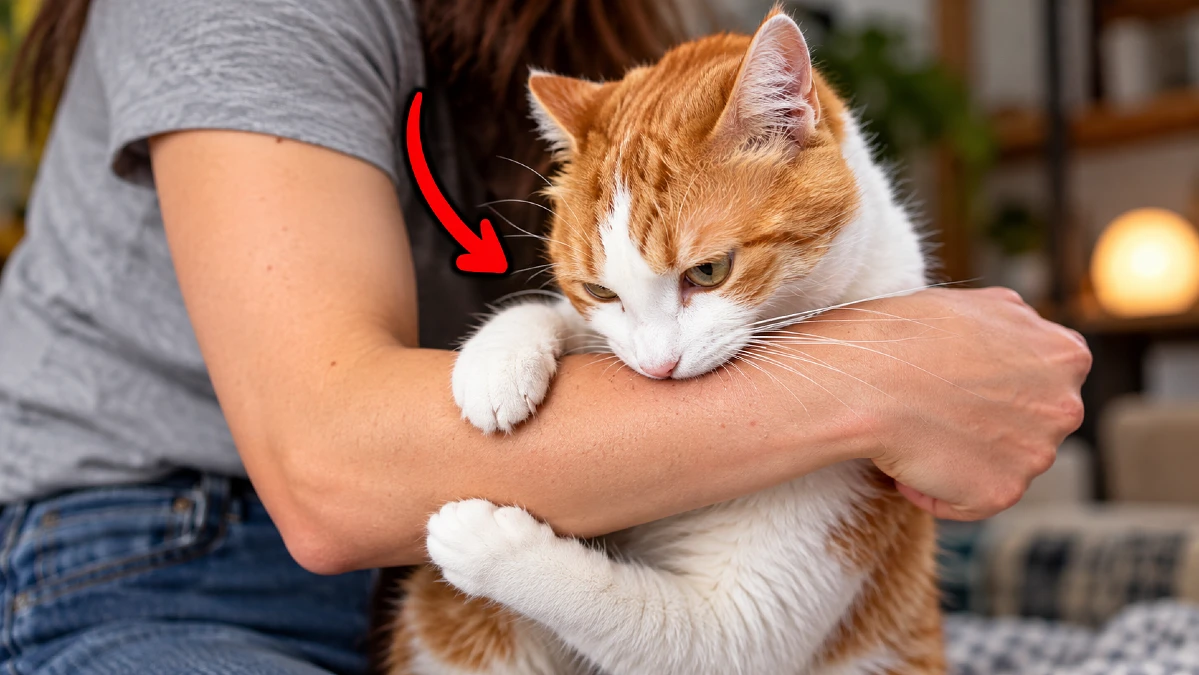
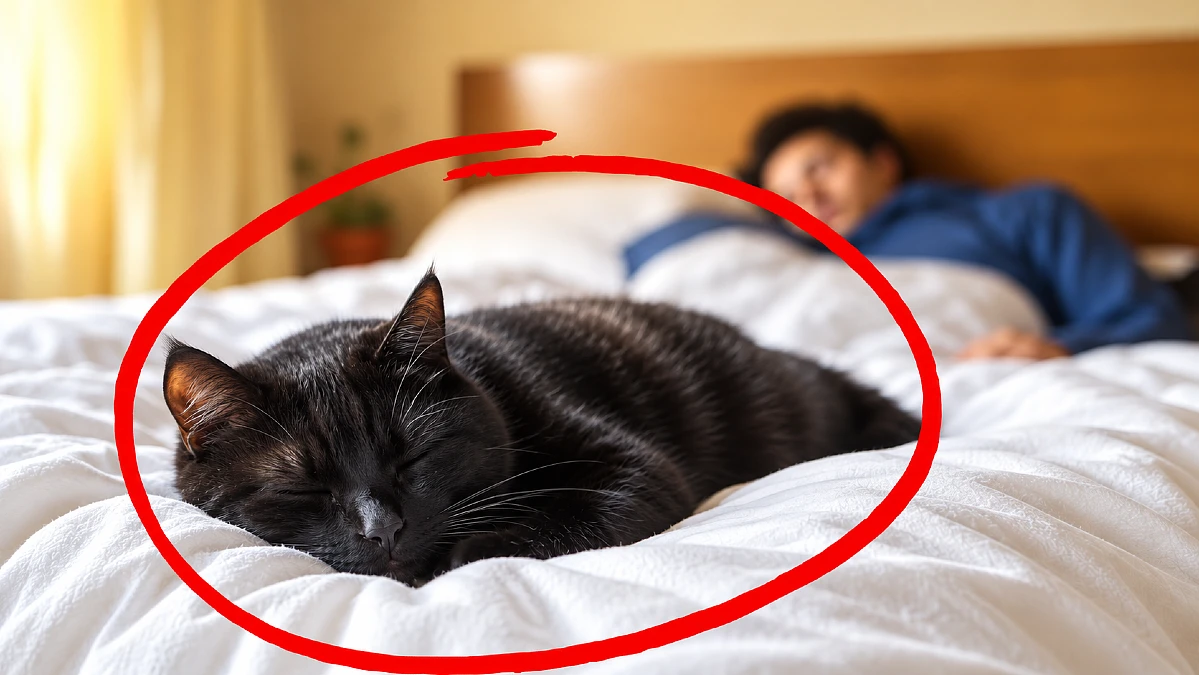
Does your cat sleep at your feet every night, even when there’s plenty of room beside your pillow? You might wonder why your furry friend chooses your toes instead of curling up in your arms. Sometimes, it can even feel like your cat wants to be close without getting too close.
But here’s something interesting. Where your cat sleeps can offer clues about what makes them feel comfortable, safe, and relaxed. The foot of your bed may provide warmth, familiar smells, and an easy way to move around without being disturbed.
Cats also have very different sleeping habits from humans. According to PetMD’s 2026 guidance, cats generally sleep around 12 to 16 hours a day, often in several shorter periods. That means your cat may want to come and go while you’re sleeping.
Why Does Your Cat Sleep at Your Feet Instead of Your Head?
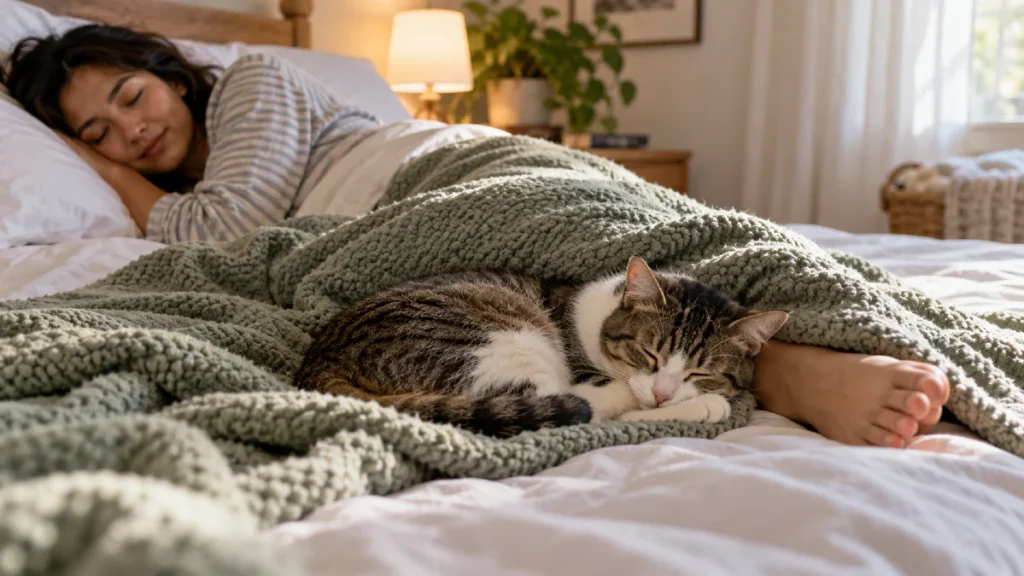
Your cat might choose your feet because that part of the bed offers a comfortable balance of warmth and personal space. They can stay close to you without having to sleep directly against your upper body.
Cats naturally seek warm places when they rest. A soft blanket covering your legs can create a pleasant sleeping spot, especially during colder nights. Your body heat also makes the bed appealing.
But warmth is just part of the explanation. The foot of your bed may also give your cat more freedom to move. Cats often prefer resting places where they can leave easily if something catches their attention.
Think about what happens when your cat hears a noise in another room. If they’re sleeping near the edge of your bed, they may be able to get up and investigate without climbing over you.
Cats Protection explains that cats sleep and rest at different times throughout the day. Some naps are brief, while others last much longer. This pattern means your cat may wake up several times while you’re still asleep.
Sleeping at your feet can make those little nighttime trips easier. Your cat can get up, walk around, visit the litter box, and return without needing to disturb your pillow.
There’s another possible reason. Some cats enjoy being around their owners but dislike being tightly held or crowded. The foot of your bed lets them share your space while keeping a comfortable distance.
So, if your cat chooses your feet every night, there’s usually no reason to feel rejected. Your kitty may simply have found a sleeping position that works well for both of you.
Does Sleeping at Your Feet Mean Your Cat Trusts You?
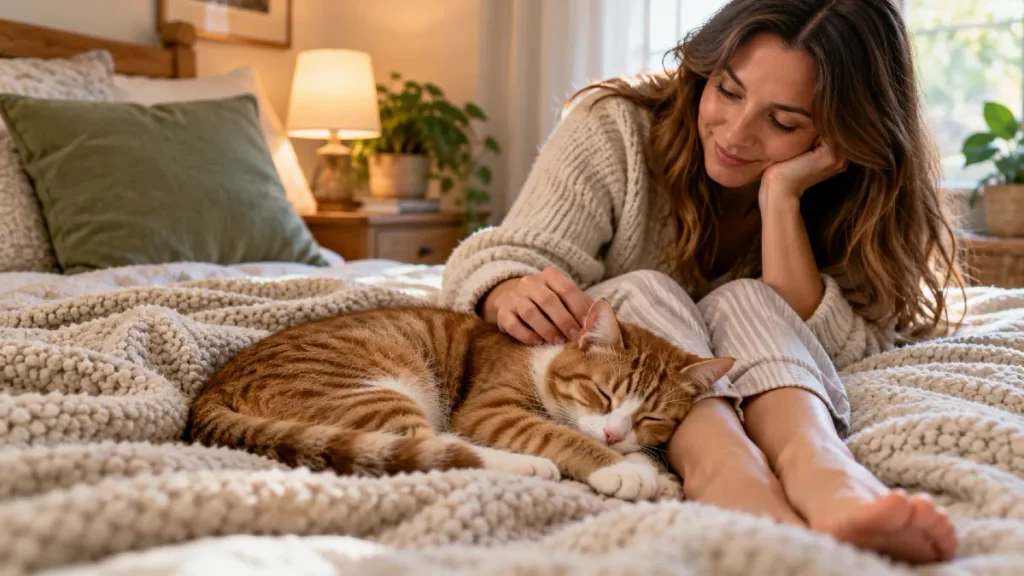
One of the sweetest things about cats is that they often choose where and with whom they want to rest. If your cat regularly settles beside you, that can be a positive sign that they feel comfortable in your company.
Sleeping leaves cats less able to react quickly to things around them. They often prefer familiar places where they can relax without being disturbed. Your bed may become one of those safe spaces.
A cat that voluntarily sleeps near you may feel secure around you. However, sleeping at your feet does not prove exactly how much your cat loves or trusts you.
Cats have individual preferences, just like people. One cat may enjoy sleeping on a person’s chest, while another prefers a little distance. Both can have close relationships with their owners.
Your scent may also play a role. Cats rely heavily on their sense of smell, and familiar scents can help make a resting place feel comfortable.
Your bedding carries smells your cat recognizes from everyday life. That may be one reason your cat chooses your bed even when you’re not lying in it.
If you want to know whether your cat feels attached to you, look beyond their sleeping position. Cats Protection identifies several friendly behaviors that can help you recognize a relaxed, social cat.
These include approaching you with a relaxed body, rubbing against you, and giving slow blinks. A cat that regularly seeks your company and enjoys gentle contact may be showing signs of a strong bond.
The important thing is to let your cat make choices. A cat that comes to sleep near you on their own is sharing a space they feel comfortable using.
What Your Cat’s Other Bedtime Spots Might Tell You

Your cat may have a favorite sleeping position, but that spot can change from one night to another. Sometimes your kitty wants extra warmth, while other nights they may prefer more room.
Sleeping near your head can be especially appealing because your pillow is soft and carries your familiar scent. Veterinarian Wailani Sung explained in a February 2026 PetMD article that warmth, comfort, and bonding may all contribute to this behavior.
Some cats also learn that sleeping near your face gives them easy access to your attention. If your cat wants breakfast or a little affection, they may discover that touching your face gets a faster response.
Sleeping on your chest offers a different kind of comfort. Veterinarian Hannah Hart noted in a June 2026 PetMD article that cats may enjoy the warmth and familiar movement of their owner’s breathing and heartbeat.
Your cat may also choose the space between your legs. This creates a snug resting area with warmth on both sides, although it may leave you struggling to change positions.
Other cats enjoy sleeping in their owner’s arms. This allows close physical contact, but some cats dislike feeling restricted and prefer to move away when they choose.
What Different Cat Sleeping Spots May Mean
No sleeping position gives a perfect answer about your cat’s emotions. This comparison shows some possible reasons behind the choices you notice.
| Sleeping Spot | Possible Reason | What It Does Not Prove |
|---|---|---|
| At your feet | Warmth and easy movement | That your cat is guarding you |
| Near your head | Soft pillow and familiar scent | That your cat loves you more |
| On your chest | Warmth and close contact | That your cat needs constant attention |
| Between your legs | A snug, sheltered space | That your cat feels afraid |
| In your arms | Enjoyment of close contact | That every cat wants cuddles |
| Beside your body | Company with some space | That your cat dislikes touch |
These positions are best treated as clues rather than fixed messages. Your cat’s mood, health, room temperature, and personal habits can all influence where they choose to rest.
A cat that moves from your pillow to your feet has not necessarily changed their feelings about you. They may simply be choosing whichever spot feels nicest at that moment.
Why Your Cat Turns Away or Slips Under the Covers
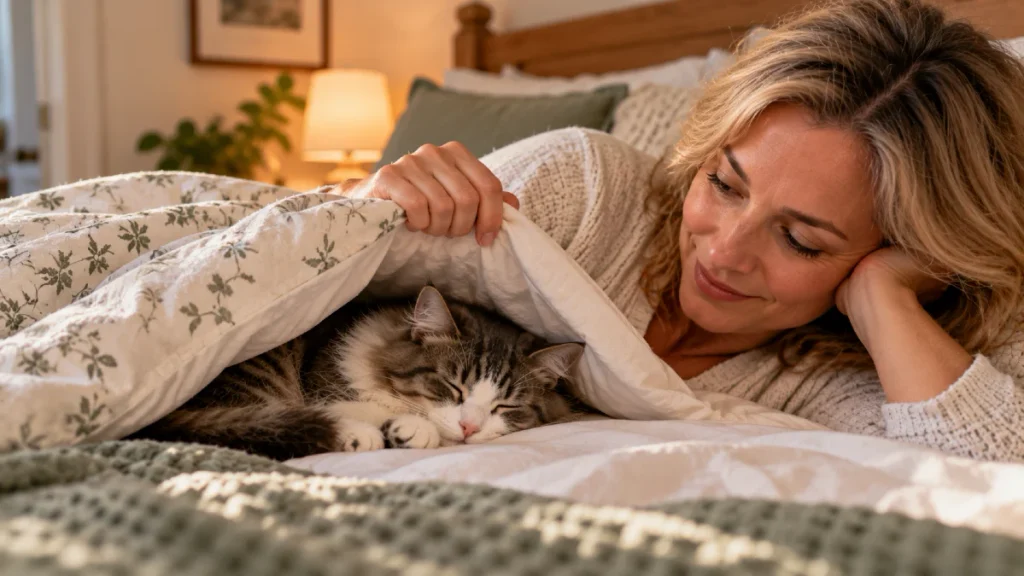
Have you ever noticed your cat sleeping beside you with their back turned toward your face? It can look as though they’re ignoring you, especially when you want a little affection before bed.
But cats do not use sleeping positions in exactly the same way people use body language. Turning away does not automatically mean your cat is upset or trying to avoid you.
Your cat may simply find that position more comfortable. They might be facing a quiet part of the room, resting in their favorite direction, or settling into a position that helps them relax.
Some people believe a cat that sleeps facing away is asking its owner to watch for danger. While feeling safe may influence where cats rest, there is no reliable way to confirm that message from sleeping direction alone.
And what about a cat that disappears beneath your blanket?
This behavior has a more practical explanation. Blankets create warm, enclosed spaces that some cats enjoy, especially when the surrounding room feels cool.
The area beneath your covers also carries your familiar scent. For a cat that enjoys closeness, sharing that space may feel comfortable and reassuring.
Still, sleeping under blankets requires a little care. PetMD advises that bedding should allow good airflow, and your cat must be able to leave whenever they want.
Avoid trapping your cat beneath heavy covers or tucking blankets tightly around them. Always check where your kitty is before moving, sitting, or rolling over in bed.
If your cat prefers sleeping under blankets, provide a light, breathable covering. A covered cat bed nearby can also offer a sheltered alternative without sharing your sleeping space.
Why Your Cat Sleeps Under the Bed Instead of With You
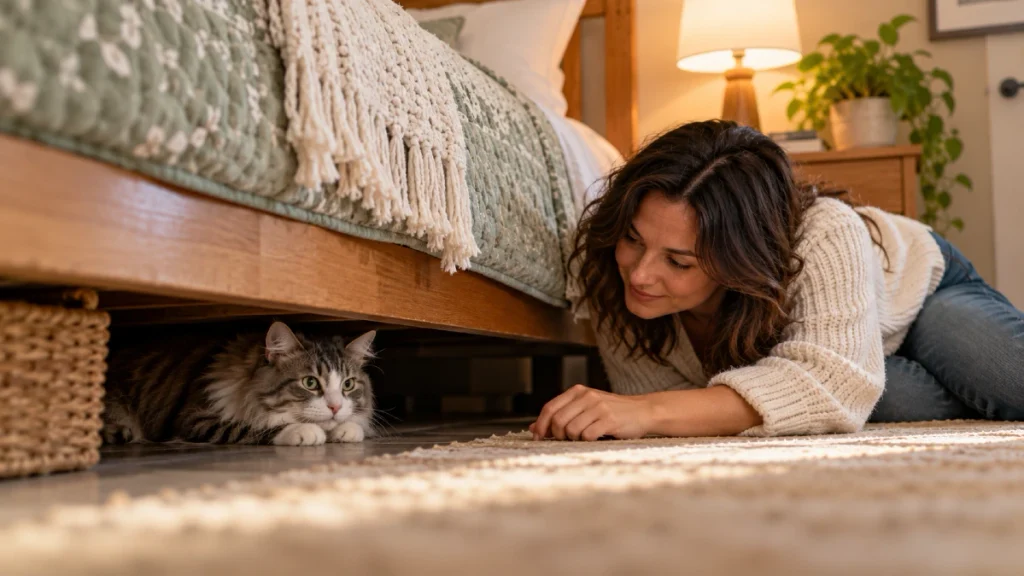
Sometimes your cat might ignore your comfortable mattress and disappear underneath the bed. You may wonder why your kitty prefers a dusty hiding place over a warm spot beside you.
The answer often comes down to privacy and security. Cats naturally look for quiet, sheltered places where they can rest without interruptions.
Cats Protection explains that hiding is a normal part of feline behavior. Cats may hide when they want to sleep, play, or feel safer in their surroundings.
The space beneath your bed offers a covered resting area with less activity than the open room. It may also give your cat some distance from bright lights, household noise, or other pets.
For some cats, that quiet space becomes a favorite daytime sleeping spot. They may use it regularly and still come out to eat, play, and spend time with you.
However, sudden hiding deserves more attention than a long standing sleeping habit. A cat that normally sleeps beside you but suddenly spends most of the day hidden may be stressed or feeling unwell.
New visitors, loud building work, or changes in the household can cause some cats to seek more privacy. Illness or pain can also make cats withdraw.
Avoid dragging your cat out of a hiding place unless there is an immediate safety concern. Give them a quiet area where they can come out when they feel comfortable.
If the hiding is new, persistent, or accompanied by changes in appetite or activity, contact your veterinarian. It is better to check for a health problem than assume your cat simply wants time alone.
How to Tell Whether Your Sleeping Cat Feels Safe
If you want to know how your cat feels while sleeping near you, start by looking at their body. Their posture, breathing, and behavior can provide more useful clues than their chosen spot on the mattress.
A comfortable cat usually has relaxed muscles and a settled position. Their face may appear soft, and their ears often rest in a natural position.
Cats Protection and RSPCA both explain that feline body language needs to be judged as a whole. A single movement or expression does not tell the full story.
For example, a cat that is lying quietly with closed eyes may be sleeping peacefully. But a cat that remains stiff, tense, or unusually withdrawn may need closer attention.
How to Read Your Sleeping Cat’s Body Language
Use these clues to compare relaxed resting behavior with changes that may deserve a closer look.
| What to Check | Relaxed Signs | Signs to Watch |
|---|---|---|
| Body | Loose and comfortable | Stiff or hunched |
| Ears and eyes | Natural ears, soft face | Flattened ears, tense face |
| Breathing | Quiet and regular | Fast or difficult breathing |
| Movement | Gets up normally | Struggles to stand or jump |
| After waking | Normal daily behavior | Unusual withdrawal |
These signs should always be considered together. A different sleeping position by itself is rarely enough to show whether something is wrong.
Pay special attention to how easily your cat gets up and moves after resting. A comfortable position means less if your cat appears sore, weak, or unwilling to move afterward.
Purring can offer another clue, but it should never be used as the only test. Cats Protection notes that cats can also purr in stressful situations or when they are in pain.
A relaxed cat that purrs, stretches, and seeks gentle contact may be comfortable. However, unusual purring combined with changes in behavior needs a closer look.
You can also watch how your cat responds when they wake up. If they stretch, groom themselves, and continue their normal activities, those are generally reassuring signs.
The best approach is to observe your cat without repeatedly waking or handling them. This helps you learn their normal sleeping habits while respecting their need for rest.
When a New Sleeping Spot Could Mean Something Is Wrong
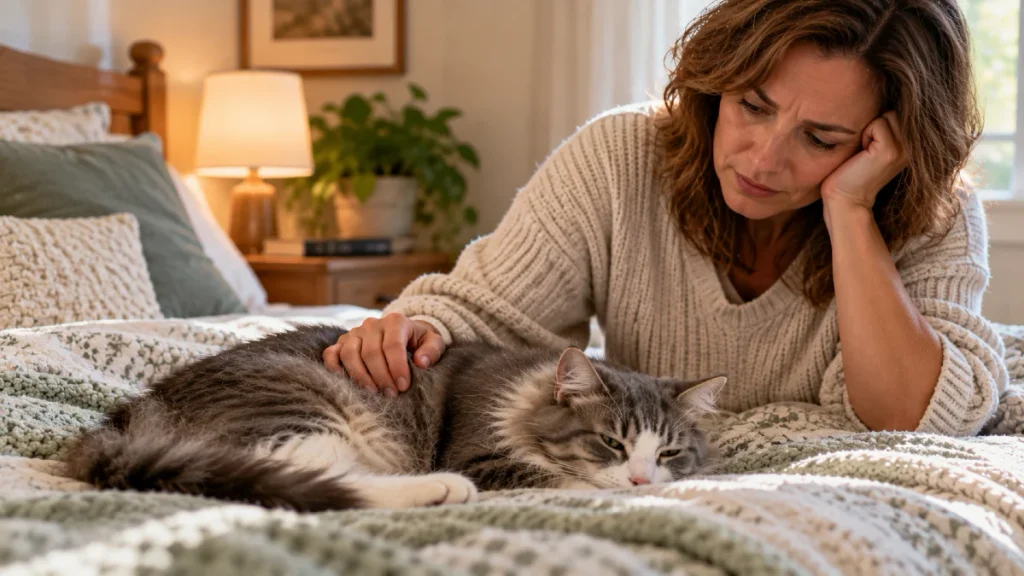
Most changes in sleeping positions are harmless. Your cat may move to a different part of the bed because the room feels warmer, the bedding has changed, or they simply want a new spot.
However, a sudden change in where your cat sleeps can sometimes happen alongside illness or pain. The real warning sign is a change from your cat’s normal behavior, especially when other symptoms appear.
VCA Animal Hospitals explains that cats often hide signs of illness. Owners may first notice that their cat is sleeping more, spending time alone, eating differently, or avoiding normal activities.
For example, a cat that normally jumps onto your bed may suddenly start sleeping on the floor. That change could be a preference, but it can also happen when jumping becomes painful.
Older cats may develop joint problems that make climbing onto furniture uncomfortable. If your cat seems stiff or struggles with familiar movements, a veterinary examination can help identify the cause.
When Sleeping Changes Need Attention
Not every change calls for an emergency appointment. The following guide can help you decide what to do next.
| Change You Notice | What to Do | Urgency |
|---|---|---|
| New sleeping spot, otherwise normal | Watch for further changes | Monitor |
| Hiding more and eating less | Contact your vet | Prompt |
| Avoiding jumps or moving stiffly | Arrange a vet examination | Prompt |
| Very little food for 24 hours | Seek veterinary care | Urgent |
| Open mouth or difficult breathing | Seek emergency care | Emergency |
| Straining but unable to urinate | Seek emergency care | Emergency |
A cat that chooses your feet one night and your pillow the next usually does not need medical attention. But a cat that suddenly becomes withdrawn, stops eating, or has trouble moving should be checked.
Breathing difficulties and an inability to pass urine are emergencies. Do not wait to see whether a different sleeping position makes those problems disappear.
Changes in grooming and litter box habits also matter. If your cat begins avoiding their usual routines while sleeping much more than normal, contact your veterinarian.
You know your cat’s ordinary behavior better than anyone else. Paying attention to changes can help you recognize when something needs care instead of dismissing it as another strange cat habit.
How to Keep Your Cat Close Without Losing Sleep
Sharing your bed with a cat can be comforting, but it is not always easy. Your furry friend may take over your pillow, stretch across your legs, or wake you up long before your alarm rings.
The good news is that you do not have to choose between caring for your cat and getting a comfortable night’s sleep. A few simple changes can help both of you rest.
Start by offering your cat a comfortable sleeping place near your bed. A washable cat bed with a soft fleece blanket may provide enough warmth for a cat that usually sleeps near your feet.
Choose somewhere quiet and free from frequent disturbance. Cats Protection recommends offering several comfortable resting places because cats often change where they like to sleep.
A covered cat bed may appeal to a cat that enjoys hiding beneath blankets. A sturdy cardboard box with soft bedding can also create a sheltered resting spot without much expense.
If your cat is older or struggles with jumping, choose a resting place that is easy to reach. Avoid expecting a cat with mobility problems to climb onto high furniture.
You can also try a short play session before your bedtime. Using a wand toy or another safe interactive toy gives your cat a chance to move, chase, and use some energy.
Keep a fairly steady evening routine and avoid rewarding unwanted nighttime waking with exciting play. Remember that cats may still wake during the night because their sleeping patterns differ from yours.
If your cat regularly interrupts your sleep, encourage them to use their own resting space. Never punish them for choosing your bed or force them to remain in one sleeping position.
There are also times when sharing a bed may not be suitable. People with cat allergies or certain health concerns may need to keep cats out of their sleeping area, and Cats Protection recommends keeping cats out of babies’ and young children’s bedrooms for safety.
Most importantly, respect your cat’s preferences. If they want to sleep at your feet, let them settle there when it is safe and comfortable for both of you.