Your cat suddenly starts meowing at you, even though their food bowl is full. They follow you from room to room, stare at something you cannot see, or become strangely nervous around someone they usually tolerate. You might laugh it off as another strange cat habit, but what if there is a reason behind it?
Cats cannot explain what they want with words. Instead, they rely on sounds, body movements, facial expressions, and changes in their usual behavior to communicate with you. Sometimes, the message is simple, like wanting attention or asking for dinner.
But other times, your cat may be reacting to something important that you have not noticed yet. Their sharp hearing, sensitive noses, and strong awareness of their surroundings can help them detect small changes.
Why Your Cat Suddenly Won’t Leave Your Side
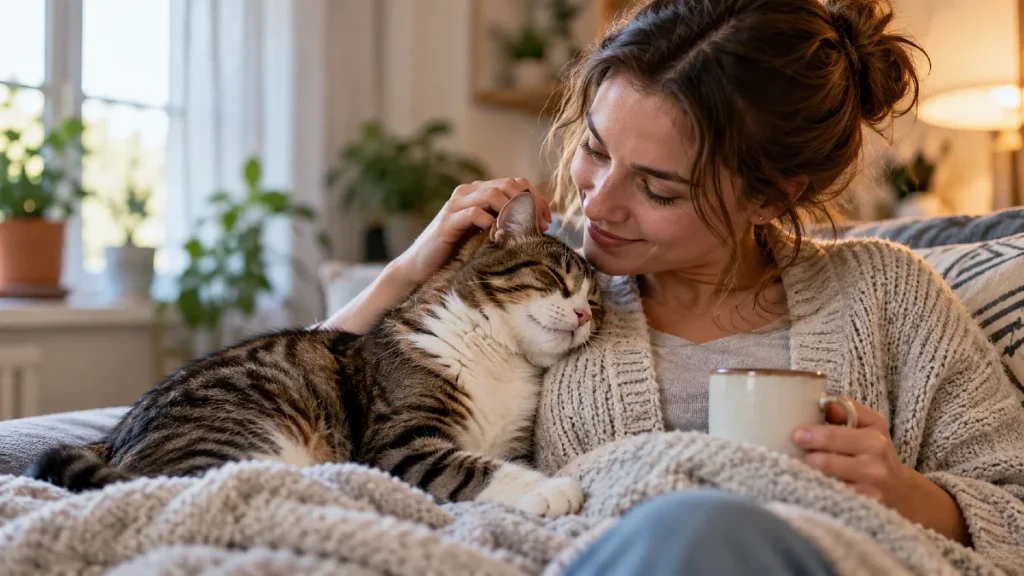
Your cat usually enjoys sleeping alone, watching birds, or exploring the house. But suddenly, they refuse to leave you alone. They follow you into every room, sleep beside you, and seem unusually interested in everything you do.
This sudden affection might feel sweet, but it can also leave you wondering why your cat is acting differently. Sometimes, cats respond to changes in their owner’s behavior, mood, or daily routine.
Cats have an excellent sense of smell and can recognize familiar voices, movements, and habits. If you become sick, tired, or upset, some of those familiar signals may change.
Researchers Jennifer Vonk and Moriah Galvan studied how cats respond to human emotional expressions. Their 2015 research found that cats showed some ability to recognize emotional signals, especially from people they knew.
However, this does not mean cats can reliably detect heart attacks, cancer, or other medical conditions. Their behavior may simply reflect changes they notice in someone familiar.
The Cat That Woke His Owner During a Heart Attack
In August 2022, a British woman named Sam Felstead reported an unusual experience involving her cat, Billy. According to BBC News reporting, Billy jumped onto her chest and began pawing and meowing while she was asleep.
The behavior was unusual enough to wake her. After waking, she experienced worrying symptoms and was taken to the hospital, where doctors diagnosed a heart attack.
Felstead believed Billy’s actions helped save her life. Although nobody can know exactly what Billy noticed, the incident shows why a sudden change in a pet’s behavior may deserve attention.
Your own cat might behave differently when you are resting, crying, or spending more time in bed. But there are several possible reasons for this change, and illness is only one of them.
What Your Cat’s Sudden Attention Might Mean
Before assuming something serious, look at the situation and your cat’s other actions. These common behaviors can help you decide what to check first.
| Cat behavior | Possible explanation | What to do |
|---|---|---|
| Follows you everywhere | Wants company or attention | Check their usual needs |
| Paws at you repeatedly | Wants a response | Look for other signals |
| Sleeps beside you suddenly | Seeking comfort or warmth | Watch for other changes |
| Meows more than usual | Stress, needs, or illness | Check for possible causes |
The most useful clue is whether the behavior is unusual for your particular cat. If your cat is normally affectionate, staying beside you may mean very little.
However, if your cat suddenly becomes restless or unusually demanding, pay attention to the whole situation. And if you feel physically unwell, respond to your own symptoms rather than relying on your cat to identify a medical problem.
Why Your Cat Hisses or Hides When Someone Visits

Have you ever noticed your friendly cat suddenly becoming frightened when a particular visitor enters your home? One moment, your cat is relaxing on the sofa. The next, their ears flatten, their body becomes tense, and they disappear beneath the furniture.
It can feel as though your cat knows something about that person that you do not. But the explanation usually has more to do with how cats experience unfamiliar people.
Cats pay close attention to movements, sounds, scents, and the way people approach them. A visitor who speaks loudly, moves quickly, or tries to touch your cat without warning may seem threatening.
Even someone’s unfamiliar perfume or the smell of another animal on their clothing can affect how a cat responds. Your cat may simply feel safer keeping their distance.
According to the RSPCA and Cats Protection, fearful cats may crouch, hide, flatten their ears, or show wide pupils. Hissing and growling can also be ways of asking someone to stay away.
These signals do not mean your cat has discovered that someone is a bad person. A cat’s fear is a warning about its own comfort, not proof of someone’s character.
What Should You Do When Your Cat Reacts This Way?
Start by giving your cat space. Never force them to approach a guest or allow someone to pull them out of their hiding place.
Ask visitors to avoid staring directly at your cat or reaching toward them. A calm voice and slow movements can help make the situation less stressful.
You can also provide a quiet room, a familiar blanket, or a covered cat bed where your pet can retreat. Let your cat decide when they feel ready to come closer.
If the same visitor regularly frightens your cat, pay attention to how they interact. Rough handling, chasing, or ignoring your cat’s attempts to escape should never be allowed.
However, if your cat suddenly becomes afraid of many people, including familiar family members, consider a veterinary check. Pain, illness, and changes in hearing or vision can sometimes affect how cats react to others.
What to Check When Your Cat Keeps Alerting You to One Spot
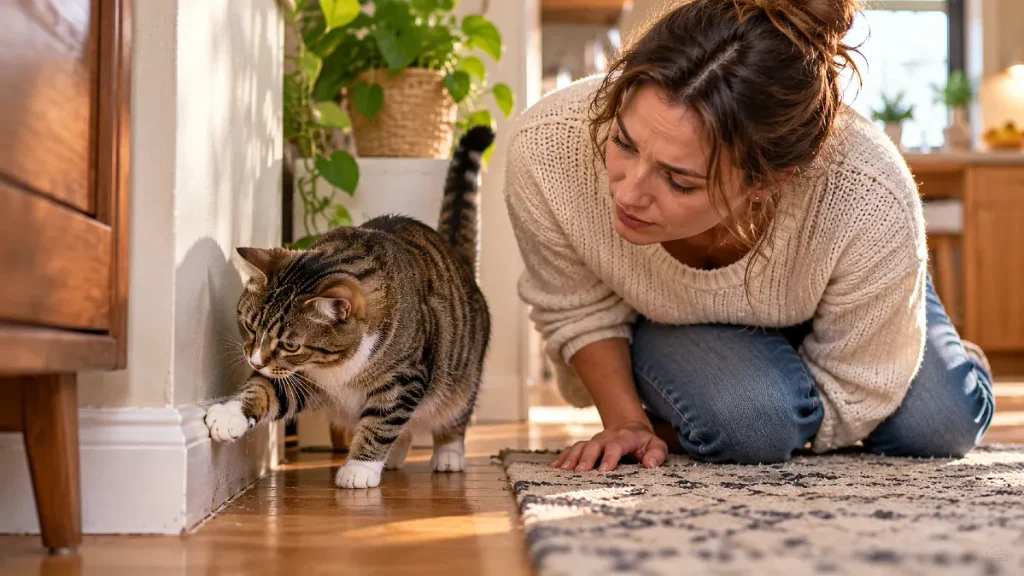
Your cat keeps returning to the same corner of the house. They scratch the floor, sniff around a cabinet, or stare at a spot near the wall. Even when you distract them, they return and begin the same behavior again.
Sometimes, your cat has simply discovered a mouse, insect, or unfamiliar smell. But repeated attention to a particular location can also be a reason to check your surroundings.
Cats can hear sounds that are too faint or too high for humans to notice. Their sensitive noses also help them investigate changes in their environment.
This means your cat might notice a small animal behind a wall, a strange sound beneath the floor, or something unusual near an appliance.
A Cat Helped Locate a Dangerous Gas Leak
A reported incident in Swansea, Wales, involved a cat that kept scratching and digging at a particular part of the carpet. A gas engineer named Sean Evans was investigating a suspected gas leak in the home.
According to news reports, Evans noticed the cat’s interest in that area and examined the floor beneath it. He discovered a damaged gas pipe directly below the spot.
The cat’s behavior helped draw attention to the leak’s location. However, it is impossible to know whether the animal recognized danger or was simply reacting to an unusual sound or smell.
That distinction matters. Cats are observant animals, but they should never be treated as reliable household safety detectors.
When Your Cat Focuses on One Spot
If your cat repeatedly returns to one location, these clues may help you decide what to do. Always put your own safety first.
| What you notice | Possible cause | Safe response |
|---|---|---|
| Scratching near a wall | Insects or small animals | Check for pests |
| Staring toward an appliance | Unfamiliar sound | Inspect if safe |
| Sniffing one area repeatedly | New or unusual scent | Check for spills |
| Distress near a possible gas source | Possible household hazard | Leave if a leak is suspected |
A cat’s strange behavior alone cannot confirm a dangerous leak. But if you smell gas, hear a suspicious hiss, or have another reason to suspect one, leave the building immediately.
The American Gas Association advises against using electrical switches, flames, or phones near a suspected gas leak. Take your pets with you if you can do so safely, then contact emergency services or your gas provider from a safe location.
You should also have suitable home safety alarms installed and maintained. Your cat may notice something unusual, but proper detectors and professional inspections are far more reliable.
Why Your Cat Meows Repeatedly and Tries to Lead You Somewhere
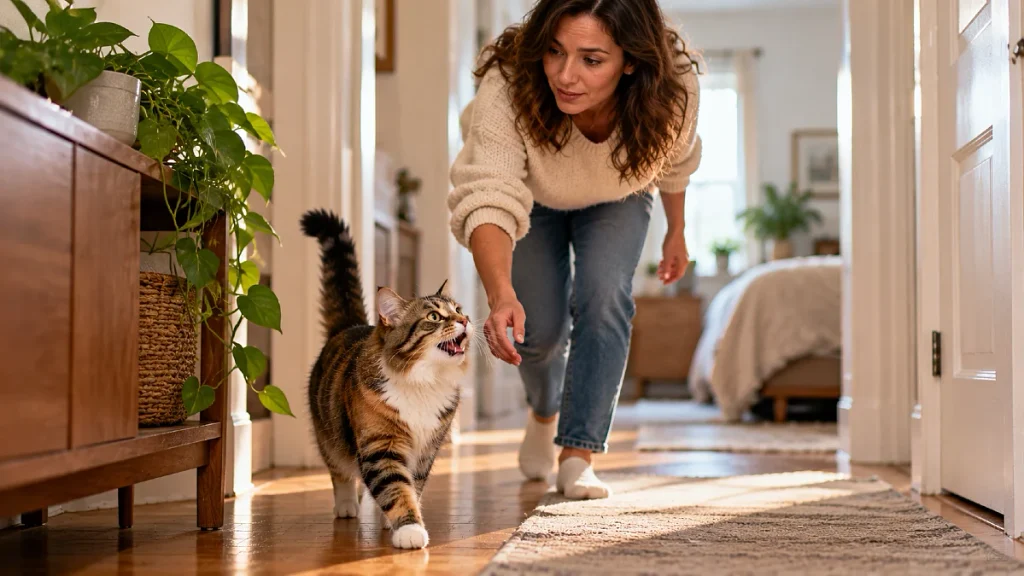
Your cat stands in front of you and meows loudly. When you move closer, they walk away, stop, turn around, and meow again. It almost seems as though they want you to follow.
This behavior can be surprisingly easy to misread. Many cats learn that meowing gets their owner’s attention, especially when they want food, playtime, or access to another room.
For example, your cat may walk toward an empty water bowl or sit beside a closed door. They may repeat the same sounds until you respond to what they want.
But there are also reported cases where a cat’s unusual cries have drawn human attention to something more serious.
The Story of Masha, the Cat Who Stayed Beside a Baby
In January 2015, reports emerged about a cat named Masha in Obninsk, Russia. Residents discovered that the cat had been staying inside a box with an abandoned baby during freezing winter weather.
According to reporting by The Washington Post, a resident heard crying and went to investigate. She discovered the child, who was around two and a half months old, and emergency services were contacted.
Masha had been keeping close to the baby, and residents believed her warmth had helped protect the child from the cold. Reports also described the cat following the emergency workers as they carried the baby away.
Nobody can say whether Masha deliberately tried to rescue the child. Still, her cries helped attract attention to a situation that needed human help.
When Repeated Meowing Means Something Is Wrong
Most cats are not alerting people to emergencies when they meow. But a sudden change in vocal behavior can still be important, especially if your cat appears uncomfortable.
VCA Animal Hospitals explains that unusual vocal sounds can sometimes accompany illness. Cats may meow differently when they feel pain, confusion, or distress.
Pay particular attention when repeated meowing comes with changes in eating, movement, or litter box habits. A cat that suddenly cries while using the litter box needs prompt attention.
Straining to urinate while producing little or no urine is a veterinary emergency. Cornell Feline Health Center warns that urinary blockages can become life threatening, especially in male cats.
If your cat keeps trying to lead you somewhere, calmly check what they seem interested in. Make sure their basic needs are met, but do not assume every repeated meow is simply a request for attention.
When the behavior is sudden, persistent, or paired with physical symptoms, contact your veterinarian. The most important message may be that your cat needs help.
Why Your Cat Hides Before a Storm Arrives
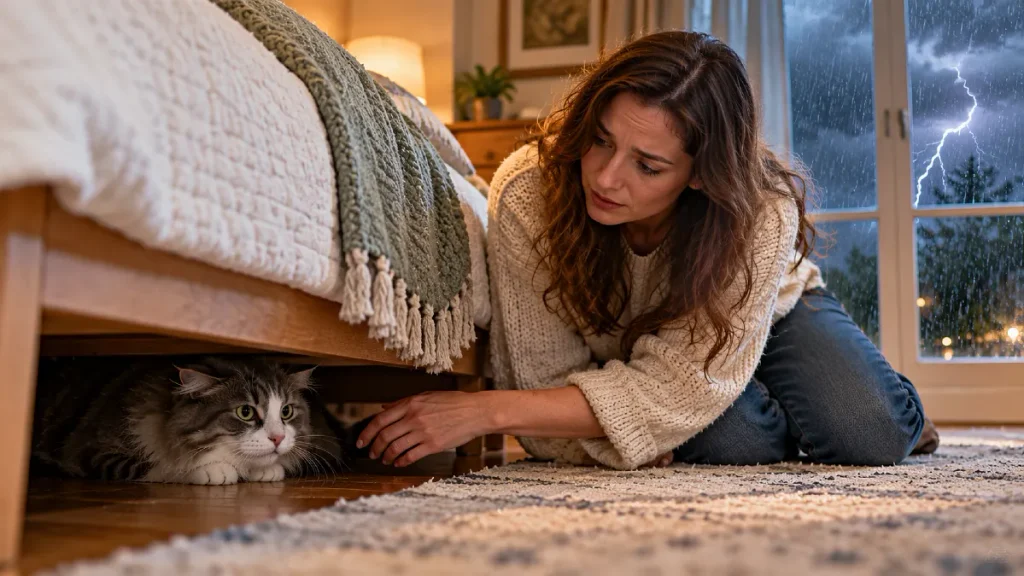
The weather outside looks perfectly normal, but your cat suddenly becomes restless. They stop playing, leave their favorite window, and disappear beneath the bed. A little later, heavy rain or thunder begins.
If this sounds familiar, your cat may be reacting to changes associated with an approaching storm. Cats have sensitive hearing and can respond to sounds or environmental changes that people have not noticed.
Some cats become nervous when distant thunder begins. Others react to strong winds, flashes of lightning, or changes in atmospheric pressure.
Virginia Tech Veterinary Teaching Hospital discussed these reactions in its 2026 guidance on storm and fireworks anxiety. It explained that frightened cats often respond by finding small, sheltered places where they feel protected.
Unlike dogs that may pace or bark, a scared cat can become unusually quiet. Hiding is often their preferred way to deal with something frightening.
Can Cats Really Predict Bad Weather?
Cats may detect some signs of changing weather before you notice them. However, that does not make them dependable weather forecasters.
A 2022 study involving reports from 426 cat owners examined how weather events affected their pets. It found that intense weather could influence behavior, but it did not show that cats can accurately predict when storms will happen.
The same caution applies to earthquakes. Although people have reported unusual animal behavior before earthquakes, the U.S. Geological Survey says there is no reliable evidence that these reactions can predict a specific earthquake.
So, what should you do when your cat suddenly hides as a storm approaches?
First, allow your cat to stay somewhere safe. Avoid dragging them out from under furniture or forcing them to sit beside a noisy window.
Close windows and curtains when needed, and keep a comfortable hiding space available. A covered bed or an open carrier with familiar bedding can provide a place to retreat.
If your cat becomes extremely frightened during storms, speak with your veterinarian about ways to reduce their fear. Severe shaking, panting, or panic should not be dismissed as normal behavior.
And always follow official weather warnings rather than relying on your cat’s reactions. Your pet may notice something changing, but forecasts and emergency alerts remain essential.
Why Your Cat Stares at a Wall and Reacts to Nothing
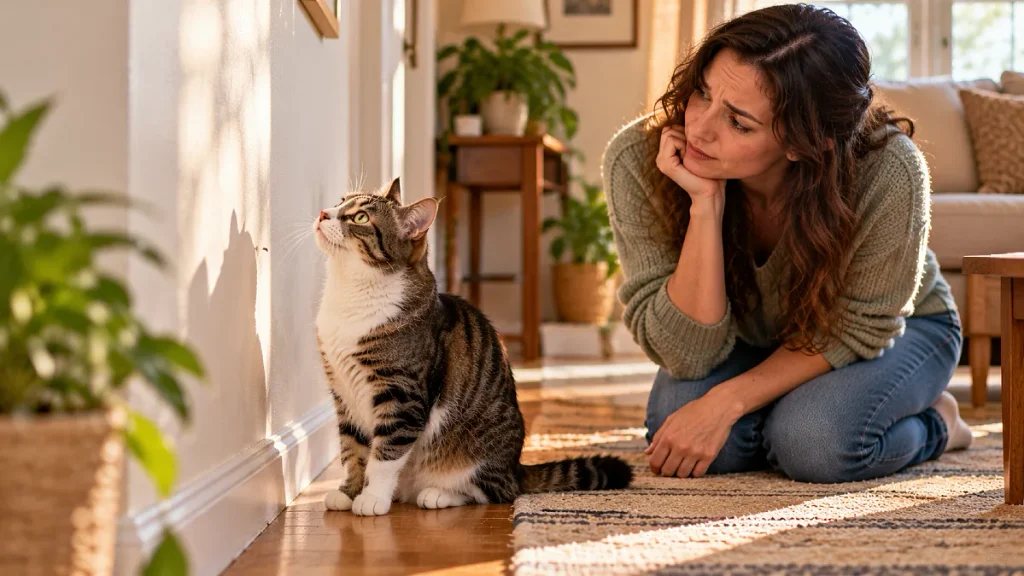
Your cat suddenly freezes in the middle of the living room. Their eyes become fixed on an empty wall, their ears begin moving, and their body looks ready to jump. Then they suddenly run away or pounce at something you cannot see.
It is one of the strangest behaviors cat owners witness. The room looks completely normal, yet your cat seems fascinated by something invisible.
Fortunately, there are several ordinary explanations. Cats experience their surroundings differently because their hearing and vision are built for detecting small movements.
A tiny insect crawling along the wall might escape your attention. Your cat, however, may notice its movement immediately.
The same applies to reflections from windows, moving shadows, and small changes in light. Even a faint sound from behind furniture can hold a cat’s attention.
Cats May Notice Light That Humans Cannot See
A scientific study published in Proceedings of the Royal Society B in 2014 examined how light passes through the eyes of different mammals. Researchers found that cats’ eye lenses allow significant amounts of ultraviolet A light to pass through.
This suggests cats may be sensitive to some ultraviolet light that humans cannot normally see. However, it does not prove that cats regularly see detailed hidden patterns on walls.
Cats also have vision that works well in dim light, helping them detect movement in conditions where people struggle to see clearly.
So when your cat stares at an empty corner, they may simply be watching something too small, too faint, or too quick for you to notice.
What Your Cat Might Be Watching
There are several possible explanations for these strange staring episodes. Looking at what happens around your cat can help you separate normal curiosity from a possible health concern.
| What attracts attention | Possible explanation | When to act |
|---|---|---|
| Sunlit walls | Moving reflections | Usually harmless |
| Corners and ceilings | Small insects | Check for pests |
| Air vents or cabinets | Faint noises | Inspect if needed |
| Repeated blank staring | Possible health concern | Ask your veterinarian |
Occasional staring is usually nothing to worry about when your cat remains alert and behaves normally afterward. Cats are naturally curious, and their attention can shift quickly.
However, sudden changes deserve more care. If your cat repeatedly stares without responding, seems confused, loses balance, or makes unusual movements, seek veterinary advice promptly.
If your cat becomes unresponsive or has seizure like movements, contact an emergency veterinarian. These symptoms should never be explained away as your cat simply seeing something humans cannot.
The next time your cat fixes their eyes on an empty wall, watch their ears, tail, and body position. You might discover a tiny insect or moving reflection that explains the whole mystery.