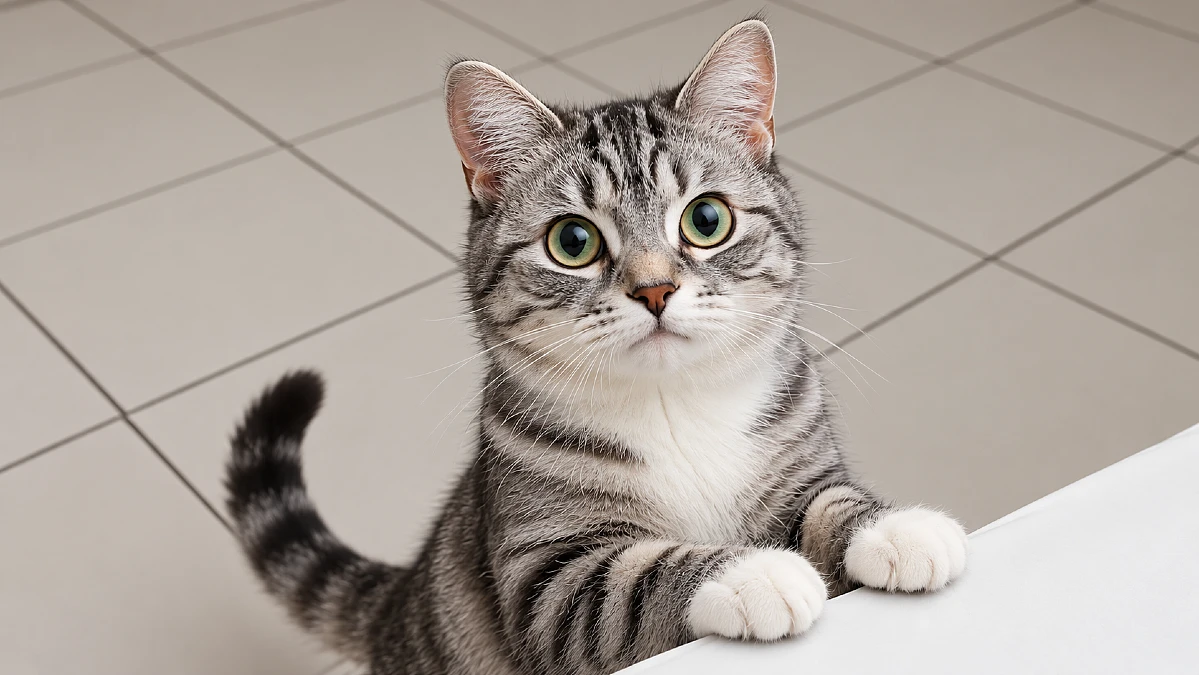
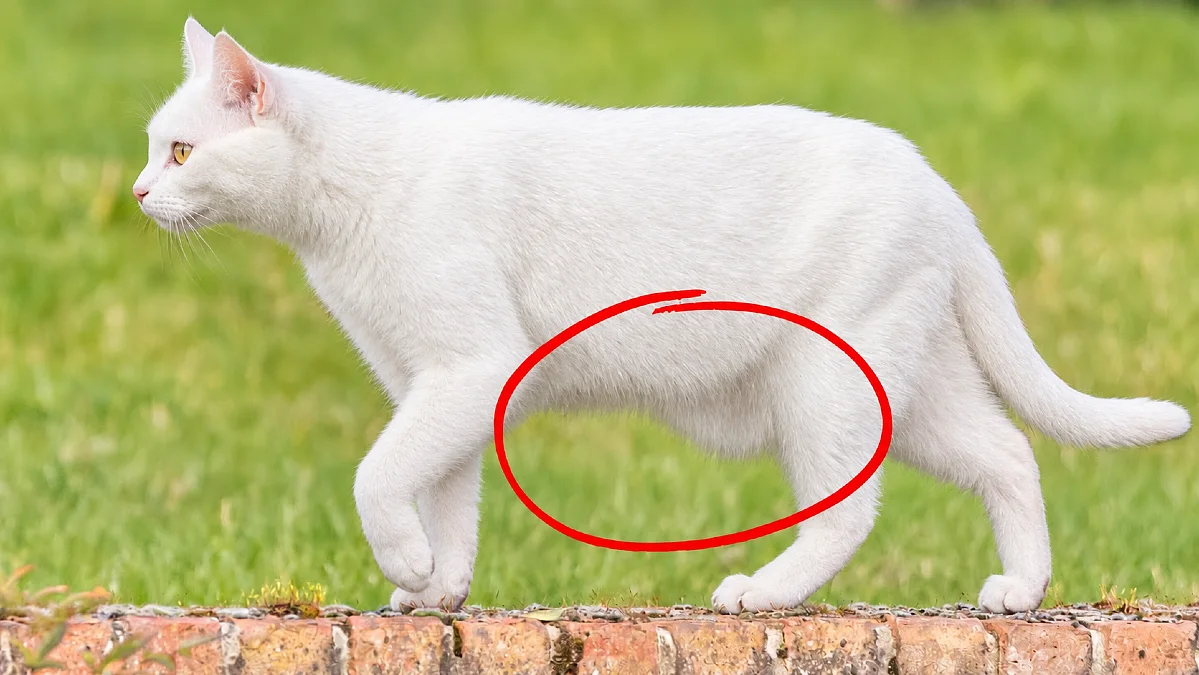
Does your cat’s belly wobble from side to side when they walk? You might have noticed a soft, hanging pouch near their back legs and started wondering if your cat has gained too much weight.
It can look strange, especially when your cat seems perfectly healthy everywhere else. That loose belly might even make you worry that something is wrong inside your cat’s stomach.
But here is something many cat owners do not realize. That saggy belly may be your cat’s primordial pouch, a normal part of feline anatomy that has little to do with being overweight.
Even lean, active cats can have a large primordial pouch. You can also find similar loose belly skin in wild cats, including lions and tigers.
Scientists believe this extra skin may have helped cats survive by protecting their bodies, allowing greater movement, and making room for larger meals. However, the exact reason cats developed it remains uncertain.
What Is a Primordial Pouch on a Cat’s Belly?
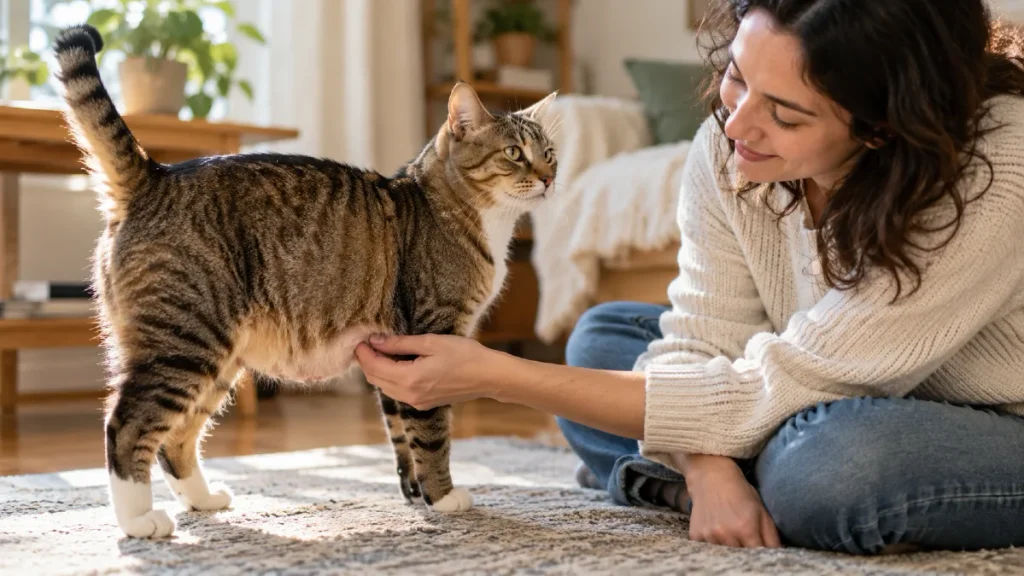
A primordial pouch is a loose flap of skin and fatty tissue along the underside of your cat’s body. It usually becomes most noticeable near the back legs, where it hangs below the normal belly line.
When your cat walks, the pouch may swing gently from side to side. Some cats have a very small pouch, while others have one that looks surprisingly large.
According to Cats Protection, both male and female cats have this natural feature. It is also found in large wild cats, which suggests it is an old part of feline anatomy.
The pouch is different from the rounded belly that develops when a cat gains excess body fat. A normal primordial pouch often feels soft, loose, and floppy rather than like a full, swollen abdomen.
You may notice it most when your cat stands, stretches, or runs across the room. When your cat curls up to sleep, the loose skin can become much harder to see.
The pouch usually becomes more noticeable as a kitten matures. PetMD explains that it often develops around six months to one year of age, although the exact timing differs between cats.
Some owners worry when they first notice this change in a young adult cat. In many cases, it is simply part of the cat’s normal physical development.
The important point is that the pouch itself is not a disease. A cat can be lean, muscular, and healthy while still having a swinging belly flap.
Why Cats Have a Primordial Pouch: Three Leading Theories
Your cat’s loose belly may look unnecessary, but scientists have several ideas about why this feature developed. Many of these explanations relate to how wild cats protected themselves, hunted, and survived.
PetMD and Cats Protection describe three common theories. None fully explains every cat’s pouch, and the proposed benefits have not all been proven through direct research.
Protection During Fights
Cats sometimes use their back legs to kick an opponent while holding it with their front paws. This behavior is often called bunny kicking, and you may have seen your cat do it while playing with a stuffed toy.
During a real fight, those back claws can cause serious injuries. Researchers and veterinarians suggest that loose belly skin and fatty tissue may provide an extra layer of protection over sensitive areas.
The pouch would not make a cat immune to injury. It may simply provide another small barrier between an attacker’s claws and the abdomen.
More Freedom to Stretch and Jump
Watch your cat leap onto a tall shelf or stretch across the floor. Their body can extend much farther than you might expect.
One theory suggests that the extra belly skin allows greater freedom of movement. This may help cats extend their bodies when running, jumping, and making sharp turns.
However, a cat’s flexible spine, muscles, and balance system also play major roles in its movement. The pouch alone does not explain why cats can twist in midair or often land on their feet.
Extra Room After a Large Meal
Wild cats cannot always predict when they will catch their next meal. Some may eat larger amounts when food becomes available.
The loose skin may allow the abdomen to expand more comfortably after feeding. This could have been useful for wild ancestors that faced uncertain food supplies.
Here is how the leading theories compare.
| Theory | Possible benefit | Evidence status |
|---|---|---|
| Protection | Extra barrier during fights | Proposed function |
| Flexibility | More room to stretch | Proposed function |
| Meal expansion | Space for a fuller abdomen | Proposed function |
These explanations are reasonable, but they remain theories rather than settled facts. Your house cat may no longer need every feature that helped its wild ancestors survive.
Primordial Pouch vs Belly Fat: How to Tell the Difference
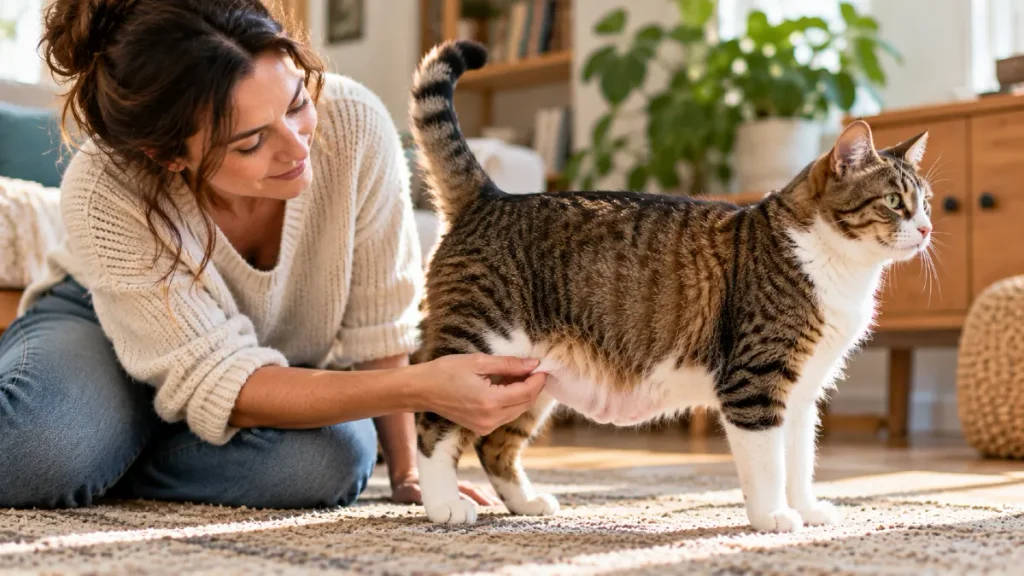
One of the biggest mistakes cat owners make is assuming that every hanging belly means their cat is overweight. A large primordial pouch can appear on a cat whose overall body condition is healthy.
The reverse is also true. An overweight cat can have a primordial pouch and excess body fat at the same time.
That is why veterinarians recommend checking the entire body instead of judging only the belly.
A normal pouch usually hangs from the underside, often closer to the rear legs. Excess body fat tends to change the cat’s overall shape, including the waist and the area covering the ribs.
Cats Protection explains that an overweight cat may have a rounded abdomen and ribs that are difficult to feel beneath thick fat deposits. The belly may also appear fuller rather than forming a separate swinging flap.
Use this comparison as a starting point.
| Feature | Normal primordial pouch | Possible excess body fat |
|---|---|---|
| Location | Loose flap below belly | Fat across body |
| Texture | Soft and floppy | Thicker padding |
| Movement | Often swings freely | Less separate movement |
| Waist | May remain visible | Often less defined |
| Ribs | Usually easy to feel at ideal weight | Harder to feel |
These signs work best when considered together. A hanging pouch alone cannot confirm whether your cat is at a healthy weight.
Why the Rib Test Matters More Than the Belly
Gently place your hands along the sides of your cat’s chest. You should usually be able to feel the ribs beneath a thin layer of fat without pressing hard.
If you must push firmly to locate the ribs, your cat may be carrying too much body fat. If the ribs are extremely sharp or clearly visible, your cat may be too thin.
VCA Animal Hospitals recommends combining this touch test with an overhead look at the waist. This gives you a better picture of body condition than measuring the pouch itself.
Remember that these checks are only a guide. A veterinarian can assess your cat’s weight, muscle condition, age, and body shape more accurately.
Why Some Cats Have a Bigger Primordial Pouch
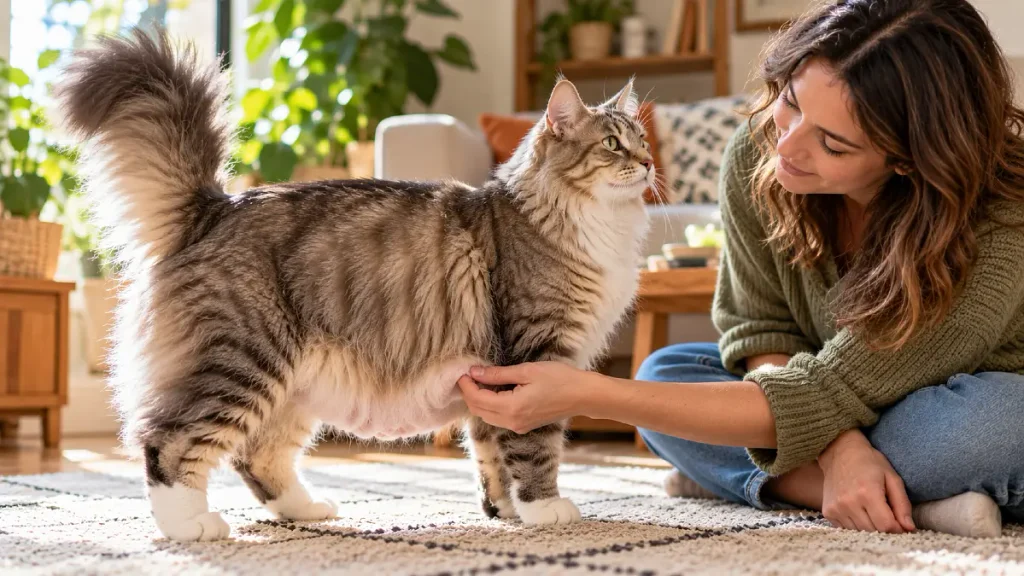
Have you ever compared two cats and wondered why one has a large swinging belly while the other looks completely flat? The answer often comes down to natural differences in body shape.
Genetics can affect how much loose skin a cat has. Age, breed, and the amount of fat beneath the skin can also change how noticeable the pouch appears.
The Egyptian Mau is a useful example. The International Cat Association describes a loose skin flap extending from the rear of the rib cage toward the hind leg as a recognized feature of this breed.
But you do not need to own a special breed to see a prominent pouch. Ordinary mixed breed house cats can develop large, floppy belly flaps too.
Does Neutering Cause a Cat’s Belly Pouch?
Many owners first notice a larger belly after their cat has been spayed or neutered. This has created the common belief that surgery causes the primordial pouch.
Cats Protection explains that this is a myth. The pouch is a natural feature found in cats regardless of whether they have been neutered.
However, neutering can reduce a cat’s energy needs. If you continue feeding the same amount while your cat burns fewer calories, they may gain weight, making the belly look larger.
Older cats may also develop more noticeable hanging skin as their bodies change. A pouch that gradually becomes looser with age can be normal, but sudden changes deserve a veterinary check.
How to Check Your Cat’s Body Condition at Home
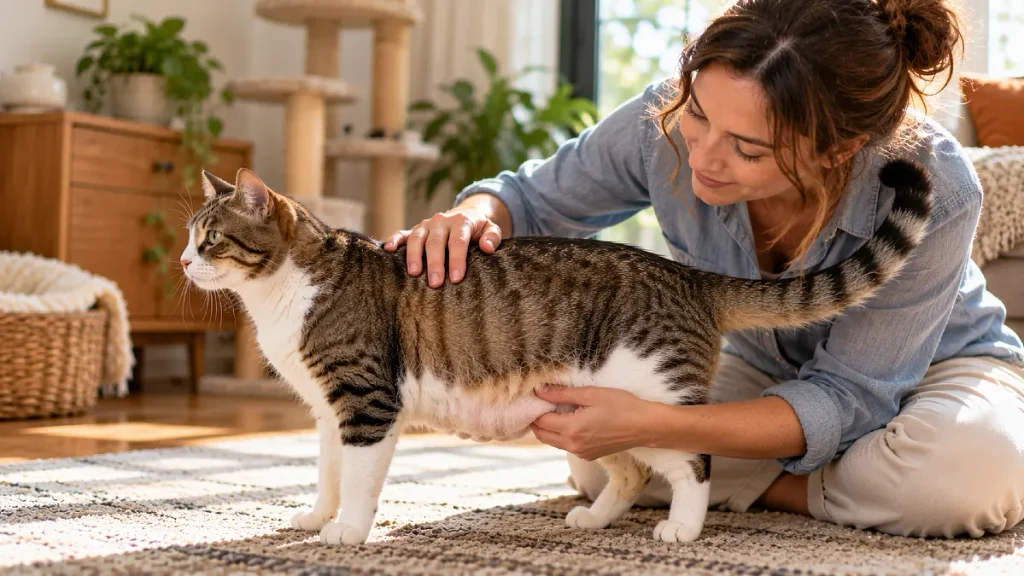
You do not need expensive equipment to get a basic idea of your cat’s body condition. A gentle hands on check and a good look at their shape can reveal useful information.
Veterinarians use a method called the Body Condition Score, or BCS. The World Small Animal Veterinary Association provides a nine point scale that helps assess whether a cat is too thin, at an ideal weight, or carrying excess fat.
For most adult cats, a score around 5 out of 9 is considered ideal. A veterinarian may recommend a different target based on your cat’s health, age, and build.
Start with these simple steps.
- Feel the ribs. Gently run your fingers along the chest and check how much fat covers the ribs.
- Look from above. Stand over your cat and look for a gentle narrowing behind the rib cage.
- Check the side view. Look for the overall belly shape without treating the loose pouch as proof of obesity.
- Check the back. Feel along the spine and hips to notice unusually sharp bones or thick fat covering.
- Track body weight. Record your cat’s weight over time and discuss changes with your veterinarian.
For a quick reference, the following table groups scores using the WSAVA body condition system.
| Body condition | Physical signs | Next step |
|---|---|---|
| Underweight, 1 to 3 | Prominent bones, little fat | Veterinary assessment |
| Near ideal, 4 to 5 | Ribs easy to feel, waist present | Maintain healthy routine |
| Above ideal, 6 to 7 | Extra fat, waist less clear | Review feeding with vet |
| Severely overweight, 8 to 9 | Heavy fat cover, waist absent | Veterinary weight plan |
Your cat’s muscle condition matters as well, especially as they age. A senior cat can lose muscle while still carrying extra fat around the body.
Cornell University’s April 2026 guidance recommends working with a veterinarian to find an appropriate target weight. This is more reliable than comparing your cat with pictures of other breeds.
When a Cat’s Belly Pouch Needs a Vet Check
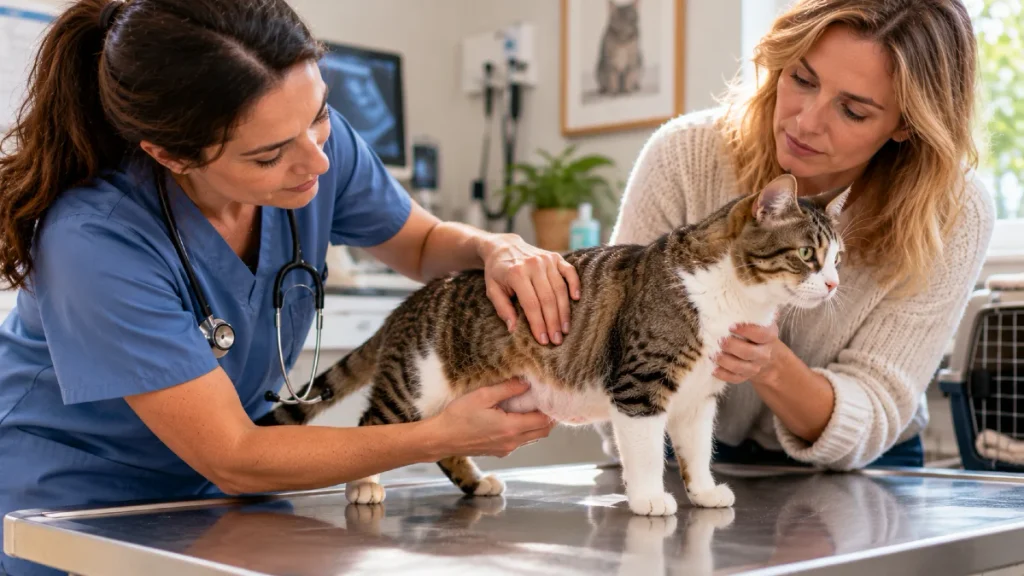
Most primordial pouches are harmless. However, there are situations where a changing belly could point to something much more serious.
The biggest warning is a sudden change in your cat’s abdomen, especially if the belly becomes swollen, firm, painful, or much larger than usual.
VCA Animal Hospitals explains that abdominal enlargement can have several causes. These include fluid buildup, intestinal problems, enlarged organs, pregnancy, and other medical conditions.
A normal pouch is loose tissue hanging beneath the belly. A swollen abdomen may involve changes deeper inside the body, which you cannot safely identify just by touching it.
Watch for Changes Beyond the Belly
Your cat’s appetite, energy, and litter box habits can tell you a great deal. A cat with a normal pouch should not become sick or painful simply because the pouch exists.
Pay particular attention if your cat suddenly refuses food, vomits repeatedly, hides more than usual, or becomes unusually weak. These changes can indicate a problem that needs prompt medical attention.
Hard lumps, growing masses, or a new area of swelling also need examination. Avoid squeezing or massaging the area to see what is inside.
Use this table to decide how urgently to seek help.
| What you notice | Possible concern | What to do |
|---|---|---|
| Longstanding soft pouch | Normal anatomy | Monitor at routine visits |
| Gradually growing belly | Weight gain or other cause | Book a vet appointment |
| New lump or swelling | Mass or tissue problem | Prompt vet assessment |
| Painful, hard abdomen | Possible serious illness | Emergency vet care |
| Swelling with breathing trouble | Possible emergency | Immediate emergency care |
| Straining with little or no urine | Possible urinary blockage | Immediate emergency care |
A sudden swollen abdomen accompanied by pain, weakness, or breathing problems should never be treated as normal belly fat. These symptoms may require emergency treatment.
Male cats that strain to urinate but produce little or no urine also need immediate veterinary attention. A urinary blockage can become life threatening.
An unspayed female cat with a growing belly could be pregnant, but pregnancy is not the only possibility. Some reproductive illnesses can also cause serious abdominal enlargement.
If your cat seems otherwise healthy but the belly has changed, arrange a veterinary visit rather than guessing. A physical examination and, when needed, imaging can help identify the cause.
Should You Try to Shrink or Remove a Primordial Pouch?
If your cat has a large primordial pouch, you may wonder whether feeding less food will make it disappear. The answer depends on whether the cat is actually overweight.
A normal primordial pouch does not need treatment. It is part of your cat’s anatomy, and its presence alone is not a reason for dieting or surgery.
If your cat is overweight, losing excess body fat may change the belly’s appearance. However, the loose skin that forms the pouch may remain even after your cat reaches a healthier weight.
That means you should never use pouch size as the only measure of weight loss success. Your cat’s body condition, weight trend, muscle health, and daily activity are more useful.
Why Crash Diets Can Be Dangerous for Cats
Cats should never be placed on extreme diets without veterinary guidance. Cutting food too quickly can cause serious health problems.
Cornell Feline Health Center warns about hepatic lipidosis, commonly called fatty liver disease. This dangerous condition can develop when a cat, particularly an overweight cat, stops eating or takes in far too little food.
A veterinarian can help decide whether weight loss is needed and how quickly it should happen. They can also recommend suitable meals and portion sizes for your cat’s needs.
The goal is to improve your cat’s health, not to eliminate a natural belly flap. A healthy cat with a large primordial pouch may need no change at all.
How to Keep Your Cat Healthy Without Worrying About the Pouch
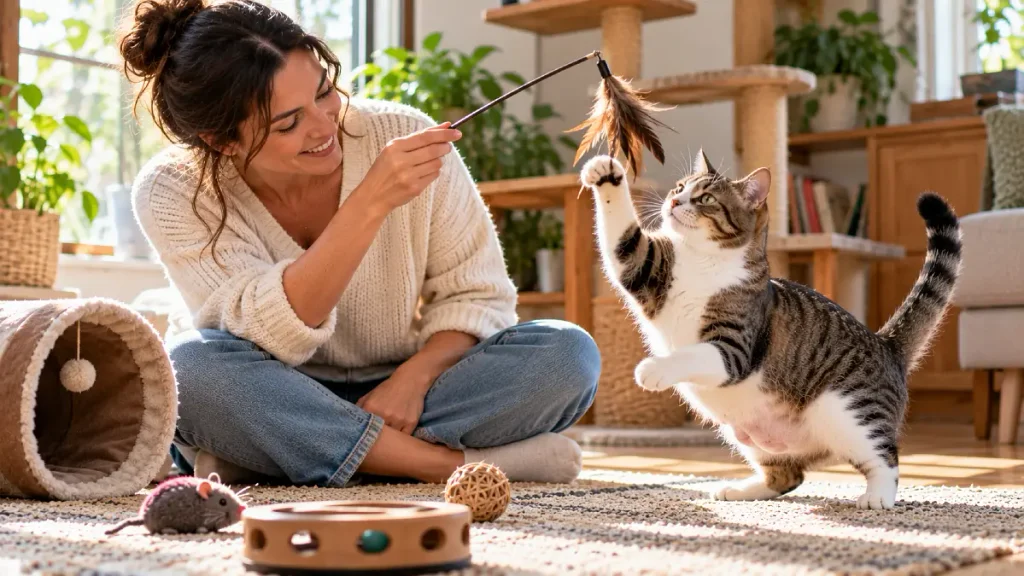
Instead of focusing on the hanging belly, pay attention to what your cat does every day. Healthy eating habits, regular activity, and routine veterinary care matter far more than the shape of a normal pouch.
Indoor cats especially benefit from opportunities to run, chase, climb, and explore. These activities support physical fitness while helping prevent boredom.
Cornell Feline Health Center recommends safe toys that encourage cats to stalk, pounce, and solve simple problems. You do not need expensive equipment to make playtime useful.
Try spending a few short sessions each day playing with a wand toy or tossing a lightweight ball. Let your cat catch the toy regularly so the activity remains rewarding.
Food puzzles can also encourage movement during mealtime. Products such as the Catit Senses Food Tree and PetSafe SlimCat Interactive Feeder allow cats to work for portions of their food.
Just remember to count any food placed inside a puzzle toward your cat’s daily allowance. A feeding toy does not prevent weight gain if your cat is still eating more calories than needed.
You can also make a few simple changes at home.
- Measure food portions instead of guessing.
- Keep fresh drinking water available.
- Provide stable climbing and resting areas.
- Rotate safe toys to maintain interest.
- Monitor your cat’s weight and body shape.
- Schedule regular veterinary wellness checks.
Cats Protection also recommends discussing feeding amounts with your veterinarian when weight becomes a concern. This is especially helpful if your cat has been neutered, is becoming less active, or is getting older.
And if your cat dislikes having their belly touched, respect that boundary. A visible primordial pouch is not an invitation for belly rubs, and forcing contact may cause stress or scratches.