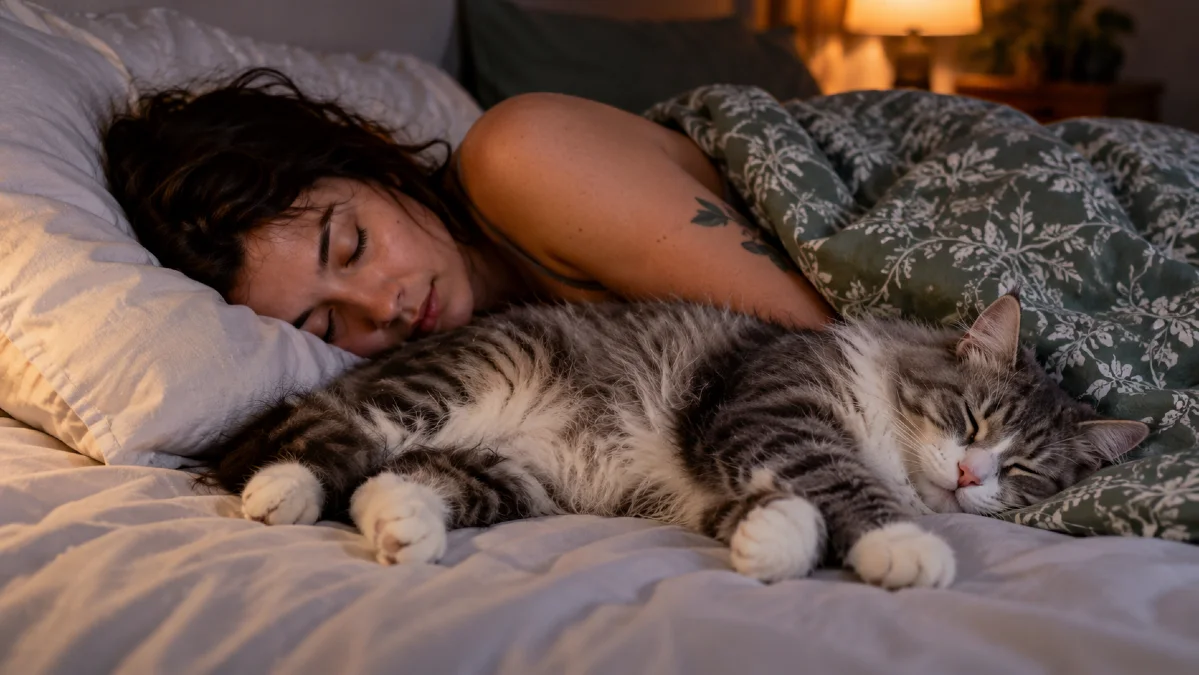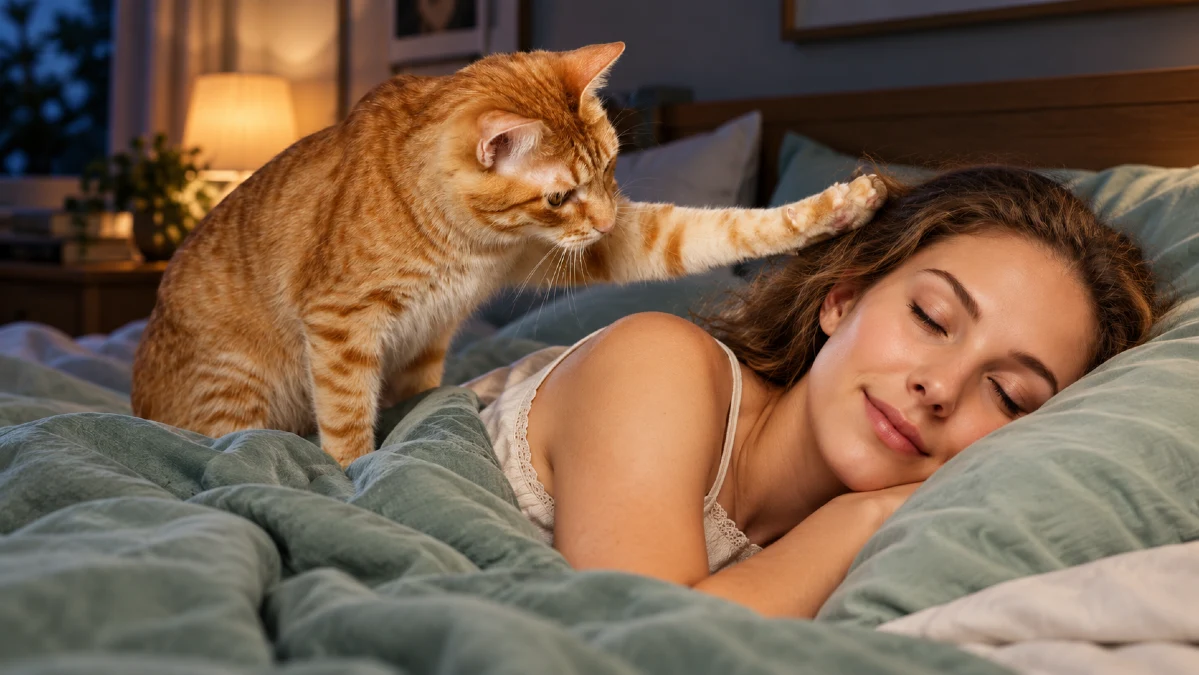

Your cat rubs against your legs, follows you into the bathroom, and sleeps beside you at night. But when you call their name, they sometimes act like you don’t exist. It makes you wonder what your cat really thinks you are.
Do they see you as their owner, their parent, or simply the person who fills their food bowl? The answer is more interesting than you might expect. Scientists studying how cats see humans have found that these animals build relationships in ways that are quite different from dogs.
Your cat may greet you using the same signals they use with another friendly cat. They can also recognize your voice, learn your routines, and turn to you for comfort when something feels unfamiliar.
Does Your Cat Really Think You Are a Giant Cat?
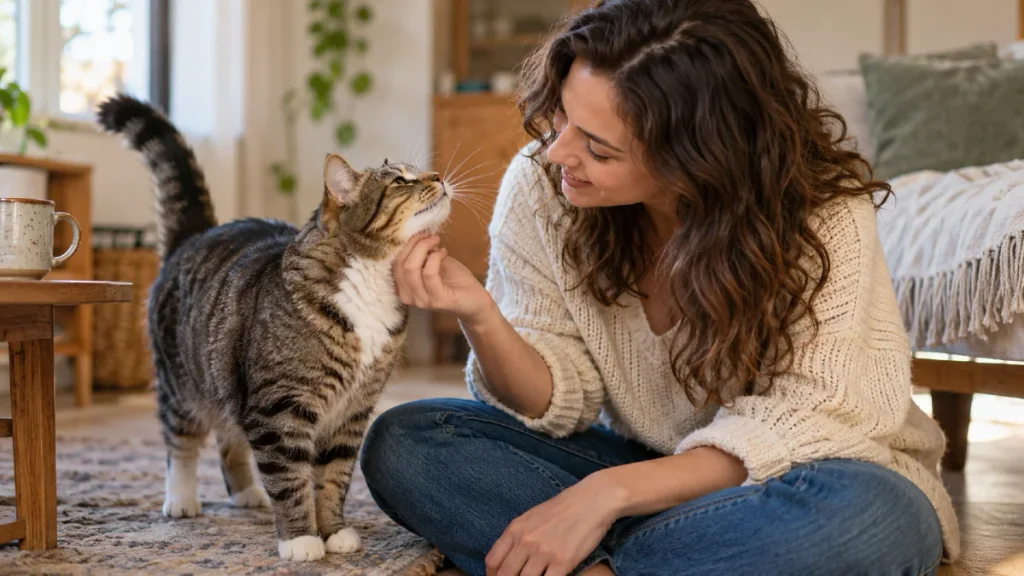
Your cat might treat you like another member of their social group, even though you look nothing like them. That is the idea behind the popular claim that cats see humans as giant cats.
Animal behavior expert John Bradshaw, author of Cat Sense, spent years studying how cats interact with other cats and people. In an interview with National Geographic, he explained that cats use many of the same social behaviors with humans that they use with familiar cats.
Think about what happens when your cat approaches you. They might walk toward you with their tail raised, rub against your legs, or settle down beside you.
These are familiar behaviors between cats that have a friendly relationship. Your cat does not need to invent a completely different greeting just because you are human.
But Does Your Cat Actually Think You Are a Cat?
Here is where the popular story gets ahead of the science. Bradshaw did not prove that cats literally mistake people for oversized cats.
Cats clearly notice differences between people and other animals. They react to human voices, learn human routines, and change their behavior based on their experiences with specific people.
What researchers can say is that cats use many familiar social signals when interacting with humans. This suggests that you can become an important social companion rather than simply a source of food.
And that changes how you might interpret your cat’s behavior.
When your cat walks past several people to sit beside you, they may be choosing the person who feels most familiar and comfortable. Their choice can reveal a meaningful relationship, even without the excitement people often expect from dogs.
Why Your Cat Rubs Against You, Grooms You, and Blinks Slowly
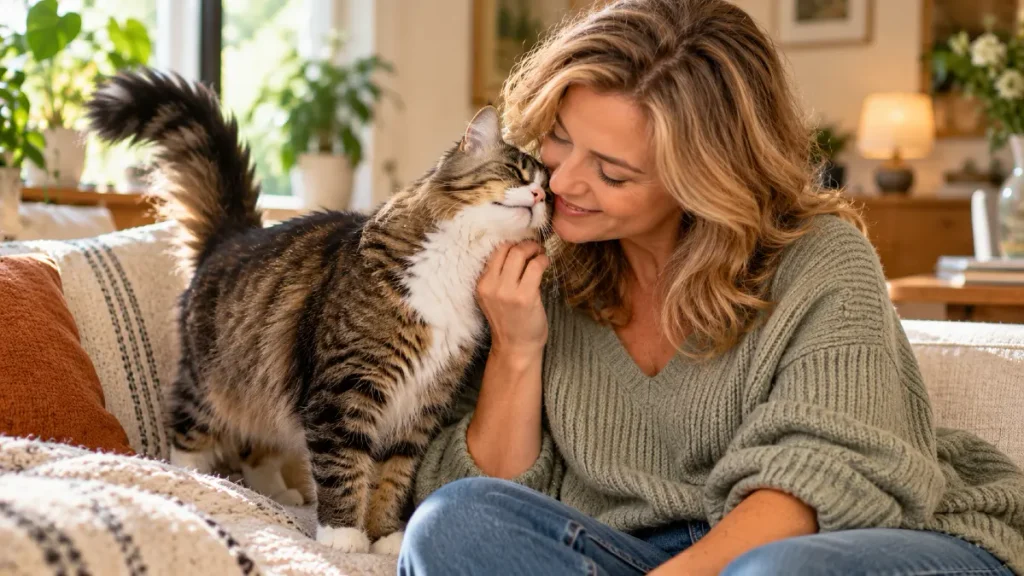
Your cat may be showing affection in ways you have been overlooking. Some of their warmest greetings are quiet, brief, and easy to miss.
One common example is rubbing against your legs. Cats have scent glands around their cheeks, forehead, and other areas of their bodies.
When your cat rubs against you, they can leave familiar scent signals behind. These signals are part of how cats communicate with their surroundings and familiar companions.
Why Your Cat Wants Their Scent on You
Cats rely heavily on scent to identify familiar places and individuals. Rubbing can be part of a friendly greeting while also spreading familiar smells.
If your cat approaches with a relaxed body and an upright tail, that combination often suggests friendly intentions. You can respond by offering your hand and allowing them to decide whether they want contact.
Grooming can carry a social meaning, too. Cats sometimes lick familiar companions, and some extend that behavior to their human caregivers.
A cat gently licking your hand while resting beside you may be engaging in friendly social contact. However, licking can have several causes, so the situation matters.
Slow blinking is another useful signal. In a 2020 study published in Scientific Reports, researchers found that cats responded positively when people slowly narrowed and closed their eyes.
That gives you a simple way to communicate without touching your cat.
What Your Cat’s Friendly Behavior May Mean
These common behaviors can have different meanings depending on your cat’s mood and surroundings. Use the table to choose a response that respects their comfort.
| Cat behavior | Possible meaning | Your response |
|---|---|---|
| Rubbing against your legs | Friendly greeting or scent marking | Offer gentle contact |
| Slow blinking | Relaxed, positive interaction | Blink slowly back |
| Licking your hand | Social grooming or interest | Allow it if comfortable |
| Walking with tail upright | Friendly approach | Greet calmly |
| Kneading a blanket beside you | Comfort or settling behavior | Let them relax |
The important clue is the whole situation, not one movement. A relaxed cat who approaches on their own is communicating something different from a tense cat who is trying to move away.
How Your Cat Recognizes You Without Relying on Your Face
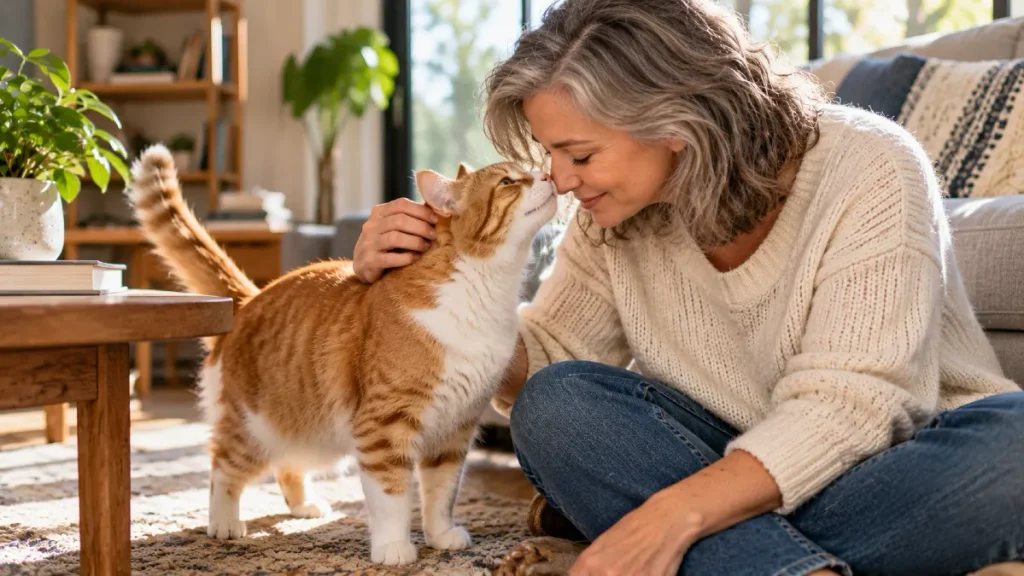
Your cat can recognize you even when they are not looking directly at your face. Their ears, nose, eyes, and memory all help them identify familiar people.
Human faces contain details we use to recognize one another. Cats have a different visual system, and their eyesight works especially well for certain tasks.
Veterinary information published by PetMD in February 2026 explains that cats have difficulty focusing on objects very close to their faces. Objects closer than roughly 10 inches can appear blurry.
That may explain why your cat sometimes struggles to find a treat placed directly in front of their nose. Their whiskers and sense of smell can help them locate nearby objects.
However, it would be wrong to say cats cannot recognize human faces at all. Their ability to recognize people through facial details alone is still being studied.
Your Voice Gives Away Who You Are
A 2013 study by researchers Atsuko Saito and Kazutaka Shinozuka found that cats could distinguish their owners’ voices from unfamiliar voices.
The cats did not always rush toward their owners or make a sound. Some showed recognition through small movements of their ears and heads.
That is an important detail for cat owners. A quiet response does not always mean your cat failed to recognize you.
Your cat may also notice your footsteps, daily schedule, and the sounds you make around the house.
For example, a cat might walk toward the kitchen when you open a particular cabinet. That response can come from learning the sounds and events that usually happen before a meal.
How Cats Recognize Their Favorite People
Your cat can use several clues together to identify you. This table shows how to work with those natural abilities.
| Recognition cue | What your cat notices | What you can do |
|---|---|---|
| Voice | Familiar sound and tone | Speak gently |
| Scent | Familiar body and clothing smells | Let your cat sniff |
| Vision | Shape and visible movements | Approach calmly |
| Movement | Familiar walking patterns | Avoid sudden gestures |
| Routine | Repeated daily events | Keep a steady schedule |
These cues help explain why a cat may recognize you without staring at your face. Recognition is often shown through small changes in attention or behavior rather than an obvious greeting.
Why Your Cat Has a Special Meow Just for You

Your cat may have learned which sounds get your attention. That is one reason the meow you hear at breakfast can sound different from the one you hear outside a closed door.
Adult cats communicate with one another through body language, scent, touch, and vocal sounds. They can meow at other cats, but meowing is especially common in their interactions with people.
Kittens meow to communicate with their mothers. As cats grow, their use of vocal sounds changes, particularly when they regularly interact with humans.
A cat living with people can learn that making a sound produces a response.
For example, your cat might meow beside an empty food bowl and watch you approach. If you repeatedly respond by feeding them, that sound can become part of a familiar routine.
Your Cat Can Learn How You Speak to Them
Research published in Animal Cognition in 2022 found that cats could tell when their owners were using speech directed at them rather than ordinary speech directed at adults.
The same response was not found when unfamiliar people used the different speaking styles. That suggests experience with a particular person matters.
Still, there is no scientific dictionary that translates every meow into a fixed sentence. A loud meow does not always mean hunger, and a soft one does not always mean affection.
Watch what happens before and after the sound. A cat standing near a favorite toy may want play, while one waiting beside a door may want access to another room.
Pay attention when your cat’s normal vocal habits suddenly change. New, frequent crying or unusual nighttime vocal sounds can sometimes point to stress, discomfort, or illness.
If these changes continue, especially with changes in eating, drinking, or activity, ask your veterinarian for advice.
Why Your Cat Brings You Toys, Mice, or Strange Objects
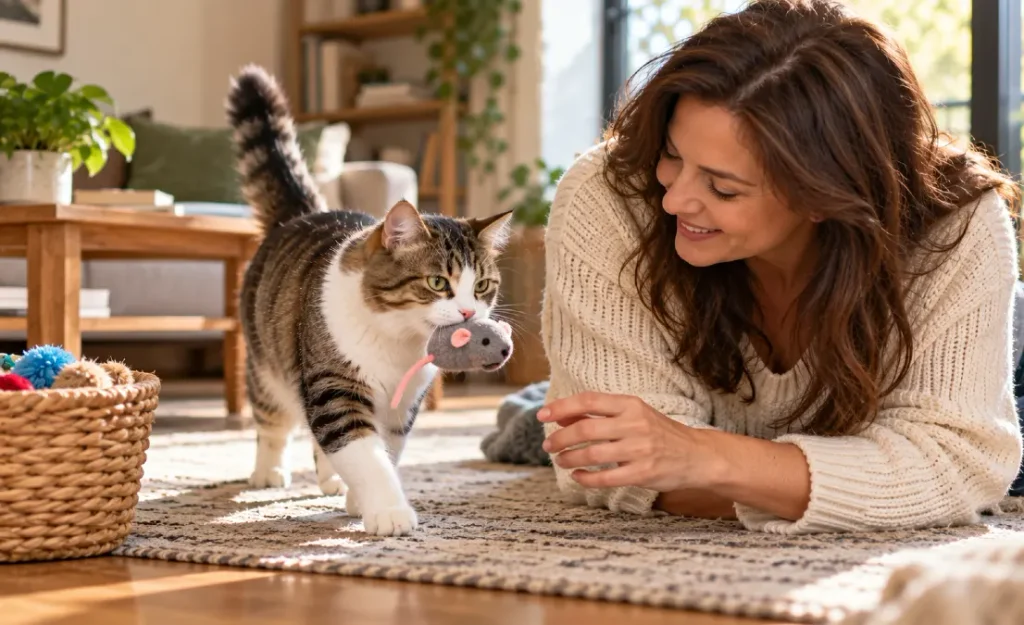
Finding a toy mouse on your pillow can feel like receiving a personal gift. Finding a real mouse in the same place is a very different experience.
Both situations can leave you wondering why your cat decided to bring the object to you.
One popular theory says cats bring people prey because they think humans cannot hunt. The story comes from real behavior seen in mother cats, which bring prey to their kittens as part of their development.
But there is no strong evidence that house cats are trying to teach their human caregivers how to hunt.
Cats Protection offers a simpler explanation. Cats often carry captured prey back to a place where they feel safe.
Your Home May Be Their Safe Place for Prey
A cat that catches a mouse outdoors may carry it back to the house because the house is familiar territory. They may feel more comfortable handling their catch there than outside.
This behavior can happen even when your cat receives enough food. Hunting is a natural behavior that is not driven by hunger alone.
The situation can be different when your cat brings you a toy.
Some cats learn to carry toys toward people because doing so starts an enjoyable game. A cat who drops a small ball nearby and waits for you to throw it may have learned a simple form of fetch.
Other cats carry their favorite toys to resting places without wanting any interaction.
You can learn a great deal by watching what your cat does next. If they follow the toy with interest after you move it, they may be inviting you to play.
If your cat brings home real prey, avoid punishing them for natural hunting behavior. Remove the prey safely, keep pets away from it, and consider supervised outdoor access or a secure cat enclosure to reduce wildlife hunting.
Indoor play can also give your cat a safer way to chase, pounce, and catch.
Why You May Be Your Cat’s Favorite Source of Safety
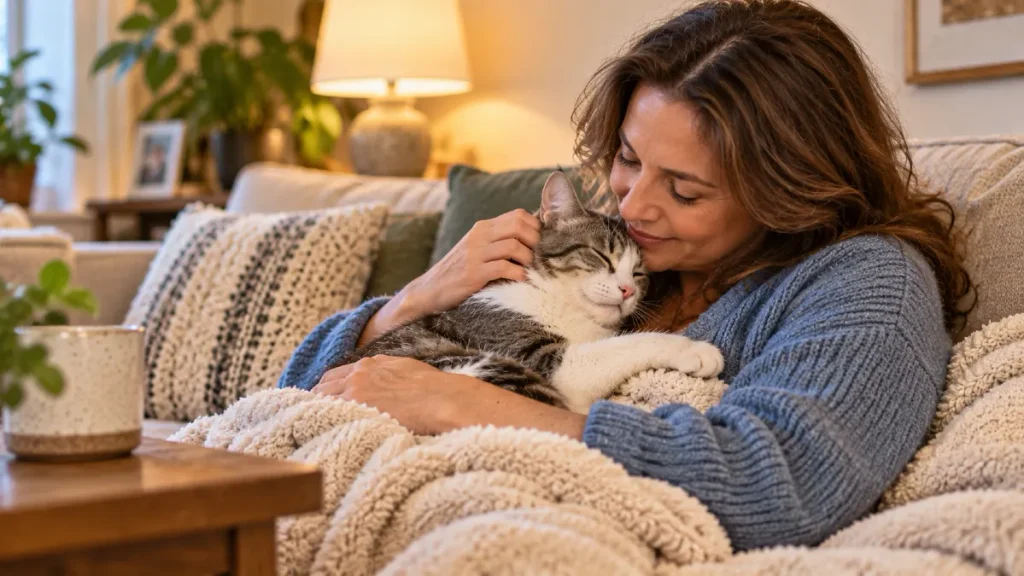
Your cat may treat your presence as a sign that things are safe. This is one of the most meaningful findings to come from research on cat attachment to humans.
In 2019, researchers at Oregon State University studied how cats responded to their caregivers in an unfamiliar room.
The research team, led by Kristyn Vitale, used a test designed to examine attachment behavior. Cats spent time with their caregivers, experienced a short separation, and were observed when their caregivers returned.
Researchers looked for patterns of behavior linked with feeling secure or insecure.
What the 2019 Cat Attachment Study Found
Of the 70 kittens whose attachment behavior could be classified, 64.3% showed a secure attachment pattern.
Researchers also studied 38 adult cats. Among those adults, 65.8% were classified as securely attached.
For securely attached cats, the caregiver could serve as a source of comfort in an unfamiliar environment. After their person returned, these cats were better able to settle and explore.
That is quite different from the popular image of cats as animals that never need emotional support.
The findings do not mean every cat reacts the same way. An insecure attachment classification also does not mean a cat is unloved or incapable of forming a close bond.
Your Presence Can Change How Your Cat Responds to Stress
Consider what happens when something unfamiliar enters your home.
Your cat might hide when a visitor arrives or become alert when a strange noise comes from another room. Some cats appear more willing to come out and explore when their trusted caregiver is nearby.
That does not mean your presence instantly removes fear. It means a familiar person can be part of what helps a cat feel secure.
This is also why predictable routines matter.
Your cat learns when you usually feed them, when the house becomes quiet, and where they can rest without being disturbed. These repeated experiences can help make daily life feel more predictable.
You may see signs of comfort when your cat settles beside you, stretches out in a familiar sleeping spot, or chooses to remain nearby while you work.
Sometimes your cat’s strongest sign of trust is simply being relaxed enough to sleep while you are there.
How to Tell Whether Your Cat Trusts You or Feels Stressed
Your cat can enjoy your company without wanting constant physical attention. Learning the difference between comfort and stress helps you avoid pushing your cat beyond what they enjoy.
A relaxed cat often has loose body muscles, a comfortable posture, and ears resting in a natural position. They may approach you voluntarily or settle down nearby.
But one behavior is rarely enough to tell you exactly how your cat feels.
For example, purring often happens during pleasant moments, but cats may also purr when distressed or unwell. You need to look at their whole body and the situation.
The same is true when a cat shows their belly.
Rolling onto their back can suggest they feel safe, but it does not automatically mean they want their stomach touched. Some cats dislike belly rubbing even when they trust you.
How to Read Your Cat’s Comfort Level
The table below can help you decide whether to continue an interaction or give your cat space. These are general clues, so compare them with your cat’s usual behavior.
| Body signals | Possible emotional state | Best response |
|---|---|---|
| Loose body, soft eyes | Relaxed | Let them choose contact |
| Tail up, ears forward | Friendly or interested | Offer a greeting |
| Fast tail swishing, skin twitching | Growing irritation | Stop petting |
| Ears flattened, body crouched | Fear or distress | Give space |
| Sudden hiding, unusual withdrawal | Stress or possible illness | Check for other changes |
The most useful habit is to stop touching your cat before they become upset. If they return for more attention, you can offer another short interaction.
When a Change in Behavior Needs Attention
A cat who has always enjoyed sitting beside you may suddenly begin hiding. Another cat may become aggressive when someone touches an area of their body.
These changes should not automatically be treated as a sign that your cat no longer likes you.
Cornell Feline Health Center and the Merck Veterinary Manual explain that pain and health problems can affect a cat’s behavior.
If your cat suddenly avoids contact, becomes unusually aggressive, stops eating normally, or shows other signs of illness, arrange a veterinary examination.
Trust grows when your cat can choose what happens to their body. Respecting a warning signal is part of keeping that relationship comfortable.
How to Build a Stronger Bond With Your Cat Every Day
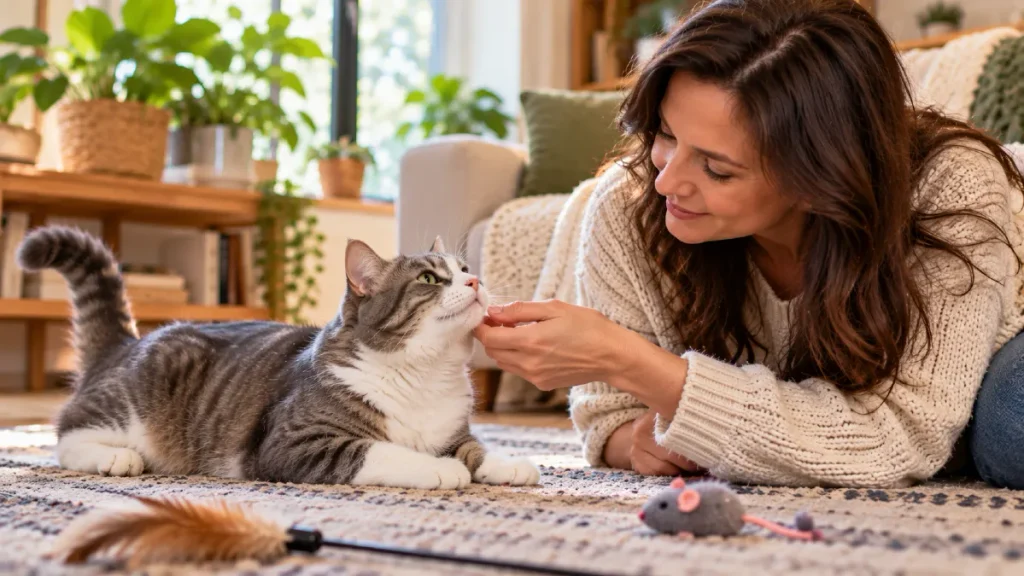
You do not need expensive toys or constant attention to build a stronger bond with your cat. Small changes in how you approach them can make daily interactions more comfortable.
Research published in Frontiers in Veterinary Science in August 2026 examined ways to improve human interactions with cats in rescue settings. It supported handling practices based on feline comfort, choice, and control.
The study involved shelter workers rather than ordinary home relationships, so its findings should not be treated as proof that one method works for every pet. Still, respecting a cat’s preferences is a sound approach to everyday care.
Let Your Cat Decide When Contact Begins
Instead of picking your cat up whenever you want affection, allow them to approach you.
Sit somewhere comfortable and offer a relaxed hand for them to investigate. If your cat rubs against your fingers or moves closer, try a gentle stroke around the cheeks or head.
Pause after a short time and watch what happens. A cat who leans back toward you may want more, while one who walks away is asking for space.
That simple habit helps you avoid unwanted handling.
Use Slow Blinking During Quiet Moments
Slow blinking is an easy way to interact without touching.
When your cat is calm and looking in your direction, gently narrow your eyes and close them for a brief moment. Open them slowly and avoid staring directly afterward.
Your cat may return the movement, look away, or continue resting. Do not force the interaction or expect an immediate response.
The goal is to make your presence comfortable, not to get a particular reaction.
Turn Play Into a Shared Activity
Interactive play gives your cat a chance to express natural hunting behavior while spending time with you.
A feather wand, such as Go Cat Da Bird, can encourage chasing and pouncing. Move it along the floor, let it disappear behind furniture, and occasionally allow your cat to catch it.
That final catch matters because chasing something without ever reaching it can become frustrating.
You can also use a food puzzle, such as the Nina Ottosson Buggin’ Out Puzzle & Play, to encourage food searching. Start with an easy setup so your cat can learn how it works.
Always supervise toys with strings, feathers, or small parts that could be swallowed. Put wand toys away after play and replace damaged items.
Make Your Daily Routine Feel Safe
Your cat benefits from knowing where to find food, water, resting places, and a clean litter box. Quiet hiding spots and raised resting areas also give them choices when they need space.
Try keeping feeding and play schedules reasonably consistent. You do not need to follow an exact clock, but familiar patterns can help reduce uncertainty.
If you have several cats, provide enough separate resources so they do not have to compete for everything.
Most of all, pay attention to what your particular cat enjoys.
One cat may love sitting on your lap. Another may prefer following you between rooms or sleeping several feet away.
Both can form meaningful relationships with people. Closeness is not measured by how often your cat allows you to hold them.
A cat who chooses to remain nearby, greet you, or seek you out for play may be showing trust in their own way.