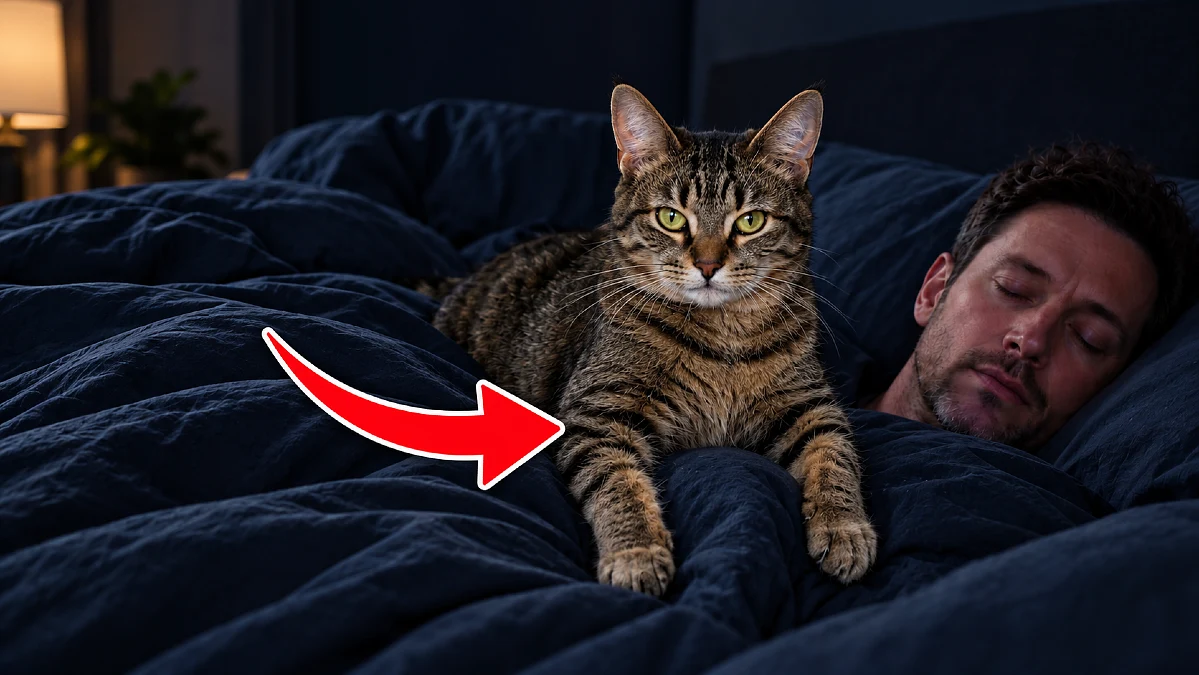

Have you ever looked into your cat’s eyes and wondered what they actually see when they look back at you? You feed them, clean their litter box, give them a comfortable home, and love them like family. Yet sometimes they act as if you’re just another creature sharing their space.
Your cat might rub against your legs one minute, completely ignore you the next, and then climb onto your chest when you’re trying to sleep. These little habits can leave you wondering whether your cat truly loves you or simply enjoys the food and warmth you provide.
The science of how cats see humans offers some fascinating clues. Animal behavior researchers have discovered that cats use many of the same social signals with people that they use with other cats.
Why Your Cat Treats You Like a Familiar Cat Instead of a Boss
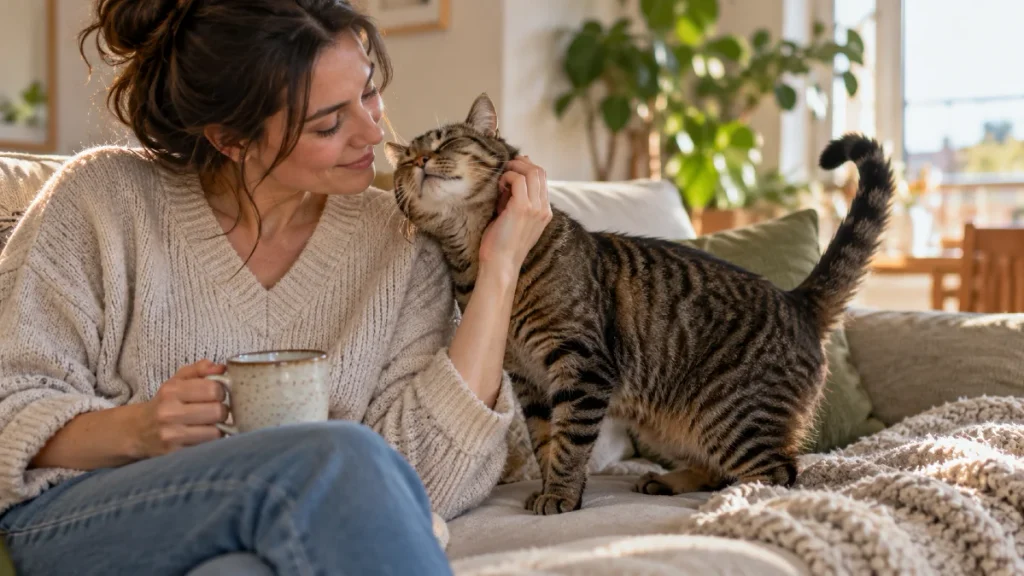
Your cat probably doesn’t see you as the boss of the house in the way you might expect. In fact, some of their most affectionate behaviors come from the same social habits they use with other cats.
Animal behaviorist John Bradshaw, author of Cat Sense, has spent years studying feline behavior. His observations suggest that cats often interact with humans using familiar behaviors from their relationships with other cats.
Think about what happens when your cat walks toward you with their tail held high. They may brush against your legs, rub their cheeks on your hand, or settle beside you on the couch.
Cats also use these behaviors when greeting other cats they know and feel comfortable around. Rather than creating a completely different greeting for humans, they often use social signals already familiar to them.
Does That Mean Your Cat Thinks You’re a Giant Cat?
The idea that cats see humans as large, clumsy cats has become popular, but scientists haven’t proved that cats literally think we’re members of their own species. Bradshaw’s observations show similarities in behavior, not exactly what cats believe.
Your cat can still notice that you’re different from another cat. They learn your routines, recognize familiar voices, and respond to the ways you behave.
What’s interesting is that your cat doesn’t need to treat you like a human to form a meaningful bond with you. They can use their own natural behaviors to show comfort, trust, and affection.
That also explains why cats don’t always act eager to please their owners. Their social relationships often depend more on familiarity, personal choice, and positive experiences than following commands.
The next time your cat quietly walks over and sits beside you, don’t assume they’re being distant. Choosing to spend time near you may be one of their simplest ways of showing that your company matters.
What Your Cat’s Head Rubs, Slow Blinks, and Tail Signals Really Mean
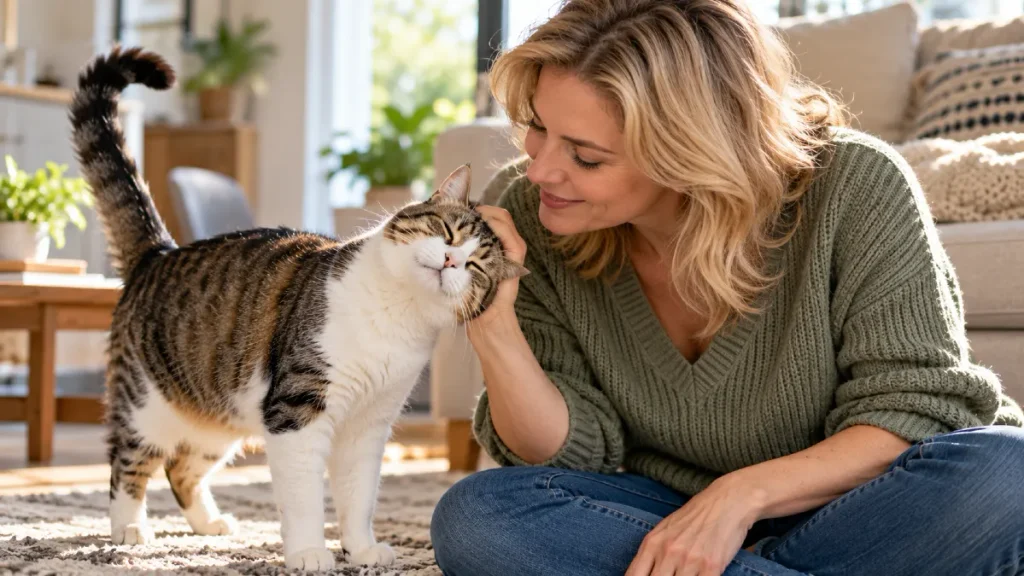
Your cat may be communicating with you all day without making a sound. The problem is that humans often overlook the smaller signals cats use to express comfort, interest, or discomfort.
One of the clearest examples is head rubbing. Cats have scent glands around their cheeks, forehead, and chin, and rubbing helps them leave familiar scents on people and objects.
When your cat presses their cheek against your hand, they may be greeting you while adding familiar scent to the interaction. It can be a friendly social behavior, especially when their body looks relaxed.
Slow blinking is another interesting signal. A study published in Scientific Reports in 2020 found that cats were more likely to narrow their eyes when people slowly blinked at them.
The researchers also found that cats were more likely to approach an unfamiliar person after a slow blink interaction than after a neutral expression. This suggests that slow blinking may play a role in positive communication between cats and humans.
How to Read Your Cat’s Body Language
Learning your cat’s signals can help you decide when to offer affection and when to give them space. However, no single movement tells you everything about how a cat feels.
Look at the ears, tail, eyes, and overall posture together. The following table can help you decide what to do in common situations.
| Cat behavior | Possible meaning | What you should do |
|---|---|---|
| Head rubbing | Friendly greeting or scent sharing | Allow gentle contact |
| Slow blinking | Relaxed, positive interaction | Slowly blink back |
| Upright tail | Friendly approach | Offer your hand |
| Kneading | Comfort or familiar nursing behavior | Let them settle |
| Exposed belly | Relaxation or trust | Avoid assuming they want belly rubs |
These signals become more useful when you watch how your cat responds to you. A relaxed cat may welcome more contact, while one that moves away is asking for space.
And remember, showing their belly doesn’t automatically mean your cat wants you to touch it. Sometimes they’re simply comfortable enough to rest in a vulnerable position.
Why Your Cat Brings You Toys or Dead Prey
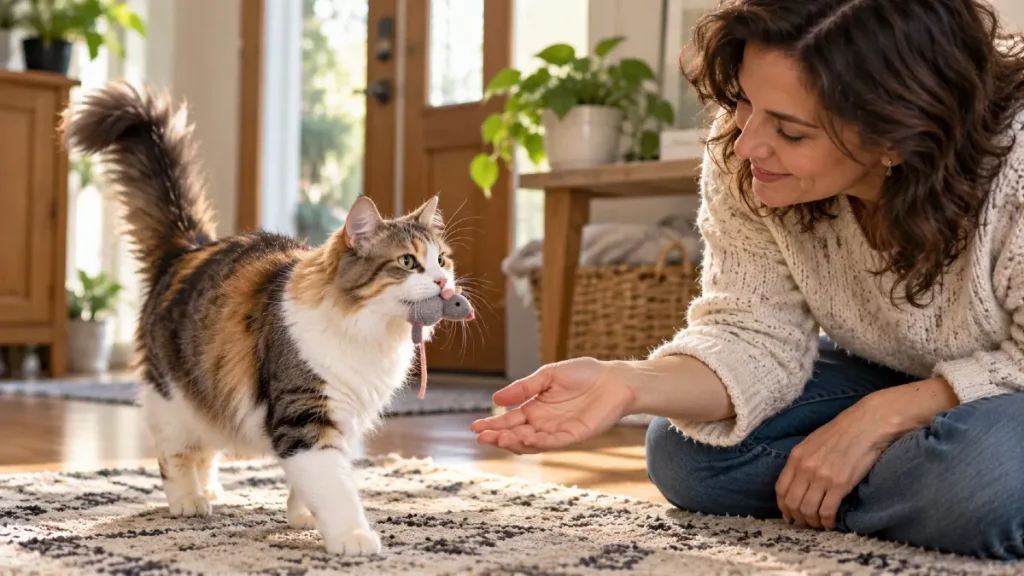
Finding a dead mouse at your feet is probably not your favorite way to start the morning. Yet this strange habit tells you something interesting about your cat’s natural instincts.
Cats are hunters, even when they have plenty of food available. Hunting involves stalking, chasing, catching, and sometimes carrying prey to another location.
Mother cats do bring prey to their kittens as part of teaching them to hunt. However, that doesn’t prove your adult cat is trying to teach you how to survive when they bring something home.
Cats Protection explains that cats often carry prey back to their core territory because it feels safer. They may prefer to eat or store their catch somewhere familiar, away from other animals.
That means your cat probably isn’t looking at you and thinking you desperately need a hunting lesson. They may simply see your shared home as a safe place to bring something they’ve caught.
What Does It Mean When Your Cat Brings You a Toy?
Indoor cats sometimes show similar carrying behaviors with toy mice, small stuffed animals, or other household objects. The reason may be different from one cat to another.
Some cats carry toys during play, while others appear interested in moving or storing objects. Watch what happens next before deciding whether your cat wants you to join in.
| What your cat brings | Possible reason | Best response |
|---|---|---|
| Dead prey | Returning to safe territory | Remove it safely |
| Live prey | Natural hunting behavior | Separate cat and prey safely |
| Toy mouse | Hunting play or carrying | Offer interactive play |
| Small household object | Curiosity or play | Check for choking hazards |
Your cat’s next action can provide helpful clues. If they drop a toy and start chasing it when you move it, they’re probably interested in playing.
You can support their hunting instincts with wand toys, soft toy mice, and puzzle feeders. These give your cat something satisfying to chase or investigate without harming wildlife.
If your cat brings home real prey, avoid yelling or punishing them. Wear gloves when handling dead animals, wash your hands afterward, and seek help from a wildlife rescue service if an animal is injured.
How Your Cat Recognizes You When Your Face Looks Blurry
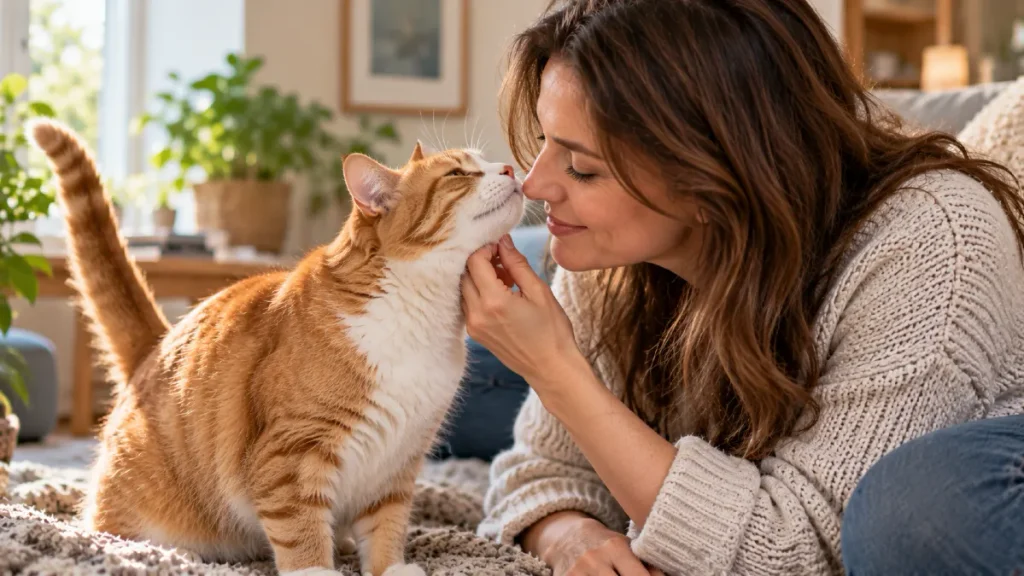
You might think your cat recognizes you mainly by looking at your face. But their senses work differently from yours, and they have several ways to identify someone familiar.
Cats are excellent at detecting movement and seeing in dim light. Their eyes are well suited for watching small animals move, although fine details are generally harder for them to see than for humans.
According to veterinary guidance published by PetMD, objects closer than about 10 inches can become difficult for cats to focus on clearly. This helps explain why your cat sometimes sniffs around for a treat held right near their face.
But blurry close vision doesn’t mean your cat has no idea who you are. They can combine information from sight, sound, smell, and past experiences.
Your Voice May Tell Your Cat More Than You Think
In 2013, researchers Atsuko Saito and Kazutaka Shinozuka studied whether cats could recognize their owners’ voices. Their findings, published in Animal Cognition, showed that cats could tell familiar owner voices apart from strangers’ voices.
The cats often responded by moving their ears or heads rather than running toward the speaker. So your cat might hear you perfectly well without making a dramatic effort to greet you.
Researchers have also examined how cats identify familiar human scents. A 2025 study published in PLOS One found that cats spent more time sniffing unfamiliar human odors than familiar ones.
This suggests that smell helps cats tell familiar people from strangers. Other research has also found that some cats can connect a familiar person’s voice with their face.
The Different Clues Your Cat Uses to Recognize You
Your cat gathers information through several senses rather than depending on a single one. Knowing this can help you communicate more comfortably with them.
| Sense | What it helps detect | What you can do |
|---|---|---|
| Hearing | Familiar voices and sounds | Speak in a calm voice |
| Smell | Familiar human scents | Let your cat sniff you |
| Vision | Faces, shapes, and movement | Approach calmly |
| Touch | Physical contact and handling | Use gentle movements |
| Daily patterns | Familiar activities and timing | Keep routines steady |
These clues work together to create a familiar experience for your cat. Your voice, movements, and scent can all help them identify you.
So when your cat looks away while you’re speaking, don’t assume they have forgotten who you are. They may already recognize you without needing to stare at your face.
Why Your Cat Has a Special Meow Just for You
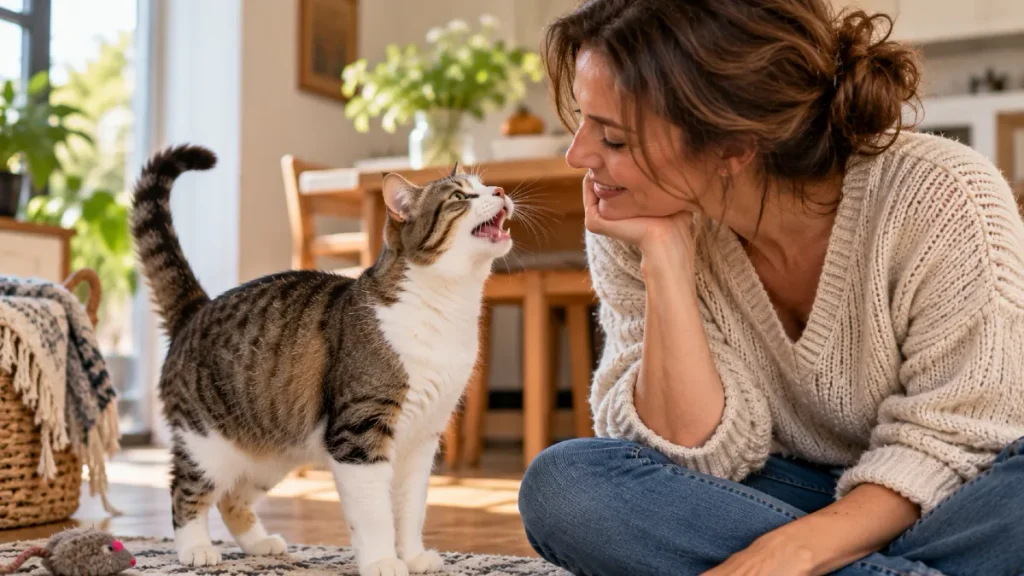
Have you noticed that your cat makes different sounds depending on what they want? The noise they make near their food bowl may sound very different from the soft greeting they give when you come home.
That’s because adult domestic cats often use meowing when communicating with humans. They rely heavily on body language, scent, and other signals when interacting with fellow cats.
VCA Animal Hospitals explains that kittens meow to communicate with their mothers. Adult cats can continue using meows, especially during interactions with people.
This doesn’t mean adult cats never meow at each other. But human directed meowing is a common and important part of how pet cats communicate.
Why Your Cat’s Meows Change Around You
Over time, your cat can learn that certain sounds get certain responses. If a meow near the kitchen makes you prepare dinner, your cat may repeat that sound when they’re hungry.
John Bradshaw has discussed how cats learn what works with different people. One family member might respond quickly to a morning meow, while another might ignore it.
Your cat can learn these patterns through everyday experience. However, that doesn’t mean every meow has a fixed meaning like a word in human language.
Consider a cat standing beside a closed bedroom door. They might meow while looking at the handle because they want access to the room.
That same cat might make a short sound while walking toward you with an upright tail. The situation suggests a different purpose, even if the sounds seem similar.
The best way to interpret a meow is to look at what your cat is doing while making it. Check their posture, surroundings, and normal routine before deciding what they need.
If your cat suddenly becomes much louder than usual, though, don’t assume they’re simply asking for attention. Changes in vocal behavior can sometimes point to stress, pain, or another health problem.
How You Become the Person Your Cat Feels Safe Around
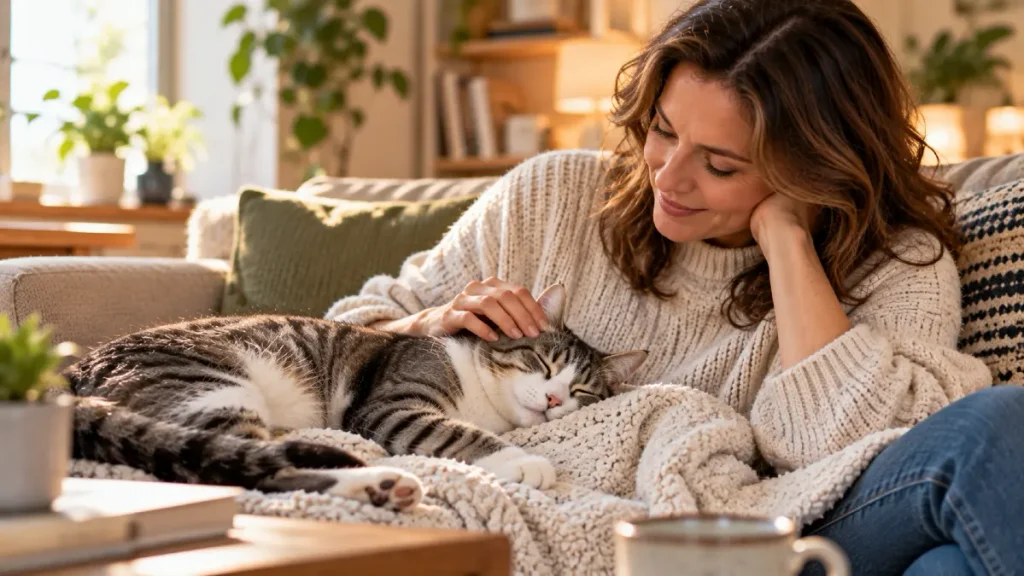
One of the most meaningful things you can offer your cat is a sense of safety. And research suggests that familiar people may play a much larger role in that feeling than we once thought.
In 2019, researchers at Oregon State University studied attachment behaviors in cats. Their findings were published in the scientific journal Current Biology.
The researchers placed cats in an unfamiliar setting and observed their behavior during periods with and without their caregivers. They also watched how the animals responded when their people returned.
Among 70 kittens whose attachment patterns could be classified, 64.3% showed behaviors categorized as secure attachment. A smaller group of adult cats showed a similar pattern.
In the study, securely attached cats generally used their caregivers as a source of comfort while exploring an unfamiliar place. Their behavior suggested that familiar people could help them feel more secure in a stressful setting.
What Secure Attachment Can Look Like at Home
Think about what happens when an unfamiliar visitor enters your house. Your cat might become cautious, watch from a distance, or retreat to a quiet corner.
Later, when the house becomes calm again, they may come out and settle near you. Your familiar presence may be one of several things helping them feel comfortable.
You might also notice your cat choosing to sleep near your desk, following you into another room, or resting in a favorite spot while you’re nearby. These behaviors can be linked to familiarity, social interest, and comfort.
However, they don’t prove your cat has a particular attachment style. Scientists are still studying how best to measure attachment in cats.
A 2025 study published in Applied Animal Behaviour Science questioned whether some cat behaviors should be described using the same attachment model developed for human infants. This reminds us that feline relationships are real but may not work exactly like human relationships.
What New Research Reveals About Cat Stress
Research published in the Journal of Feline Medicine and Surgery in August 2026 examined how different human interactions affected cats.
The researchers studied 20 pet cats and measured hormones linked with stress and social bonding. They compared interactions in which cats had more freedom with situations involving forced contact.
Passive interactions were linked with increased oxytocin and reduced cortisol, while forced interactions showed the opposite pattern. The findings suggest that letting cats control contact may support their comfort.
Because the study involved a small group, it cannot tell us exactly how every cat will respond. Still, it adds to the evidence that your cat’s preferences matter.
This is why a quiet moment beside you can be meaningful. Your cat may feel comfortable simply sharing space without being picked up or constantly touched.
And that may be one of the clearest ways your relationship works. You don’t always need to entertain your cat or shower them with affection to be important to them.
Sometimes being familiar, predictable, and gentle is enough.
Why Your Cat Can Love You Without Wanting to Be Held
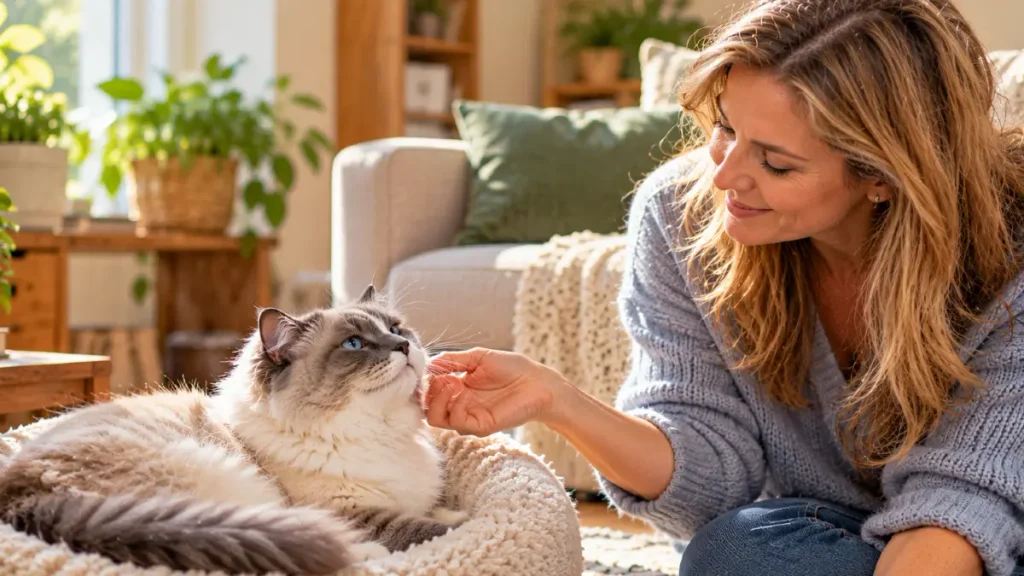
Does your cat follow you everywhere but pull away when you try to pick them up? That can feel confusing when you’re hoping for a cuddle.
But cats don’t all enjoy the same kind of physical affection. Some love sitting on laps, while others prefer lying nearby without being touched.
Their preferences can depend on personality, early experiences, health, and how comfortable they feel being handled. Even a friendly cat may dislike being restrained.
A cat that chooses to sit beside you may be showing social interest without asking for a hug. If you respect that choice, you make future interactions more comfortable.
How to Tell When Your Cat Wants Attention
The easiest way to build trust is to notice what happens before, during, and after physical contact. A cat that repeatedly moves closer may be interested in interacting.
But if they turn away, tense their body, or flick their tail sharply, it’s better to stop. Continuing to pet a cat that wants space can lead to stress or defensive behavior.
The table below shows how to respond to common situations without forcing affection.
| Your cat’s behavior | What to check | Your response |
|---|---|---|
| Approaches with relaxed body | Interest in contact | Offer your hand |
| Pushes head into your hand | Enjoyment of touch | Pet gently |
| Turns away during petting | Wants a break | Stop touching |
| Hides from visitors | Fear or stress | Provide a safe retreat |
| Struggles when lifted | Dislikes restraint or feels pain | Put them down safely |
Your cat doesn’t have to enjoy being carried to have a strong bond with you. They may feel more comfortable choosing when to come close.
This matters especially with shy cats or cats that have had frightening experiences. Giving them control can make interactions feel safer.
It also helps to remember that sudden sensitivity to touch can have a medical cause. If your normally affectionate cat starts avoiding contact or reacts painfully, arrange a veterinary examination.
Trust grows when your cat learns that you will respect their signals. Letting them walk away can be just as helpful as offering affection when they ask for it.
How to Become Someone Your Cat Trusts Every Day
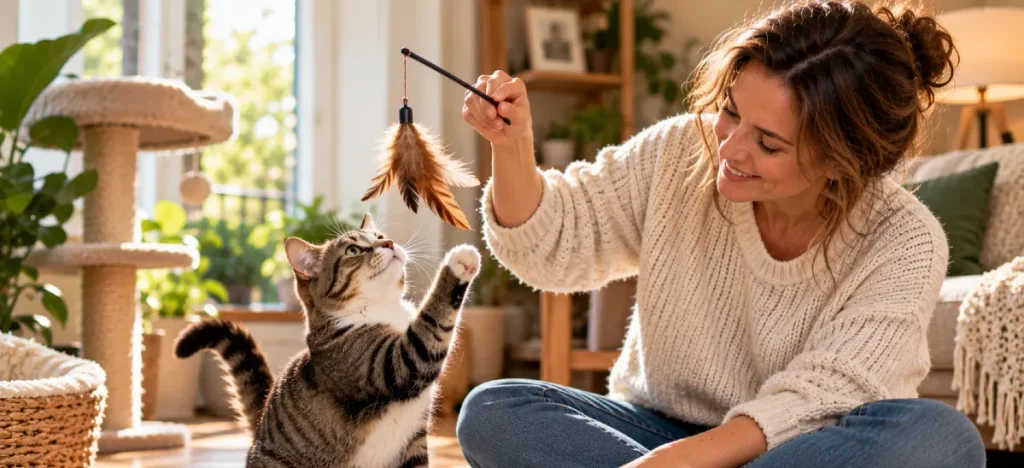
You don’t need expensive toys or constant attention to make your cat feel closer to you. Small, predictable actions can help create a comfortable relationship.
The most helpful approach is to work with your cat’s natural needs instead of expecting them to behave like a dog or a person. That means paying attention to what makes them feel safe.
Make Everyday Life Feel Predictable
Cats often benefit from familiar routines. Regular feeding times, quiet resting areas, and dependable play sessions help make their home feel familiar.
Try to keep major changes gradual whenever possible. If you’re moving furniture, introducing a new pet, or changing their feeding routine, give your cat time to adjust.
Give Them a Healthy Way to Hunt
Your cat may spend much of the day indoors, but their natural drive to stalk and chase hasn’t disappeared. Interactive play gives them a safe outlet for those behaviors.
A wand toy can encourage chasing and pouncing, while puzzle feeders provide a different kind of challenge. Let your cat catch the toy regularly so the game has a satisfying finish.
Let Your Cat Start Some of the Affection
Instead of reaching for your cat every time they walk past, sometimes allow them to approach you first. Offer your hand and wait to see whether they move closer.
If they rub against you, try gentle strokes around the cheeks or head. Stop after a short time and see whether they ask for more.
You can also try slowly blinking at your cat when they’re relaxed. Avoid staring directly into their eyes for long periods, since an intense stare can be uncomfortable.
Create Places Where Your Cat Can Relax
Every cat needs somewhere they can retreat without being disturbed. A quiet bed, covered hiding spot, or sturdy cat tree can provide that option.
Try placing resting areas where your cat already likes spending time. Give them choices rather than forcing them to use a particular bed or room.
Don’t pull your cat out of hiding simply to make them socialize. Allowing them to leave their retreat when they feel ready is usually a better approach.
Know When Behavior Changes Need Attention
Your cat’s normal habits can help you spot when something isn’t right. A sudden change in appetite, litter box use, activity, grooming, or social behavior deserves attention.
Cats Protection advises owners to seek veterinary guidance when a cat’s behavior changes unexpectedly. A cat that becomes withdrawn or unusually vocal may be stressed, uncomfortable, or unwell.
Don’t treat every behavior change as a message about your relationship. Sometimes your cat needs medical care rather than more affection.
By responding to your cat’s needs with patience, you help make everyday life more comfortable. And over time, those positive experiences can support a closer relationship.