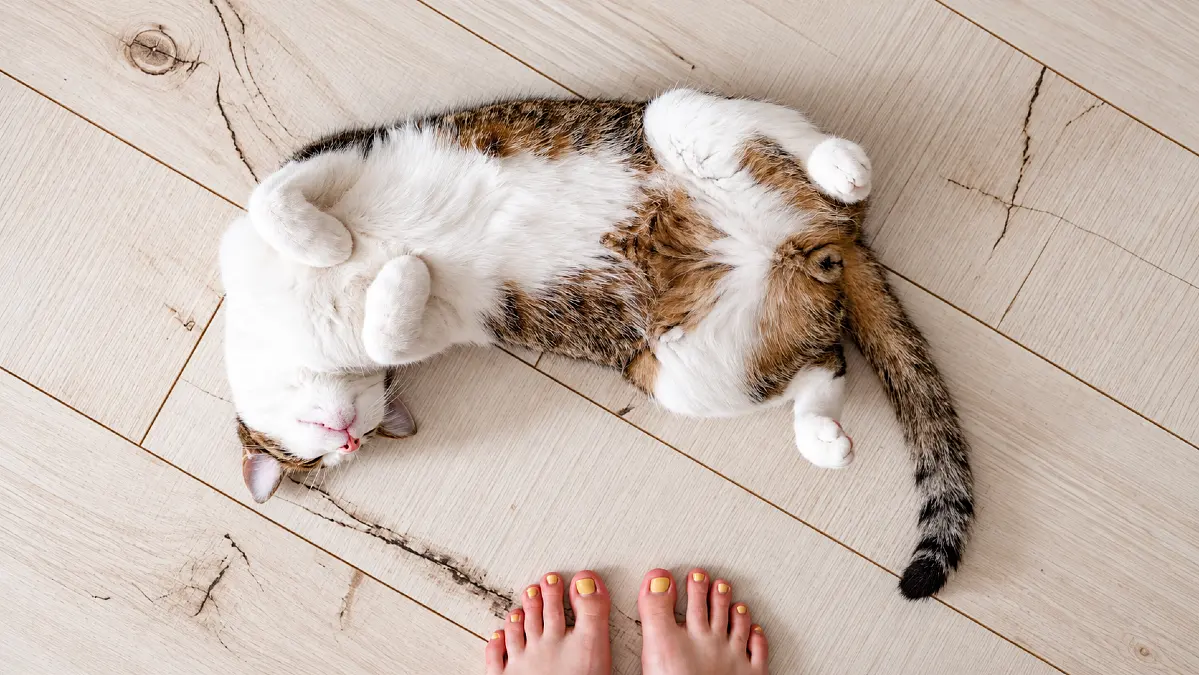
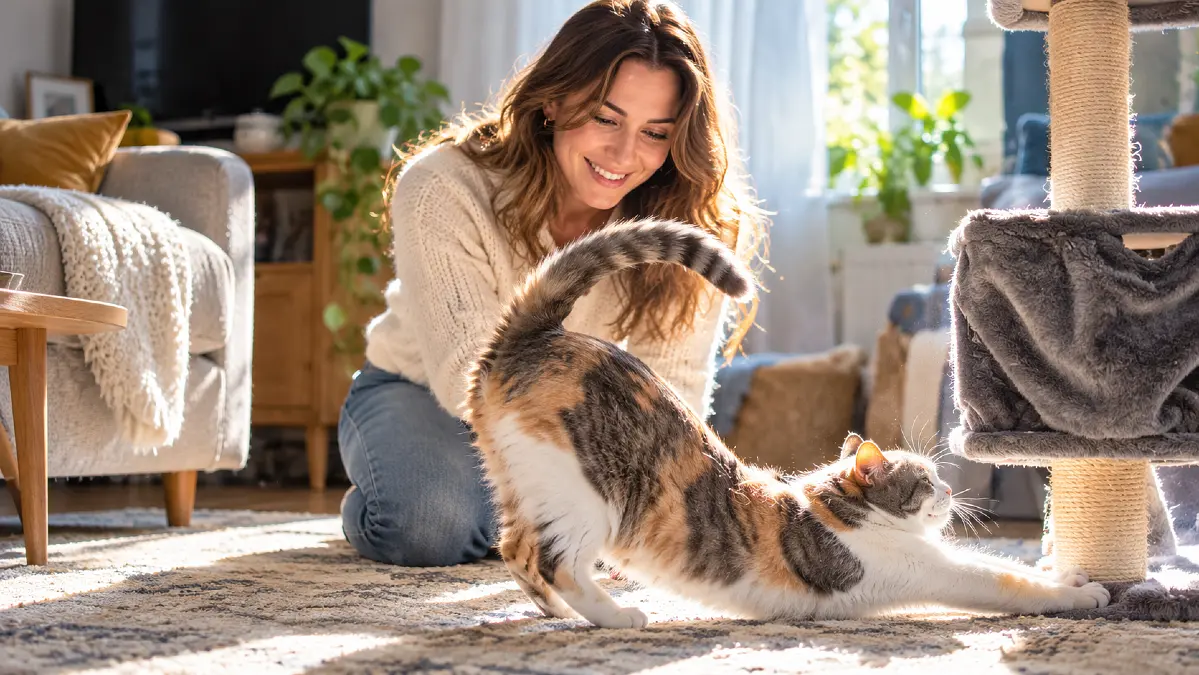
Have you ever walked into a room and watched your cat suddenly stretch its front paws, lift its back, and look straight at you? It seems like a simple movement, but the timing makes you wonder. Why does your cat do it right when you appear?
You might think your cat is just waking up or loosening its muscles. But what if that stretch is also part of the way your cat welcomes you? Cats communicate through small movements, and some of their most meaningful behaviors are easy to miss.
The interesting part is that a cat stretching when they see you can be connected to comfort, social interest, or a familiar routine. Sometimes several of these things happen together.
Researchers have even observed cats stretching more when reunited with their owners after spending time apart. However, the full meaning depends on what happens before and after the movement.
Why Your Cat’s Stretch Can Be a Quiet Greeting
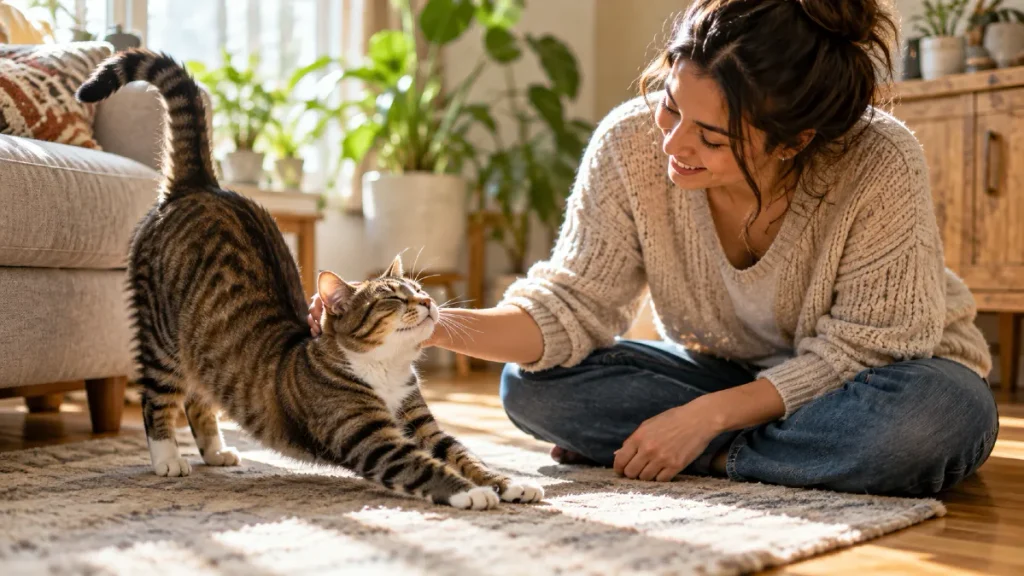
When your cat sees you and immediately stretches, you might be watching part of a friendly greeting. Cats do not always greet people with loud meows or excited movements. Sometimes their response is much quieter.
Picture your cat resting peacefully on the couch. You walk into the living room, and your cat lifts its head, stretches its front legs, and slowly gets up to approach you. That sequence may suggest your arrival has caught its attention.
The stretch itself still serves a physical purpose. But the movements that follow can tell you whether your cat also wants social contact.
Cats Protection explains that relaxed body posture, soft eyes, forward ears, and friendly tail movements can help identify a comfortable cat. These clues become especially useful when your cat stretches upon seeing you.
How to Tell Whether the Stretch Is Part of a Greeting
One movement rarely tells the whole story. Watch what your cat does immediately afterward, because those extra signals provide useful clues.
| What You Notice | Possible Meaning | What You Should Do |
|---|---|---|
| Soft eyes and relaxed ears | Comfortable and calm | Speak gently |
| Tail held upright | Friendly interest | Allow an approach |
| Rubbing against your legs | Social contact or scent marking | Offer gentle attention |
| Stretching after a nap | Normal physical movement | Allow time to wake |
| Tense body and flat ears | Possible discomfort or fear | Give your cat space |
A relaxed stretch followed by a friendly approach is more meaningful than stretching alone. If your cat walks toward you afterward, the behavior may be part of its usual greeting.
The important clue is what happens next. Your cat might be stretching its muscles and showing interest in you at the same time.
Why Your Cat May Stretch the Moment You Walk In
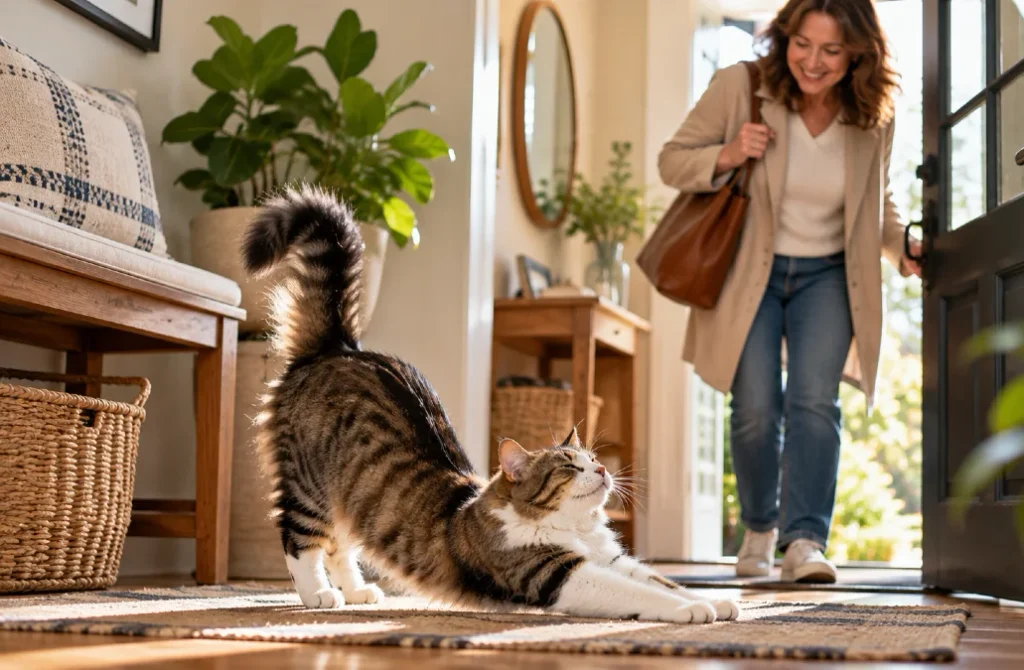
Have you noticed that your cat seems to stretch at the exact moment you return home? This timing can make the movement feel personal. And there is some research that makes the connection worth exploring.
A study published in PLOS ONE in 2017 examined how 14 household cats behaved after spending different amounts of time away from their owners. Researchers Matilda Eriksson, Linda J. Keeling, and Therese Rehn compared reunions after 30 minutes and four hours of separation.
The cats showed more body stretching and purring when their owners returned after the longer period. This suggested that the return of a familiar person could influence their behavior.
However, the researchers also pointed out another possible explanation. Cats may have rested longer during the extended separation, giving them more reason to stretch when they became active again.
That distinction matters because stretching can be both a natural physical action and part of a social moment. There is no need to choose only one explanation.
For example, your cat might sleep in its favorite chair while you are away. When you open the door, your arrival causes it to get up, stretch, and walk toward you.
The stretch helps your cat prepare to move, while its approach suggests an interest in greeting you. Both behaviors can happen within seconds.
There is also no solid evidence that domestic cats developed a special stretching movement meant only for humans. Cats naturally stretch in many situations, whether people are nearby or not.
What makes the moment interesting is the combination of timing, body language, and your cat’s response to your presence.
So the next time your cat stretches when you walk through the door, watch what happens afterward. You may notice a familiar greeting routine that has been happening for years without you realizing it.
What Your Cat’s Paws May Be Communicating During a Stretch
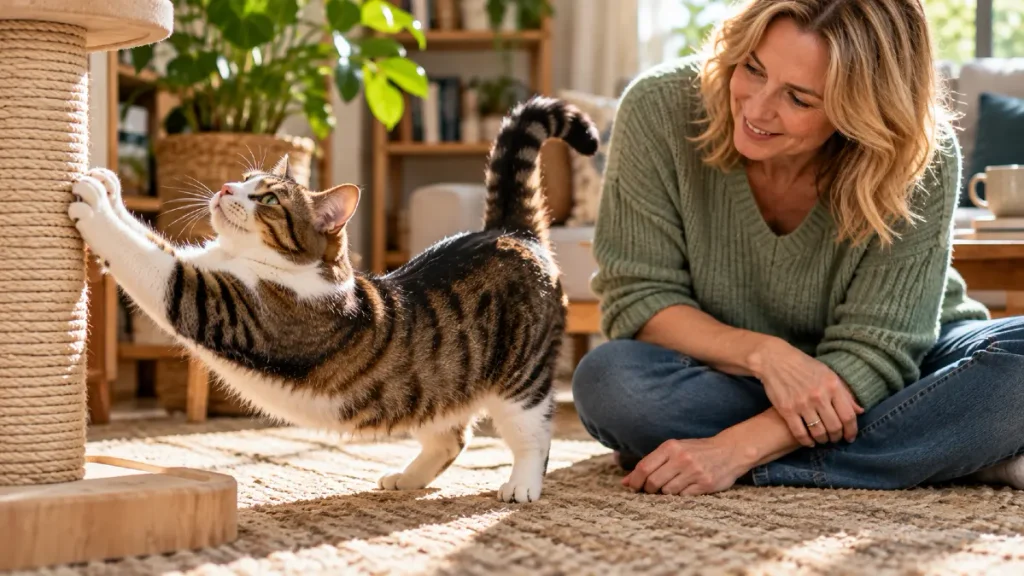
There is another interesting detail hidden in your cat’s paws. Cats have scent glands between their paw pads, and they use scent as one way to communicate with their surroundings.
According to VCA Animal Hospitals and Cats Protection, scratching can deposit scent from these glands onto surfaces. This helps explain why cats repeatedly scratch certain objects around their homes.
But there is an important difference between scratching and simply stretching. A cat extending its legs does not automatically mean it is deliberately leaving a scent mark.
Consider what happens when your cat stretches against the side of your couch. If it extends its claws and actively scratches the fabric, it may be performing several natural behaviors at once.
It is stretching its body, caring for its claws, and leaving scent on a familiar object. Those actions are related, but they do not all happen during every stretch.
How Stretching Differs From Other Paw Behaviors
Cats can use their paws and bodies in several ways. Recognizing the difference helps you avoid giving every movement the same meaning.
| Behavior | Main Function | What to Look For |
|---|---|---|
| Full body stretch | Extending muscles and limbs | Long, smooth extension |
| Kneading | Comfort and familiar behavior | Repeated paw pressing |
| Scratching | Claw care and scent marking | Claws pulling against a surface |
| Cheek rubbing | Social contact and scent marking | Face pressed against an object |
This explains why a stretch beside you and kneading on your lap should not be treated as identical behaviors. Both may happen when your cat feels comfortable, but they involve different movements.
Cornell Feline Health Center also identifies scratching as a natural marking behavior. It is one reason suitable scratching surfaces are important in a cat’s environment.
You can support this behavior by placing a stable scratching post near an area your cat already likes. A cardboard scratching pad can also be useful for cats that prefer horizontal surfaces.
If your cat stretches beside you and then rubs its face against your leg, the rubbing provides stronger evidence of scent marking than the stretch itself.
Your cat may be including you in a familiar social interaction. But it is better to read the full sequence than assume every extended paw carries a hidden message.
Why Your Cat Might Stretch for You but Ignore Someone Else
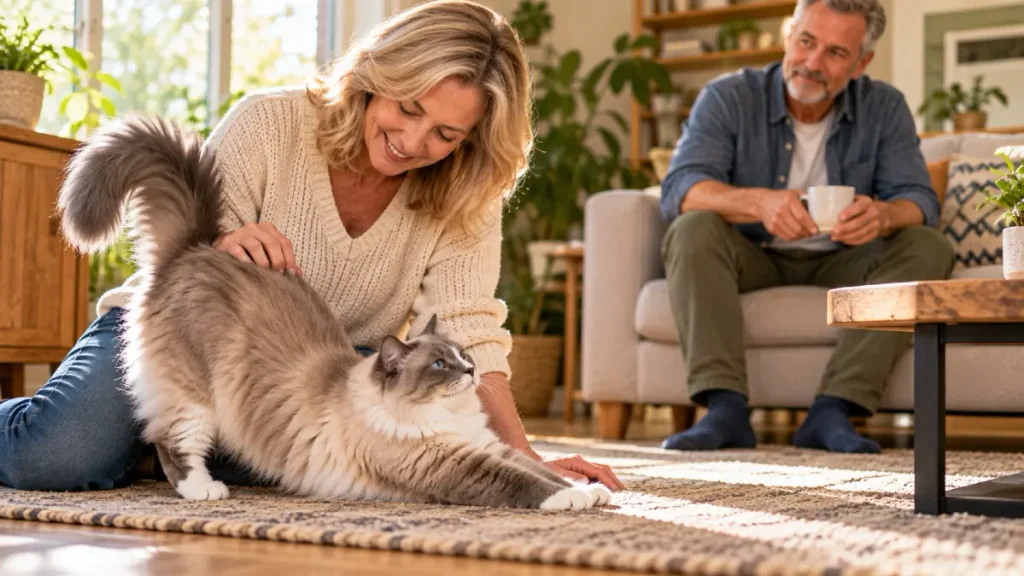
Does your cat greet you with a long stretch while barely reacting to another person in your home? That difference can feel surprisingly personal. You might wonder whether your cat has chosen you as its favorite human.
Cats can develop different relationships with individual people. Their behavior may change depending on how familiar someone is, how that person interacts with them, and what experiences they have shared.
Researcher Dennis C. Turner has reviewed studies of relationships between cats and their owners. His work, published in Frontiers in Veterinary Science, describes how cats respond to individual people and how the way humans interact with cats can shape those relationships.
For example, your cat may feel comfortable around someone who speaks softly and waits for it to approach. Another person who frequently picks it up without warning may receive a different response.
This does not mean a stretch is a reliable way to rank the people your cat loves most. Researchers have not established stretching frequency as a test of who holds the highest place in a cat’s social circle.
Still, repeated patterns can tell you something useful about your own cat.
If your cat regularly stretches, approaches you with an upright tail, and settles beside you, those behaviors may suggest it feels comfortable interacting with you.
You can encourage that comfort by respecting its choices. Let your cat approach when it wants attention, and avoid forcing physical contact.
The same rule applies if your cat seems more affectionate with somebody else. A relationship with a cat can grow through calm, predictable, positive interactions.
And remember, affection does not always look like cuddling. Some cats prefer sitting nearby, watching their owners, or quietly sharing the same room.
What Your Cat’s Morning Stretch Really Means
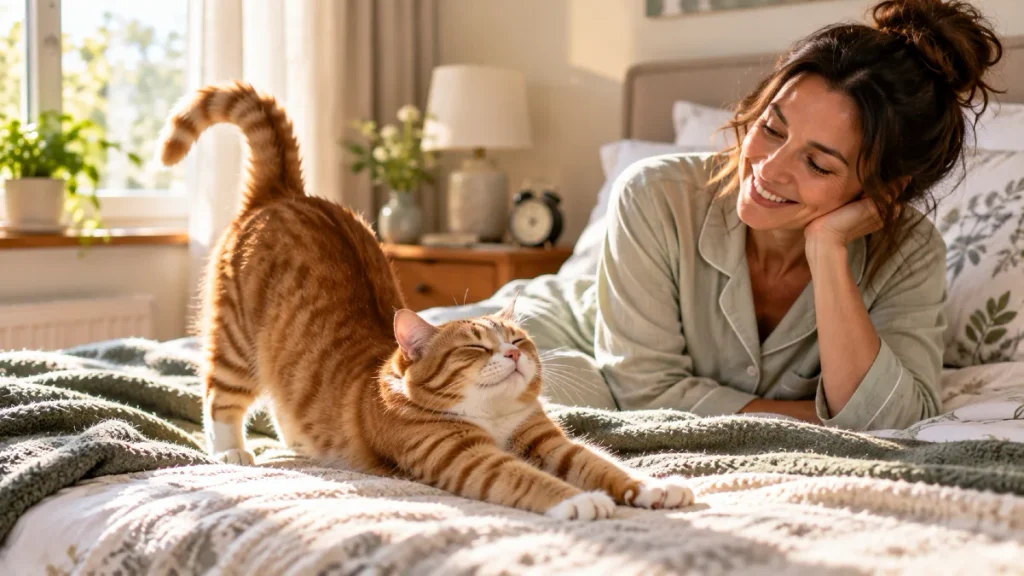
You wake up, open your eyes, and find your cat sitting beside the bed. The moment you move, it stretches its front paws, arches its back, and walks closer.
It can almost seem as though your cat has been waiting for you. But morning stretching usually has a much simpler explanation.
Cats often become active around dawn and dusk. Their natural activity patterns mean they may be resting or waking at different times throughout the night.
Stretching after a period of rest is normal. Your cat may extend its legs, back, and shoulders before walking, playing, or looking for breakfast.
Your movements can also act as a familiar morning cue. When you sit up, speak, or get out of bed, your cat may recognize that its daily routine is starting.
This can create a sweet greeting ritual. Your cat stretches, walks toward you, rubs against the bed, or follows you into the kitchen.
However, there is no good evidence that cats deliberately save their stretches until their owners wake up. It is also not proof that your cat spent the night guarding you.
A more reasonable explanation is that your cat connects your waking movements with familiar activities. Those activities may include breakfast, attention, or play.
If your cat approaches with a relaxed body and friendly tail position, the moment may include social interest too. You can enjoy that connection without assigning it a complicated hidden meaning.
Your cat’s morning stretch may be ordinary physical movement mixed with a familiar greeting. That combination can still be a lovely part of living together.
Why Your Cat Stretches Right in Front of Your Feet
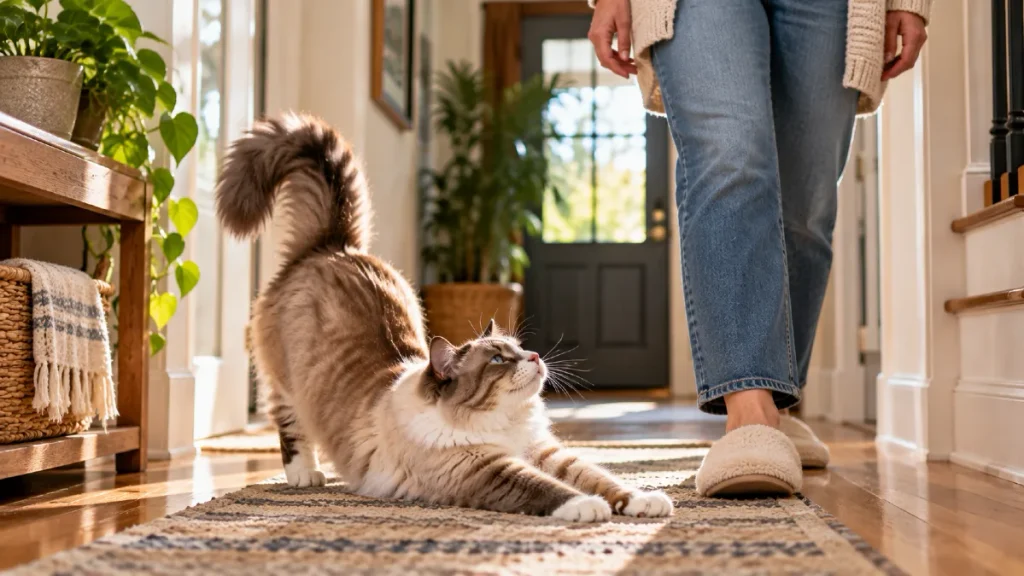
You are walking toward the kitchen when your cat suddenly stops in front of you. Before you can move around it, your cat lowers its chest, stretches its front legs, and takes up the space where you planned to step.
You might wonder whether your cat is trying to stop you on purpose. Sometimes, that possibility is worth considering.
Cats become familiar with household routines. They can learn where people walk, where food is served, and which activities usually lead to attention.
Battersea Dogs & Cats Home explains that cats seeking interaction may follow people, rub against their legs, or move around them. These behaviors can be particularly noticeable when a cat expects something enjoyable.
If your cat repeatedly stretches in a busy doorway and then looks up at you, it may be responding to a familiar situation. Perhaps you often stop to speak to it in that location.
Over time, your cat may learn that being near your path creates another chance for interaction. But that does not prove the stretch itself is a planned attempt to control you.
The cat may simply have chosen a familiar place to rest or stretch. Your arrival then turns an ordinary movement into a social encounter.
Pay attention to what follows. Does your cat rub against your legs, walk toward its food bowl, or lead you toward a favorite toy?
Those actions may help explain what it wants.
If your cat stretches directly in front of your feet, stop long enough to avoid stepping on it. Speak calmly and allow it to move before continuing.
You can also encourage your cat to use a comfortable resting place away from crowded walking areas. This helps prevent accidents without discouraging friendly interaction.
The next time your cat seems to block your path, look beyond the stretch. Its behavior afterward may tell you whether it wants food, attention, or simply a comfortable place to relax.
What It Means When Your Cat Never Stretches Around You
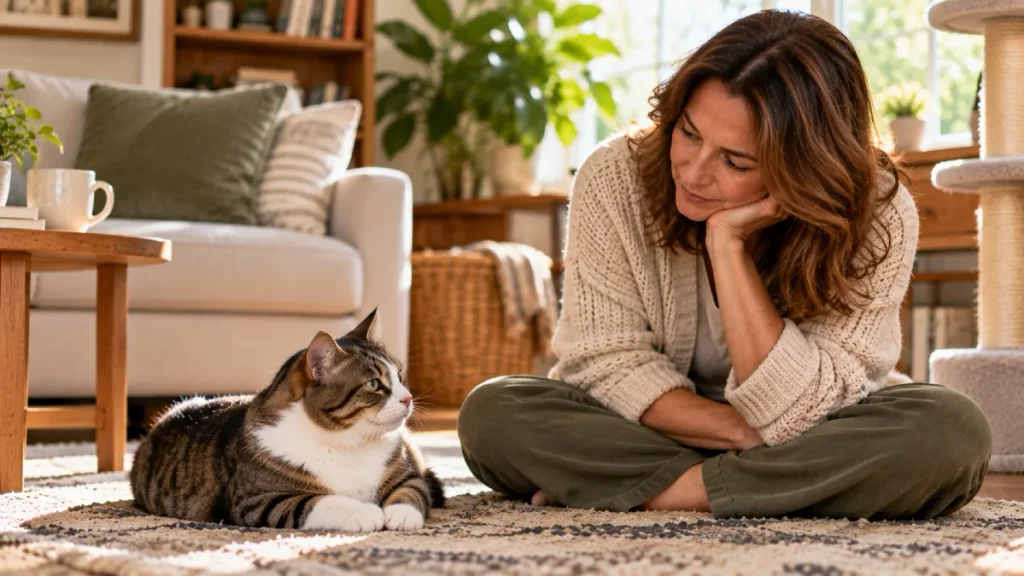
What if your cat never stretches when you enter a room? Does that mean it does not trust you, or that something is missing from your relationship?
No. The absence of a greeting stretch does not mean your cat dislikes you. Cats express comfort and affection in different ways, and stretching is not a required sign of a close bond.
Some cats greet their owners by walking toward them with an upright tail. Others use small vocal sounds, cheek rubbing, slow blinking, or simply choosing to rest nearby.
Your cat may also prefer stretching when it is alone. That can be part of its normal behavior rather than a reflection of how it feels about you.
It is important to consider your cat’s usual habits before drawing conclusions. A cat that has never stretched during greetings is very different from a cat that suddenly stops moving normally.
When a Change in Stretching Might Need Attention
Cats Protection warns that changes in movement can sometimes reveal pain, including arthritis. This can be especially relevant for older cats that become less active or develop stiffness after resting.
| Situation | Possible Concern | Best Response |
|---|---|---|
| Never stretches during greetings | Individual habit | Observe other friendly signs |
| Stretching less than usual | Possible mobility change | Monitor and contact your vet |
| Stiff after resting | Possible joint discomfort | Arrange a veterinary examination |
| Avoiding jumps or stairs | Possible pain | Seek veterinary advice |
| Hiding and moving less | Stress or illness | Contact your vet |
These differences help you decide when observation is enough and when a health check is needed. A sudden change in your cat’s normal movement deserves more attention than the absence of one greeting habit.
Arthritis can be difficult to recognize in cats because they often hide discomfort. Cats Protection identifies reduced jumping, slower movement, difficulty grooming, and stiffness after rest as common warning signs.
For example, an older cat that previously stretched and jumped onto the sofa may begin hesitating before climbing. You might also notice that it sleeps in easier places to reach.
Those changes are worth discussing with your veterinarian. Do not assume your cat has become less affectionate when physical discomfort could be involved.
On the other hand, if your cat has always been quiet but eats, plays, moves comfortably, and seeks your company, there may be nothing concerning about its stretching habits.
Focus on the full picture of your cat’s behavior. One missing movement cannot tell you whether your relationship is strong or weak.
How to Respond When Your Cat Stretches to Greet You
When your cat stretches after seeing you, your response can turn the moment into a pleasant interaction. The important part is allowing your cat to decide whether it wants contact.
Start with a calm greeting. Say something softly and give your cat a chance to approach rather than immediately reaching down to pick it up.
You can also try a slow blink. Research published in Scientific Reports in 2020 found that cats responded to slow blinking from people, suggesting this behavior can support positive communication.
Look at your cat with relaxed eyes, slowly close them, and open them again. Avoid staring directly or leaning over your cat, especially if it seems uncertain.
If your cat walks toward you, offer your hand at a comfortable distance and allow it to decide whether to come closer. Gentle attention around the cheeks or head may be welcome if your cat normally enjoys being touched there.
However, a stretch is not permission for a belly rub. Even a cat that rolls onto its back may prefer to be admired without being touched.
You can also encourage positive interactions by making time for short play sessions. A wand toy can offer an enjoyable way for your cat to spend time with you while remaining in control of its movements.
The goal is not to make your cat stretch more often. It is to recognize when your cat seems interested in connecting and respond in a way that feels comfortable for both of you.
Over time, you may notice other small greeting behaviors that you previously overlooked. Those patterns can reveal far more about your relationship than any single movement.