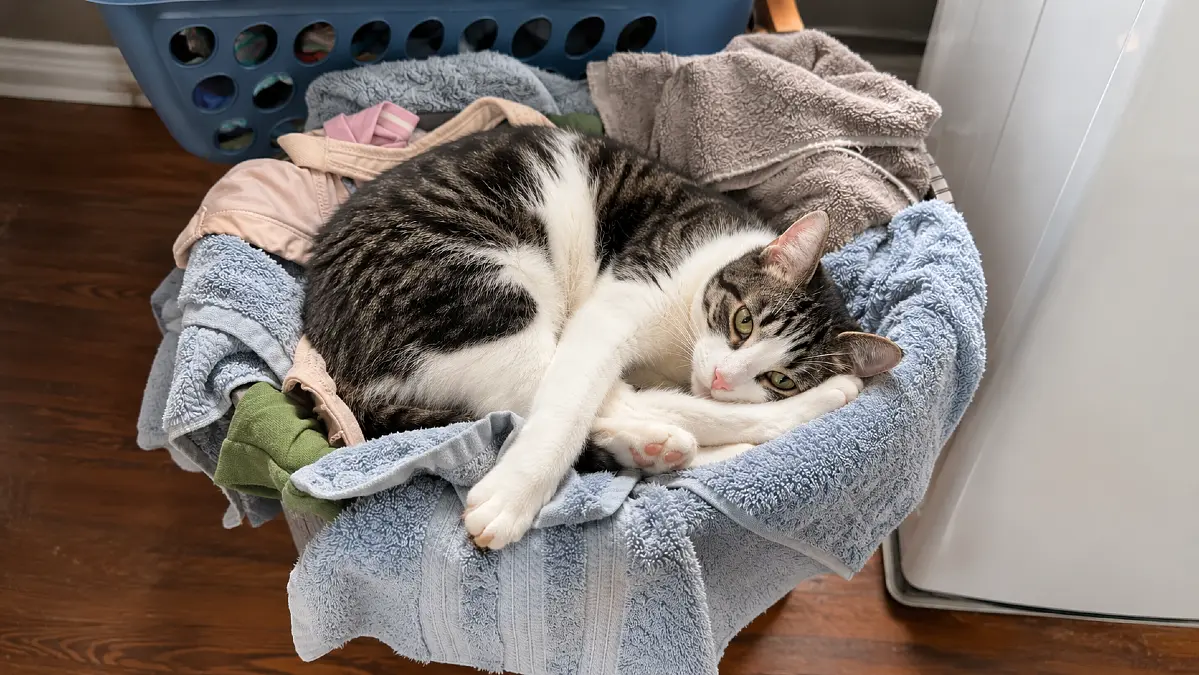
You just finished sorting your laundry when you notice something familiar. Your cat is curled up on your worn T-shirt, sleeping like it found the most comfortable bed in the house.
Meanwhile, the soft cat bed you bought sits completely empty. You cannot help wondering why your cat would choose sweaty clothes over a perfectly good place to sleep. If your cat sleeps on your dirty laundry, there is often a surprisingly sweet reason behind it. Your worn clothes carry familiar scents that may make your cat feel comfortable and secure.
Cats experience their surroundings through smell in ways humans often miss. Your clothing holds traces of your natural body scent, while a loose pile of fabric offers a soft place to rest.
Why Does Your Cat Feel Safe Sleeping on Your Dirty Laundry?
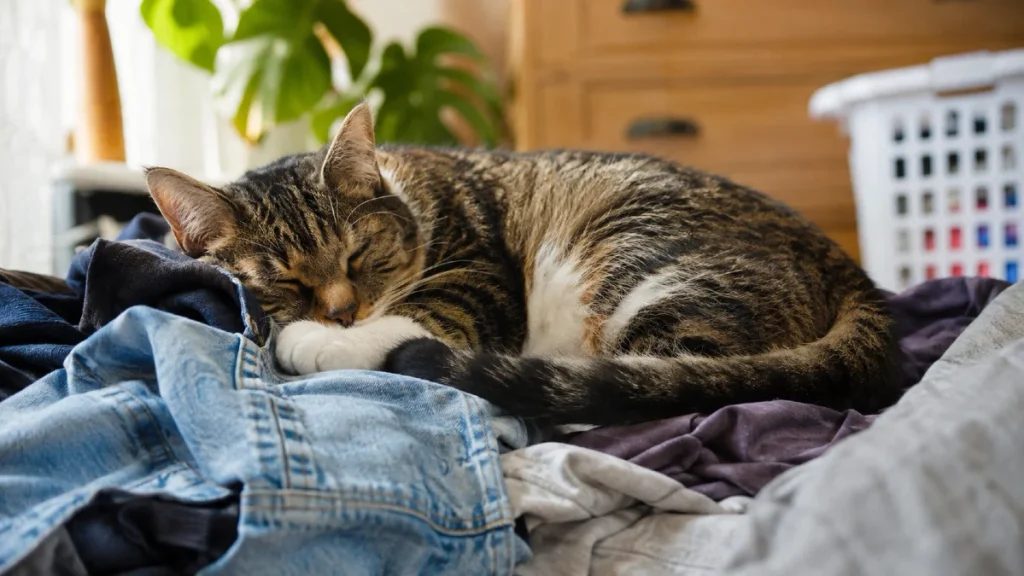
Your dirty clothes carry something your cat knows well: your scent. While you may notice that a shirt needs washing, your cat may notice the familiar smell of someone it spends time with every day.
Cats rely heavily on smell to gather information about their surroundings. Familiar odors can help them recognize places, objects, and other animals they have encountered before.
According to Cats Protection, familiar scents are important when helping cats settle into a new home. The organization even recommends using clothing that smells like a familiar person to make a new environment feel more welcoming.
Your Cat Can Tell Familiar Smells Apart
Research gives us a clearer picture of how cats respond to human scents. A study published in PLOS One in May 2025 examined how 30 domestic cats reacted to odors from their owners and unfamiliar people.
The cats spent longer investigating unfamiliar human odors than those from their owners. This suggests they can distinguish between familiar and unfamiliar human scents, although the study did not prove that cats can identify a specific person by smell alone.
That finding helps explain why your worn sweatshirt might catch your cat’s attention. Its familiar smell is one possible reason your cat chooses it over a freshly washed blanket.
Your Clothes Can Become Part of Your Cat’s Familiar Space
Cats also leave their own scents on objects by rubbing their cheeks, faces, and bodies against them. This behavior helps create a familiar scent environment around their favorite places.
When your cat rubs against your shirt before lying down, it may be adding its own scent to fabric that already smells familiar. Your clothing then becomes another object within your cat’s regular resting space.
The important point is that familiar smells may support a sense of comfort. Your cat choosing your laundry can be a positive sign, especially when it appears calm and relaxed.
Why Does Your Cat Prefer Dirty Clothes Over Clean Laundry?
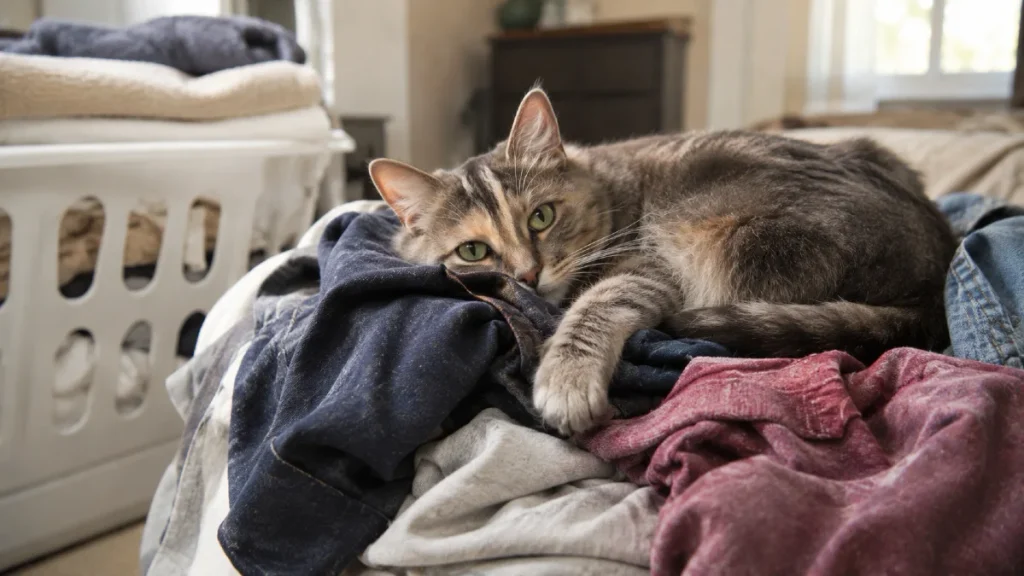
Your cat may prefer worn clothes because they offer a mix of familiar smells, soft fabric, and a convenient sleeping surface. The word “dirty” means something different to your cat than it does to you.
A shirt you wore all afternoon carries traces of your body scent. A freshly washed shirt may smell more strongly of detergent or fabric softener, which can make it less familiar.
However, scent is not the only reason cats select certain resting places. Some cats may simply like the texture of a cotton shirt or the shape of a pile of clothing.
Why Soft Laundry Piles Make Appealing Beds
A loose pile of shirts can create a soft surface that lets your cat settle into a comfortable position. The folds may also offer a little enclosure, especially when the pile sits in a quiet corner.
A warm towel recently removed from the dryer may be appealing for a different reason. Cats often seek comfortable, warm resting spots, so the fabric itself may matter more than who wore it.
Here is how different laundry spots may appeal to your cat.
| Laundry Spot | Possible Appeal | What to Notice |
|---|---|---|
| Worn cotton shirt | Familiar human scent | Often chosen after you wear it |
| Freshly washed towel | Soft texture | Chosen even without your scent |
| Warm folded laundry | Comfortable warmth | Preferred while still warm |
| Open laundry basket | Soft, partly enclosed space | Cat curls inside the pile |
These differences can help you identify what your cat actually prefers. If it sleeps on almost any soft fabric, comfort may be the main attraction.
If it repeatedly picks your worn shirts over similar clean ones, familiar scent may play a larger role. Both reasons can exist at the same time, so there is no need to choose just one explanation.
Does Sleeping on Your Clothes Mean Your Cat Loves You?
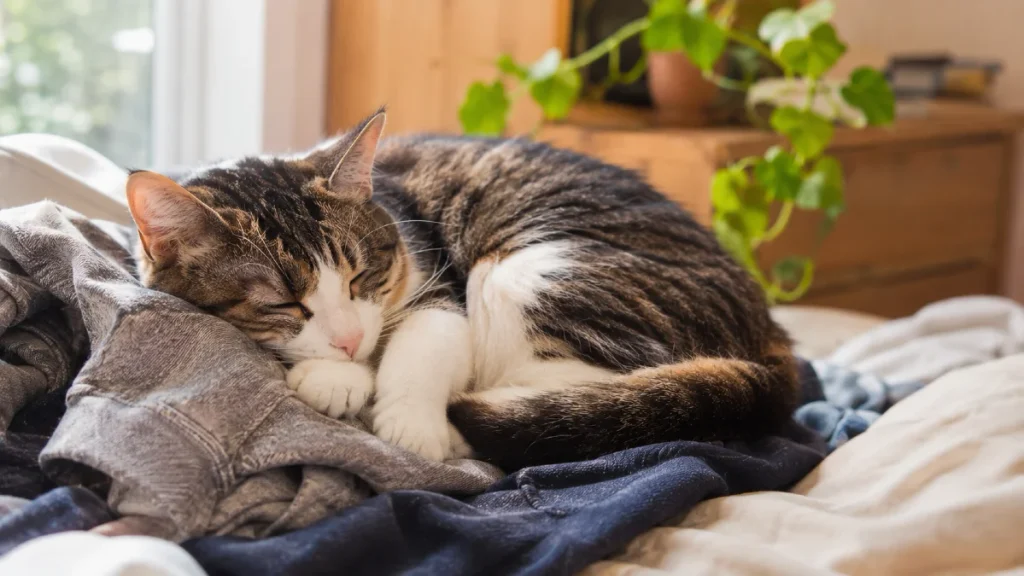
Finding your cat asleep on your clothes can feel like a small compliment. And in many cases, it fits with the behavior of a cat that feels comfortable around you.
However, sleeping on your clothes does not prove love by itself. Cats choose resting places for several reasons, and the same behavior can mean different things depending on the cat.
A cat that enjoys your company may also find your familiar scent pleasant. But a soft pile of laundry can be attractive even when affection has little to do with the choice.
Look for Other Signs That Your Cat Trusts You
Rather than judging your cat’s feelings from one sleeping habit, pay attention to how it behaves around you throughout the day. A relaxed cat often shows several friendly behaviors in different situations.
You might notice your cat:
- Rubbing its cheeks or body gently against you.
- Resting nearby with loose, relaxed muscles.
- Giving you slow blinks when it feels comfortable.
- Approaching you willingly for attention.
- Sleeping peacefully in your presence without appearing alert or tense.
Cats Protection explains that these behaviors can be associated with comfort and friendly interactions. When your cat regularly shows them, sleeping on your clothes may fit into a broader pattern of trust.
Your Scent Cannot Replace Your Presence
There is an important difference between recognizing your scent and finding it calming in every situation. A study published in Applied Animal Behaviour Science in 2021 explored whether an object carrying an owner’s scent could help cats during a brief stressful experience.
The researchers found that the scented object alone did not provide the same comfort as the owner’s presence. This means leaving a worn shirt with your cat should not be treated as a guaranteed solution for anxiety.
Still, a familiar shirt may be a pleasant addition to your cat’s normal resting area. Think of it as something your cat might enjoy, rather than something every cat needs.
How Can You Tell Whether Your Cat Is Comfortable or Stressed?
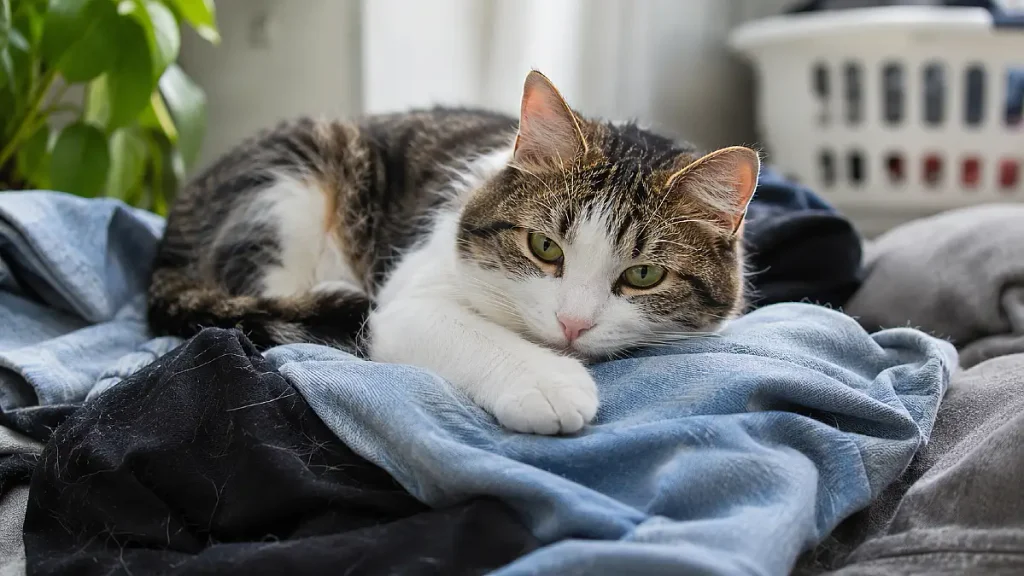
Your cat’s body language is one of the best clues to how it feels while resting on your laundry. A comfortable cat usually looks physically relaxed, while an anxious cat may remain tense even when lying still.
For example, a cat stretched across your sweatshirt with soft eyes and loose paws is probably comfortable. A cat crouched tightly in a laundry basket with flattened ears may be using the space to hide.
The RSPCA and Cats Protection both recommend looking at the whole body rather than focusing on one action. Ear position, muscle tension, movement, and changes in daily habits all provide useful clues.
Check the Rest of Your Cat’s Behavior
A cat that sleeps on your clothes and then eats, plays, grooms, and uses its litter box normally is generally less concerning than a cat showing several changes at once. The sleeping location alone cannot tell you whether your cat feels anxious.
Use this comparison to decide what deserves closer attention.
| Behavior | Possible Meaning | What You Should Do |
|---|---|---|
| Loose body and soft eyes | Relaxed and comfortable | Let your cat rest |
| Gentle cheek rubbing | Familiarity or scent marking | Allow the behavior |
| Tight crouch and flat ears | Fear or discomfort | Give your cat space |
| Hiding more than usual | Possible stress or illness | Watch for other changes |
| Sudden change in daily habits | Possible health concern | Contact your veterinarian |
A single behavior is rarely enough to explain everything your cat is feeling. Look for patterns and consider whether anything recently changed in the home.
Household Changes Can Affect Resting Habits
A new pet, unfamiliar visitors, building noise, or a change in your schedule may affect where your cat chooses to rest. Some cats seek quieter, more familiar places when their environment changes.
If your cat begins spending more time on your clothing during such a period, try offering extra resting choices. Keep feeding, play, and other daily routines as predictable as possible.
If the behavior comes with constant hiding, poor appetite, or other unusual signs, speak with your veterinarian. A cat that suddenly seems withdrawn may need medical attention rather than simple reassurance.
Why Does Your Cat Ignore Its Bed and Choose Your Laundry Instead?
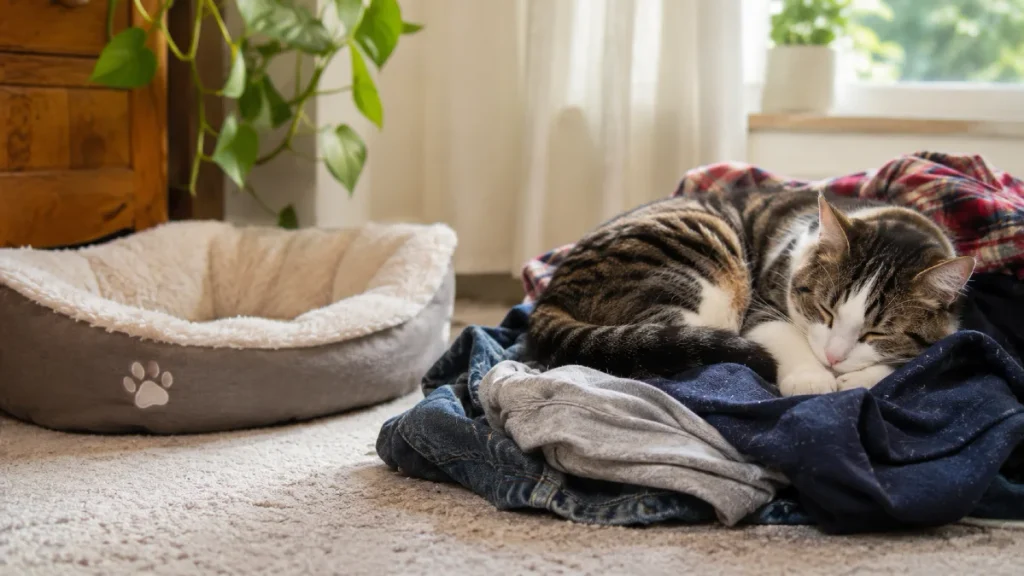
You may have spent money on a beautiful cat bed, only to watch your cat ignore it completely. Meanwhile, an old sweatshirt on the couch becomes its favorite place to sleep.
This does not necessarily mean the bed is uncomfortable or poorly made. It may simply be in the wrong location or lack something your cat prefers.
Cats often choose resting places based on privacy, easy access, familiar smells, and how safe the area feels. A soft bed near a busy doorway may be less appealing than a quiet pile of clothes on a bedroom chair.
The Location May Matter More Than the Bed
The AAFP and ISFM Feline Environmental Needs Guidelines recommend providing cats with several safe resting options. Some cats prefer higher locations, while others enjoy partly enclosed areas where they can retreat.
Think about where your cat usually settles. If it keeps sleeping on your laundry in the bedroom, that room may be quieter than the place where you put its bed.
Try moving the cat bed closer to its preferred sleeping location. You may find that a simple change makes the bed more attractive without buying anything new.
A Freshly Washed Bed May Smell Unfamiliar
Your cat’s bed may also lose familiar scents after washing. Strong fragrances from laundry products can change how the bedding smells to your cat.
The feline environmental guidelines recommend preserving some familiar scent in a cat’s surroundings. They also suggest washing bedding in rotation so every familiar scent is not removed at once.
Try placing a clean, dry cotton shirt that you have worn on top of the cat bed. Avoid strong fabric fragrances, then give your cat time to investigate the changed sleeping spot.
Do not force your cat onto the bed or repeatedly carry it back when it leaves. Let your cat choose where it feels comfortable, provided the location is safe.
How Can You Keep Your Cat Comfortable Without Losing Your Laundry?
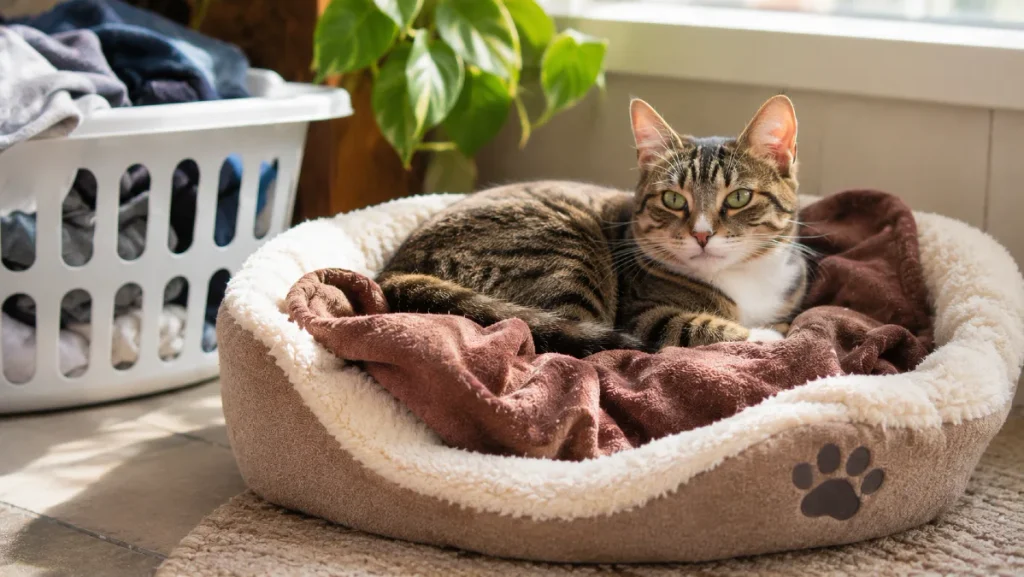
You do not need to surrender every shirt in your laundry basket to keep your cat happy. A simple resting area with familiar bedding may give your cat what it enjoys without leaving dirty clothes scattered around the house.
The easiest place to begin is with a cotton shirt you have worn but that is still dry and free from harmful substances. Place it on a washable cat bed in a quiet area your cat already likes.
Choose clothing without loose strings, decorative beads, or damaged fabric your cat might chew. Make sure your cat can enter and leave the resting area freely.
Make a Simple Bed Your Cat May Actually Use
Start with a shallow cat bed or a sturdy cardboard box with an easy opening. Add a soft washable blanket, then lay your worn shirt over part of the bedding.
Keep the bed away from heavy foot traffic, loud appliances, and places where other pets may bother your cat. If your cat likes raised spots, a stable perch with suitable bedding may work better than a floor bed.
You can also try a washable product such as the K&H Pet Products Self Warming Lounge Sleeper. However, an ordinary blanket in a safe location may work just as well for a cat that likes simple resting spots.
Allow your cat to investigate the new area without pressure. You can move the shirt into the new bed, but let your cat decide whether to use it.
Watch for Hidden Laundry Hazards
Some laundry items are unsafe even when they appear harmless. The ASPCA warns that liquid detergents, detergent pods, and dryer sheets can cause serious problems if pets chew or swallow them.
Cats Protection also advises keeping washing machine and dryer doors closed and checking inside before use. This is especially important in homes where cats regularly explore laundry areas.
Use this guide to make safer choices.
| Laundry Item or Area | Main Concern | Safer Choice |
|---|---|---|
| Plain, dry cotton shirt | Usually low risk if intact | Use as supervised bedding initially |
| Detergent pods or liquid | Chemical exposure | Store in closed cupboards |
| Dryer sheets | Chemical burns or blockage if swallowed | Keep away from cats |
| Loose strings or ribbons | Swallowing or entanglement | Remove from bedding |
| Washer or dryer | Serious injury if entered | Close doors and check before use |
The safest resting spot is one that feels familiar without exposing your cat to household hazards. Keep actual laundry products separate from the place where your cat sleeps.
If you suspect your cat swallowed a dryer sheet, detergent, or string, contact a veterinarian promptly. Do not wait for obvious symptoms or try to make your cat vomit at home.
What If Your Cat Still Chooses the Laundry?
Some cats will continue choosing the laundry basket even after you provide another bed. If the habit is harmless and your cat is healthy, there is no need to treat it as bad behavior.
You can keep your laundry in a closed hamper and leave an approved resting spot nearby. This removes the tempting pile while still giving your cat a comfortable alternative.
If anxiety is part of a wider behavior problem, your veterinarian may also discuss environmental changes or products such as a FELIWAY Classic diffuser. These products may help some cats, but they are not a replacement for finding the cause of stress.
When Should a New Laundry Sleeping Habit Concern You?
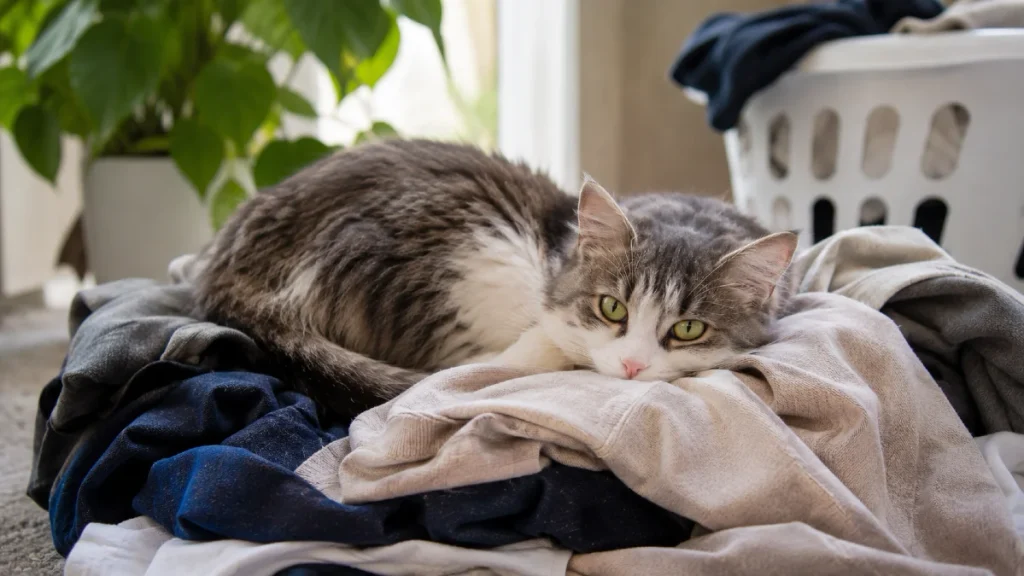
A cat that has always slept on your worn clothes is usually showing a familiar resting preference. But a sudden change in where your cat sleeps deserves more attention, especially when other behaviors change too.
For example, your cat may suddenly stop sleeping on its favorite chair and begin hiding inside the laundry basket. That could happen because the house has become noisy, but it could also be linked to pain or illness.
VCA Animal Hospitals advises watching for changes in appetite, activity, grooming, movement, and litter box habits. Cats can hide signs of illness, so small changes are worth taking seriously.
Look for Changes Beyond the Laundry Basket
Pay closer attention if your cat starts:
- Sleeping or hiding much more than usual.
- Eating less or showing little interest in food.
- Avoiding jumping, climbing, or normal movement.
- Grooming much more or less than before.
- Using the litter box differently.
- Acting unusually withdrawn, fearful, or restless.
These signs do not prove that something is wrong, but they can help you recognize a problem early. If several appear together or the change is sudden, arrange a veterinary examination.
A cat that has not eaten for 24 hours needs prompt veterinary care, and young kittens may need help sooner. Straining to urinate with little or no urine is an emergency.
Keep a Simple Record of What Changes
If your cat begins sleeping on dirty laundry more often, make a note of when it happens. Record its appetite, play, grooming, and litter box habits as well.
Also consider recent changes such as a new animal, different work hours, or a move. These details may help your veterinarian identify whether stress, discomfort, or another issue is involved.
You do not need to worry about every unusual sleeping position. The goal is to recognize meaningful changes while allowing your cat to enjoy harmless habits.