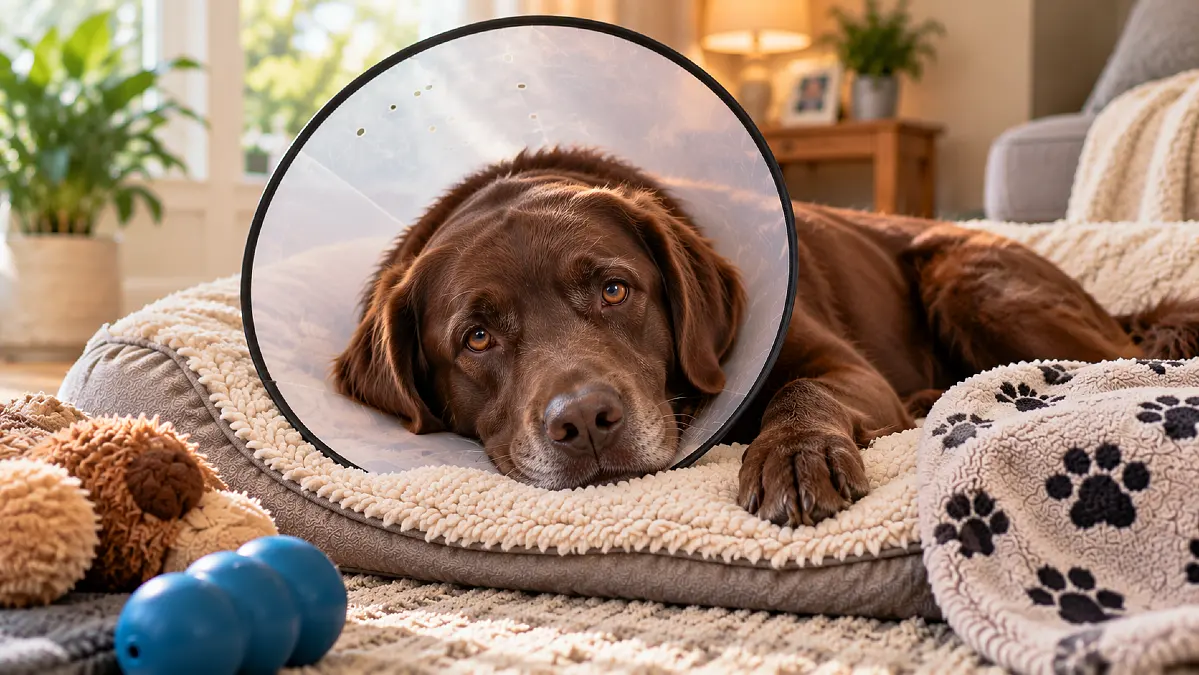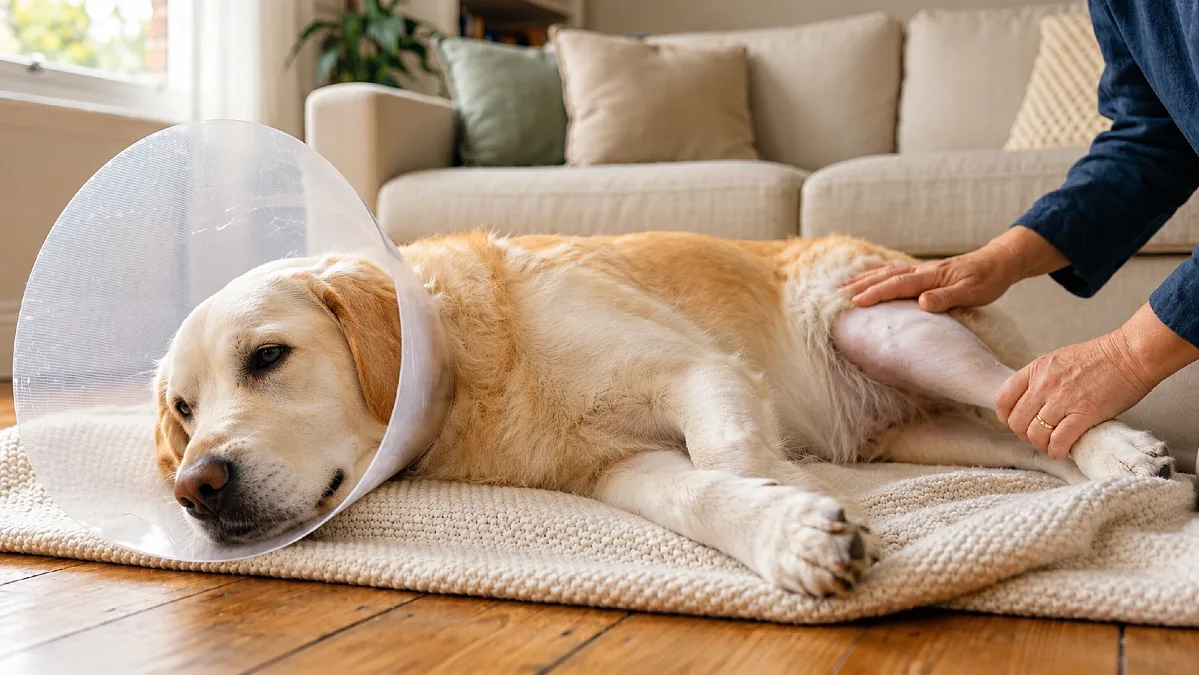
Watching your dog struggle to walk after surgery or slow down because of painful joints can be worrying. You want them to stay active and rebuild their strength, but normal walks may put too much pressure on their legs. Finding a safe way to exercise becomes an important part of their recovery.
An underwater treadmill for dogs offers a different approach. Your dog walks on a moving belt inside a tank of warm water, which supports part of their body weight while their muscles continue working. This allows some dogs to practice walking with less stress on painful or healing joints.
Veterinary rehabilitation teams often use this treatment for dogs recovering from surgery, dealing with arthritis, or experiencing muscle weakness. However, water therapy is not right for every dog, and starting at the wrong time can create problems.
How Does an Underwater Treadmill for Dogs Actually Work?
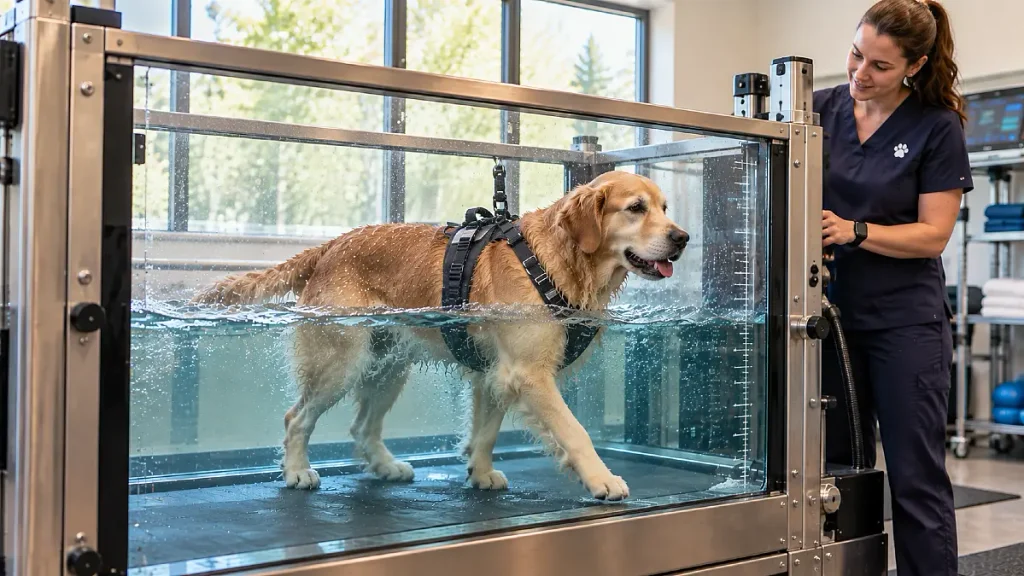
An underwater treadmill helps your dog practice walking while reducing some of the weight their legs must carry. The water supports their body, making certain movements easier than they would be on dry ground. At the same time, water resistance gives their muscles something to work against.
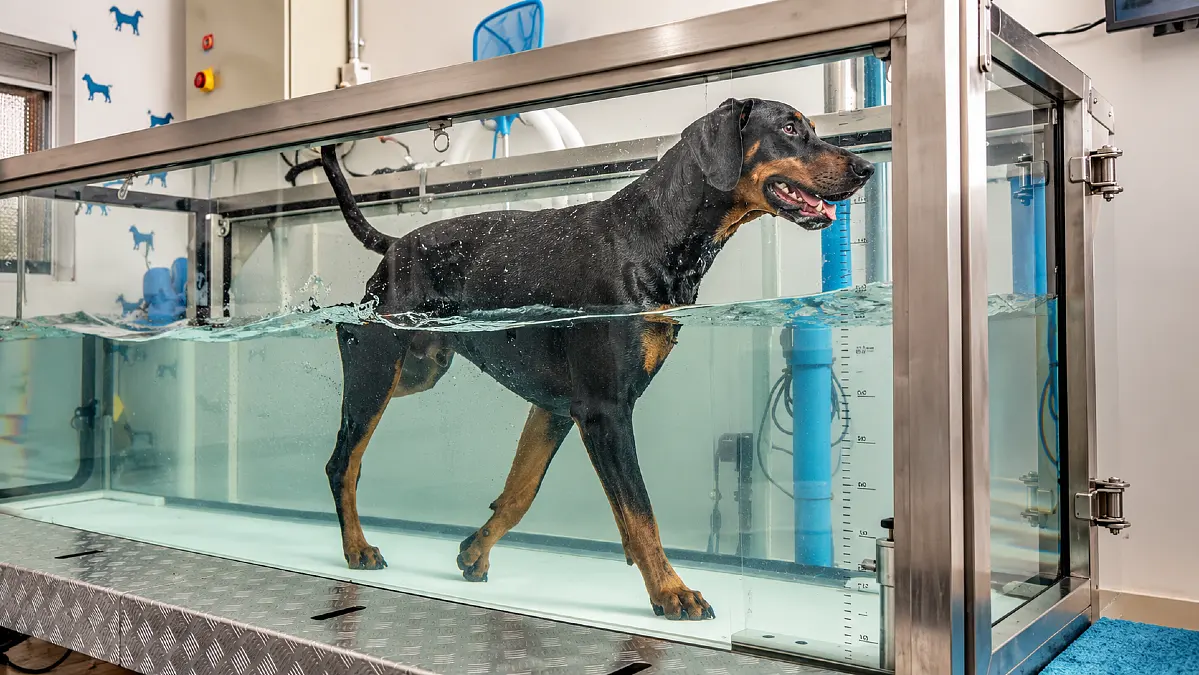
The equipment looks like a clear tank with a treadmill belt at the bottom. Your dog enters the tank before it fills with water, and a rehabilitation therapist adjusts the water depth and walking speed. These settings change how much support and resistance your dog experiences.
Why Does Walking in Water Feel Different?
Water changes the way your dog’s body moves. Three main properties make underwater treadmill therapy useful during rehabilitation.
- Buoyancy: Supports part of your dog’s weight and reduces the load on their legs.
- Water resistance: Makes muscles work as your dog moves their legs through the water.
- Hydrostatic pressure: Applies gentle pressure to the body, which may help with certain types of swelling.
Warm water may also help some dogs feel more comfortable while moving stiff joints. Purdue University Veterinary Teaching Hospital uses underwater treadmill therapy as part of rehabilitation for orthopedic and neurological patients.
How Much Weight Does Water Remove From Your Dog’s Legs?
The depth of the water affects how much force passes through your dog’s legs. Deeper water generally provides more support, although it also increases resistance to movement.
A 2010 study by David Levine and colleagues measured leg forces in 10 healthy dogs standing at different water depths. The results showed substantial differences as the water level increased.
| Water level | Reduction in leg force | What it means |
|---|---|---|
| No water | 0% | Normal standing load |
| Ankle height | 9% | Slightly less weight |
| Knee height | 15% | Moderate support |
| Hip height | 62% | Much greater support |
These figures describe dogs standing in water, not walking on an underwater treadmill. Actual movement also depends on walking speed, water resistance, and the dog’s condition.
The results help explain why therapists carefully select the water level. Deeper water is not automatically better, because your dog still needs enough control to perform the intended exercise.
What Happens During Your Dog’s First Underwater Treadmill Session?
Your dog’s first underwater treadmill appointment should begin with an assessment rather than a demanding workout. The rehabilitation team needs to know what your dog can safely do before deciding how much exercise to introduce.
A therapist may examine your dog’s walking pattern, joint movement, muscle condition, and pain response. They will also review previous surgeries, medications, and any restrictions from your veterinarian.
How Is Your Dog Introduced to the Water?
Most rehabilitation teams introduce the equipment gradually. This gives your dog time to become familiar with the tank, moving belt, and feeling of water around their legs.
A typical session may follow these steps:
- Entering the tank: Your dog walks or is carefully helped onto the stationary treadmill.
- Getting comfortable: The therapist offers reassurance and allows your dog to settle.
- Adding water: Warm water gradually fills the tank to the chosen level.
- Beginning movement: The treadmill starts at a slow, controlled speed.
- Watching each step: The therapist monitors walking quality, balance, and signs of fatigue.
- Finishing safely: The belt stops, the water drains, and your dog is helped out and dried.
Some dogs begin walking comfortably within their first appointment. Others need several attempts before they feel relaxed, especially if they have never experienced water therapy.
How Long Does the First Session Last?
The first visit often includes more assessment and preparation than actual treadmill walking. Your dog may spend only a short period exercising while the therapist checks their response.
A rehabilitation appointment may last considerably longer than the walking portion itself. The team should explain how much exercise your dog completed and what changes to watch for afterward.
The University of Illinois Veterinary Teaching Hospital uses physical, orthopedic, and neurological examinations to help develop rehabilitation plans. This type of assessment is important because your dog’s exercise limits depend on their medical condition, not just their size or age.
Which Dogs Can Benefit From Underwater Treadmill Therapy?
Underwater treadmill therapy may help dogs that need controlled movement but struggle with normal exercise. It is commonly considered when joint pain, weakness, or poor coordination makes walking difficult.
The treatment can serve different purposes depending on the dog’s condition. Some dogs need to improve joint movement, while others need to rebuild strength or practice placing their feet correctly.
Which Health Conditions May Benefit?
Veterinary rehabilitation teams use underwater treadmills for several orthopedic and neurological problems. The table below shows common treatment goals and what should be checked before beginning.
| Dog’s condition | Possible benefit | Check before starting |
|---|---|---|
| Arthritis | More comfortable movement | Pain control |
| Hip dysplasia | Support during exercise | Joint stability |
| TPLO recovery | Controlled walking practice | Surgical healing |
| IVDD recovery | Supported stepping | Nerve function |
| Muscle weakness | Strength and endurance | Cause of weakness |
| Excess weight | Lower impact conditioning | Heart and breathing health |
These are possible uses rather than guaranteed results. A veterinarian must decide whether underwater treadmill therapy is appropriate for your dog’s diagnosis and current condition.
Can It Help Senior Dogs With Arthritis?
Senior dogs with arthritis sometimes become less active because walking causes discomfort. Reduced activity can lead to weaker muscles, making it even harder to stand, climb small steps, or move around the house.
Water support may allow some dogs to exercise while carrying less weight on painful joints. However, underwater treadmill therapy should support a wider arthritis care plan that includes proper pain management, weight control, and suitable daily activity.
What About Dogs With Nerve Problems?
Dogs recovering from certain spinal injuries may have trouble coordinating their back legs. Supported treadmill walking can give them repeated opportunities to practice stepping while a therapist assists with body position.
A 2026 study by Mária Kuricová and colleagues examined 34 dogs after surgery for intervertebral disc disease, or IVDD. The dogs receiving underwater treadmill rehabilitation regained independent walking sooner than a matched group receiving home rehabilitation.
The findings are encouraging, but the study was small and retrospective. More research is needed to determine which dogs benefit most and how much of the improvement is directly caused by treadmill therapy.
When Can a Dog Start Underwater Treadmill Rehab After Surgery?
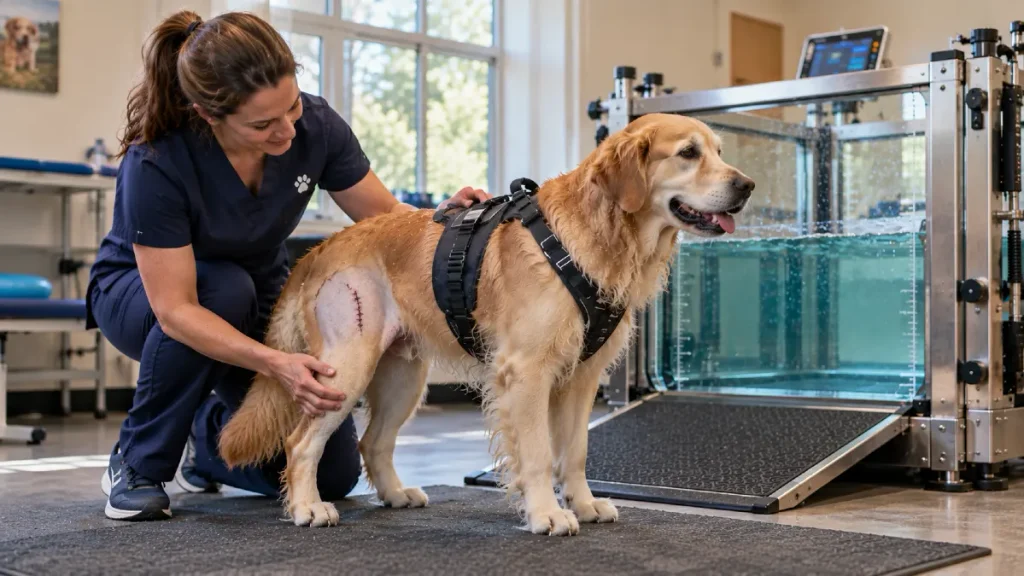
Your dog should begin underwater treadmill rehabilitation only after their surgeon or veterinarian approves it. The correct starting point depends on the procedure, wound healing, pain level, and how well the repaired tissues are recovering.
Some dogs may be ready for certain rehabilitation exercises before they are ready to enter water. Being able to stand or take a few steps does not automatically mean the surgical area can safely tolerate treadmill exercise.
After TPLO Knee Surgery
Dogs recovering from tibial plateau leveling osteotomy, or TPLO, often need a gradual return to normal leg use. Underwater treadmill walking may eventually help them practice placing weight through the operated leg while working on strength and walking quality.
However, TPLO involves cutting and stabilizing bone, which needs time to heal. The surgeon must approve the treatment based on recovery progress, incision healing, and any concerns found during follow up examinations.
Starting too soon may interfere with recovery. Your dog may still need strict activity limits even when they appear eager to walk.
After Hip Surgery
Some dogs recovering from femoral head and neck ostectomy, often called FHO, may benefit from supervised water exercise. The goal is to encourage comfortable movement and improve the use of the affected leg.
A 2026 pilot study by Nichanan Maneeganondh and colleagues examined underwater treadmill rehabilitation after FHO surgery. The treatment group began its treadmill program approximately three weeks after surgery and showed encouraging improvements in limb use.
Only nine dogs completed the study, so its findings should be treated carefully. That starting point was part of a supervised research program and should not be used as a general rule for your dog.
After IVDD or Spinal Surgery
Dogs recovering from spinal surgery may need help learning to coordinate their movements again. Underwater treadmill therapy can provide support during carefully controlled walking practice.
In the 2026 study by Kuricová and colleagues, underwater treadmill treatment began after surgical wounds had healed enough for water exposure. Sessions were adjusted according to each dog’s neurological progress and fatigue.
Your dog’s neurologist should decide when water therapy is safe. New weakness, loss of movement, or worsening pain needs veterinary attention rather than a change in exercise routine.
When Is an Underwater Treadmill Unsafe for a Dog?
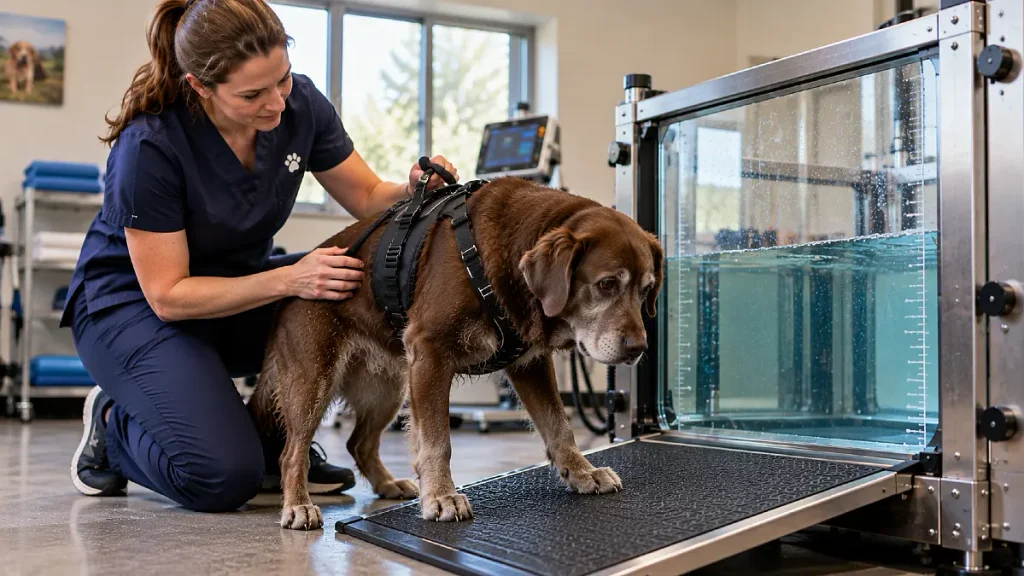
Underwater treadmill therapy is not suitable for every dog, even when the goal is to improve mobility. Water exercise still requires physical effort, and some health problems make treatment risky.
A proper medical review helps the rehabilitation team identify conditions that need treatment or stabilization first. In some cases, another type of exercise may be safer.
Which Dogs Should Avoid or Delay Hydrotherapy?
The National Association of Registered Canine Hydrotherapists lists several conditions that can prevent or limit safe water treatment.
These include:
- Open wounds or unhealed surgical incisions
- Active skin infections or contagious diseases
- Significant heart or breathing problems
- Recent or poorly controlled seizures
- Severe fear of water that causes panic
- Certain balance disorders
- Serious unexplained pain or unstable injuries
Dogs with obesity, poor exercise tolerance, or certain airway conditions may also need additional precautions. Flat faced breeds can require special care because breathing problems may become more noticeable during exercise.
A dog that is frightened by the water should not be forced to continue. The therapist may need to spend more time building confidence or recommend a different exercise.
What Warning Signs Mean a Session Should Stop?
Even a dog that has completed previous sessions comfortably can have a difficult day. Pain, fatigue, and anxiety may change how well they tolerate exercise.
Watch for the following signs:
- Sudden weakness or loss of balance
- Repeated attempts to escape the tank
- Crying, trembling, or obvious distress
- Unusually heavy breathing
- Worsening limping
- Difficulty placing the feet correctly
- Extreme tiredness
If these problems appear, the therapist should stop and assess your dog. Collapse or severe breathing difficulty requires emergency veterinary care.
Is an Underwater Treadmill Better Than Swimming or Walking?
An underwater treadmill and a therapy swimming pool both use water, but they encourage different movements. Choosing the right one depends on your dog’s condition and what the rehabilitation team wants to improve.
The main advantage of an underwater treadmill is controlled walking. Your dog’s feet remain in contact with a moving belt, allowing the therapist to observe and guide their steps.
Swimming removes normal ground contact and requires a paddling movement. This can be useful for certain exercise goals, but it does not practice the same walking pattern.
How Do These Exercises Compare?
Each type of exercise offers something different. Comparing them can help you see why a therapist may recommend one method over another.
| Exercise | Main advantage | Main limitation |
|---|---|---|
| Underwater treadmill | Controlled walking with water support | Requires special equipment |
| Therapy swimming | Exercise without ground contact | Does not practice normal walking |
| Land walking | Practices everyday movement | More weight on the legs |
| Land treadmill | Controlled walking speed | No water support |
For dogs learning to walk after nerve injuries, an underwater treadmill may be useful because the therapist can help guide repeated steps. Swimming may serve a different purpose when the goal is to encourage joint movement without ground contact.
Cornell University College of Veterinary Medicine notes that treadmill work can help therapists focus on walking patterns in dogs with neurological problems. However, a land treadmill may be preferred when a dog cannot safely enter water.
Which One Should You Choose?
The decision should come from your dog’s rehabilitation goals rather than the type of equipment that sounds most appealing. Some dogs may benefit from different exercises at different stages of recovery.
For a more detailed comparison, read our underwater treadmill vs swimming for dogs guide.
How Often Should Dogs Use an Underwater Treadmill?
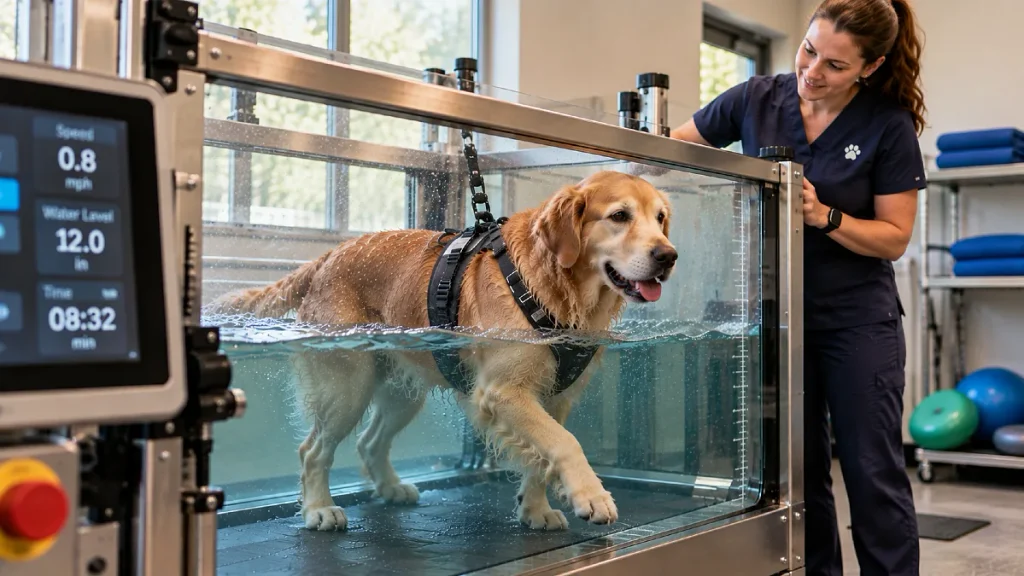
There is no fixed underwater treadmill schedule that works for every dog. Session frequency depends on the injury, recovery stage, fitness level, and how your dog responds to treatment.
A senior dog with arthritis may need a different plan from a young dog recovering from knee surgery. Even dogs with similar conditions can have very different exercise limits.
What Does Research Say About Session Frequency?
A 2025 pilot study by Julia Twarowska and colleagues reviewed 50 dogs receiving underwater treadmill therapy for different mobility conditions. Each dog completed 10 sessions over five weeks, with two sessions scheduled each week.
The researchers reported improvements in measured joint movement after the program. However, the study did not include a control group, so it cannot prove that the treadmill alone caused the changes.
The study also does not establish that two sessions per week is the best schedule for every condition. Your rehabilitation team should set the frequency based on your dog’s individual needs.
How Will You Know if Your Dog Is Improving?
A successful rehabilitation program should have measurable goals. Simply finishing more treadmill sessions does not necessarily mean your dog is recovering.
Your therapist may track changes in:
- Walking speed and step quality
- Weight placed on each leg
- Joint movement
- Muscle size and strength
- Standing balance
- Ability to complete approved daily activities
You can also watch how easily your dog gets up, walks across the room, or moves around familiar areas. Small improvements in daily movement can provide useful information when combined with the therapist’s measurements.
If your dog becomes more painful or struggles with activities that were previously easy, discuss it with the rehabilitation team. The program may need adjustment rather than more exercise.
How Much Does Underwater Treadmill Therapy Cost?
The cost of underwater treadmill therapy depends on your location, the rehabilitation provider, and the type of treatment your dog needs. Most clinics charge separately for the initial evaluation and later therapy sessions.
Some clinics offer packages for dogs expected to need several visits. However, a package is not always the best choice if your dog’s treatment plan may change.
What Are Typical Hydrotherapy Prices in 2026?
PetRehabNetwork reviewed published prices from 29 US rehabilitation clinics in September 2026. The research provides useful cost reference points, although it does not represent every clinic in the country.
| Service | Published median | What to ask |
|---|---|---|
| First rehab evaluation | $160 | Is treatment included? |
| Single hydrotherapy session | $65 | How long is the visit? |
| Package session | About $54 | How many visits? |
| Extra rehabilitation services | Varies | What is included? |
The reported hydrotherapy prices could not always be separated into underwater treadmill and pool treatments. This means your local treadmill session may cost more or less than the published median.
The survey also found that appointment lengths vary between providers. Comparing the full service offered is more useful than comparing prices alone.
How Can You Avoid Unexpected Charges?
Before booking, request a written estimate covering the evaluation, treatment visits, and any additional services. Ask how often your dog will be reassessed and whether the number of planned sessions may change.
You should also check whether your pet insurance includes rehabilitation or hydrotherapy. Some policies may cover prescribed treatment, while others have exclusions, limits, or referral requirements.
Do not buy a large package simply because the cost per session is lower. It is better to begin with a professional evaluation and a clear treatment plan.
How Do You Choose a Safe Dog Hydrotherapy Clinic?
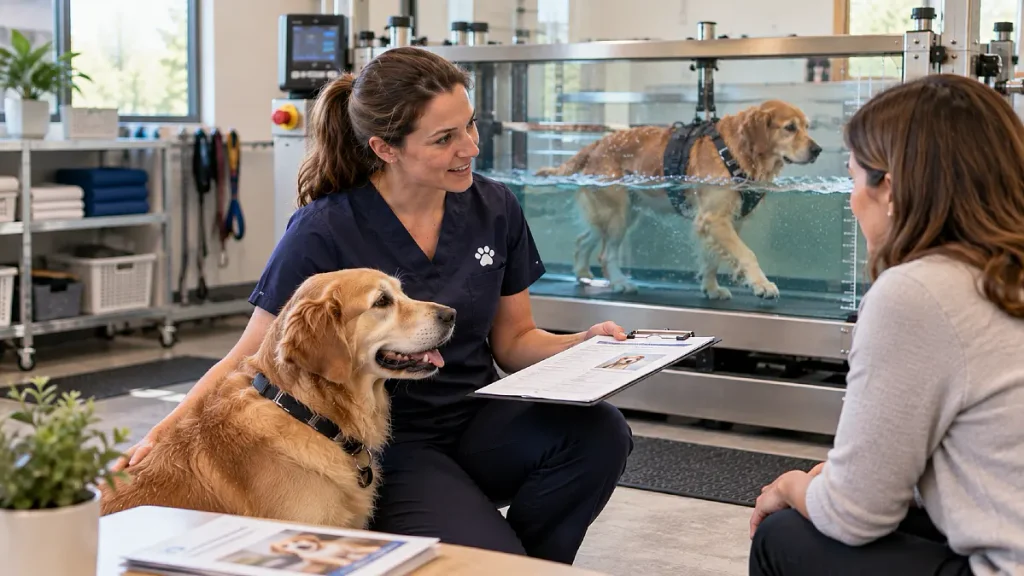
The equipment matters, but the people operating it matter more. A well run rehabilitation clinic should assess your dog’s health, explain the treatment goals, and provide close supervision during exercise.
Look for a provider who works with your veterinarian and has suitable training in canine rehabilitation. The therapist should know when to adjust water depth, reduce walking speed, or stop a session.
Which Qualifications Should You Look For?
Some professional credentials used in canine rehabilitation include:
- CCRP: Certified Canine Rehabilitation Practitioner
- CCRT: Certified Canine Rehabilitation Therapist
- DACVSMR: A veterinarian board certified in sports medicine and rehabilitation
These credentials represent different professional training routes. Ask who will examine your dog, who will operate the treadmill, and what medical supervision is available.
What Should You Ask Before Booking?
A good clinic should be willing to explain its treatment process and safety procedures. You should feel comfortable asking questions before allowing your dog into the tank.
Useful questions include:
- Will my dog need a veterinary referral?
- Who will supervise the entire session?
- How do you choose the correct water depth?
- What happens if my dog becomes frightened?
- How do you clean and maintain the equipment?
- How will you measure rehabilitation progress?
- What does the complete treatment plan cost?
Be cautious if a provider guarantees recovery or recommends many sessions without assessing your dog first. Rehabilitation should have clear goals that can be reviewed as your dog’s condition changes.
You can explore the PetRehabNetwork dog hydrotherapy directory to find clinics offering underwater treadmills and other water therapy services. Always confirm the equipment, qualifications, and current availability directly with the clinic.
What Should You Do Between Underwater Treadmill Sessions?
Your dog’s recovery continues after leaving the rehabilitation clinic. The right home routine can help maintain progress, while too much activity can increase pain or place stress on healing tissues.
Follow the exercise instructions provided by your veterinarian or rehabilitation therapist. Do not add longer walks, stairs, or strengthening exercises simply because your dog seems more energetic after a session.
How Can You Support Recovery at Home?
Simple changes around the house can make daily movement safer. Keep floors clear, provide good traction, and arrange a comfortable resting area that is easy for your dog to reach.
You can also support your dog’s rehabilitation by:
- Keeping walks within the approved limits
- Preventing jumping and rough play during restricted recovery
- Using a support harness if recommended
- Providing a comfortable place to rest
- Helping your dog maintain a healthy body weight
- Following the prescribed medication schedule
Dogs recovering from surgery may still have activity restrictions even when their walking looks better. Follow those restrictions until the surgeon changes them.
Should You Track Your Dog’s Progress?
Keeping a short daily record can help you notice changes that are easy to miss. You do not need complicated equipment or measurements to track basic comfort and movement.
Record how easily your dog stands, whether they limp, and how they behave after approved exercise. Sharing these observations with the rehabilitation team can help them decide whether the treatment plan needs to change.
New weakness, worsening pain, or sudden trouble walking should be reported promptly. Do not wait until the next scheduled treadmill session if your dog’s condition is getting worse.