Your cat follows you into the living room, settles on the couch a few feet away, and stays there for hours. But when you reach out to pet them, they sometimes move away. You start wondering why your cat wants to be near you but never seems interested in cuddling.
It can feel confusing, especially when you see other cats sleeping in their owners’ arms or begging for attention. You might even wonder if your cat actually loves you or simply enjoys being in the same room.
But here’s something many cat owners miss. A cat doesn’t always need physical contact to enjoy your company. Some cats prefer sitting nearby, quietly watching you, or resting in a familiar place while you go about your day.
Research shows that cats can form meaningful bonds with their human caregivers. Their behavior, however, varies from one cat to another.
Why Your Cat Chooses to Stay Close Without Touching You

Your cat might spend the entire afternoon beside your desk without once climbing onto your lap. They may barely look at you, yet every time you change rooms, they eventually appear nearby.
This can be a positive sign. Cats often choose resting places where they feel comfortable, and a familiar person can be part of that comfort.
Think about a young cat like Charly, who regularly settles near his person while they work. He isn’t asking for food or trying to interrupt the computer. He simply chooses a place where he can rest while remaining close to someone familiar.
But there is another detail worth checking. Cats also choose places because they are warm, quiet, comfortable, or give them a good view of their surroundings.
What Your Cat’s Favorite Spot Might Mean
Where your cat sits can offer clues about what attracts them to a particular location. Look at the spot itself as well as how your cat behaves when you move.
| Where Your Cat Sits | Possible Reason | What to Notice |
|---|---|---|
| Beside your desk | Company or routine | Follows you when you leave |
| Other end of the couch | Comfort and personal space | Relaxed while you sit |
| Near the bedroom door | Easy access or awareness | Watches the doorway |
| Chair beside your bed | Familiar place or closeness | Returns at bedtime |
| Window near your seat | Sunlight or outdoor activity | Stays after you leave |
These patterns can help you make a better guess about your cat’s behavior. If your cat regularly chooses to follow you even when other comfortable spaces are available, social interest becomes a stronger possibility.
The important clue is choice. When your cat can go anywhere but repeatedly chooses your company, that behavior is worth noticing.
What Science Reveals About Your Cat’s Attachment to You

For years, cats have had a reputation for being independent and emotionally distant. But research suggests that their relationships with people can be more meaningful than those old ideas suggest.
In 2019, researchers at Oregon State University published a study in Current Biology examining attachment between cats and their human caregivers. The researchers included kittens and adult cats in an experiment based on methods used to study attachment in children.
The experiment placed cats in an unfamiliar room with their caregivers. The person briefly left and then returned while researchers observed how the cats responded.
The results were interesting. Among 70 kittens whose behavior could be classified, 64.3% showed a secure attachment pattern. Among 38 adult cats, that figure was 65.8%.
Securely attached cats tended to use their caregivers as a source of reassurance in the unfamiliar setting. They could seek contact, settle after reunion, and return to exploring their surroundings.
This matters because affection does not always involve constant physical contact. A cat may feel comfortable with someone while also being confident enough to explore or rest independently.
However, the study did not test whether sitting a few feet from an owner proves secure attachment. That would be taking the findings further than the research allows.
What the study does show is that cats can form attachment bonds with people. Your cat’s quiet presence may be one part of that relationship, especially when it comes with other relaxed and friendly behavior.
How to Tell If Your Cat Feels Safe Sitting Near You
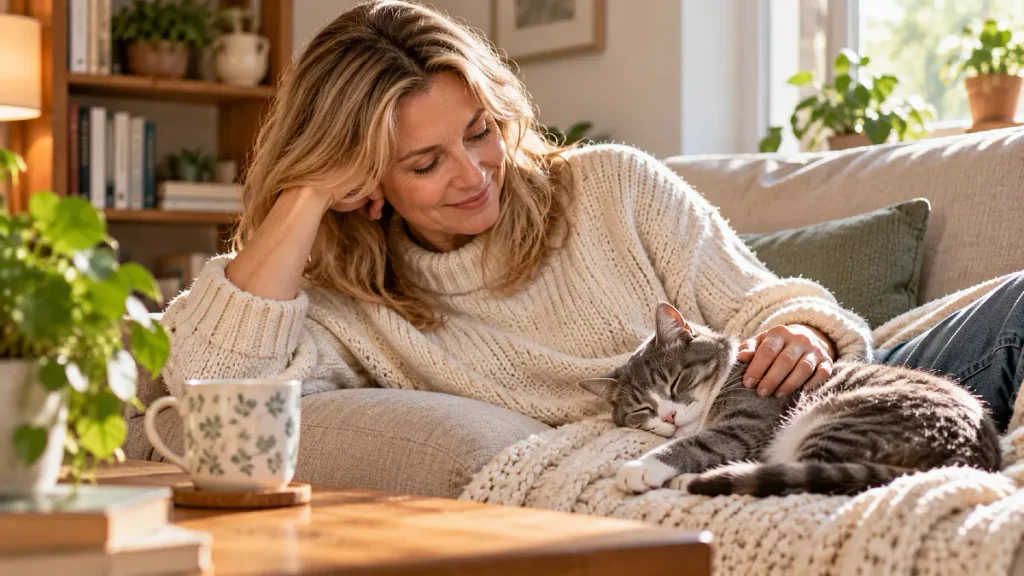
Your cat’s distance from you tells only part of the story. To get a clearer picture, pay attention to their body posture, eyes, ears, and tail.
A cat that feels comfortable often has loose muscles and a relaxed resting position. They might stretch out on the couch, rest their head on their paws, or close their eyes while you are nearby.
Cats Protection explains that feline body language should be judged as a whole. One movement alone doesn’t reveal exactly how a cat feels.
For example, a cat resting near you with soft eyes and relaxed ears may be perfectly content. But a cat sitting at the same distance with a tense body and flattened ears may be worried or uncomfortable.
Signs Your Cat Is Comfortable or Uncomfortable
Look for combinations of signals rather than focusing on a single gesture. This table can help you decide whether to interact or give your cat more space.
| Body Language | Possible Meaning | Your Response |
|---|---|---|
| Loose, stretched body | Comfortable | Let them relax |
| Soft eyes and slow blinking | Calm, friendly signal | Blink slowly back |
| Ears facing forward | Relaxed or interested | Observe other cues |
| Rapid tail swishing | Possible irritation | Pause interaction |
| Flattened ears and tense body | Fear or discomfort | Give more space |
| Hunched posture with poor activity | Possible pain | Contact your vet |
Your cat may also show trust by resting with their back partly turned to you. This can happen when they are comfortable, although it is not proof of affection by itself.
Notice whether your cat returns to the same room throughout the day. Repeated, relaxed closeness can tell you more than one brief visit.
The Simple Observation That Helps
You can learn a lot about your cat without touching them or changing their routine. Start by watching how they behave when they are free to leave.
Ask yourself these three questions:
- Does your cat come near you without being called or offered food?
- Does their body appear relaxed while they rest nearby?
- Do they choose your company at different times of the day?
If the answers are yes, you have useful signs that your cat is comfortable sharing space with you. This is a positive pattern, although it cannot confirm a particular attachment style.
Why Your Cat May Prefer Your Company Over Being Petted

Some cats love long cuddle sessions. Others enjoy a few gentle strokes before walking away, and some prefer sitting nearby without being touched at all.
That difference is normal. Cats have individual preferences for physical contact, just as they have preferences for sleeping places and favorite activities.
Veterinary behavior guidance from VCA Animal Hospitals explains that petting can sometimes become unpleasant for cats. A cat may enjoy being stroked at first but become irritated as the interaction continues.
This is often called petting induced aggression when the cat eventually responds by biting or swatting. But many cats communicate discomfort much earlier by moving away, turning their head, or flicking their tail.
Consider a cat like Sacha, who enjoys some affection but becomes uncomfortable when several people pet him. His preference for shorter contact does not automatically mean he dislikes the people around him.
The same cat may happily spend an entire evening resting near the family. For him, sharing space can be enjoyable even when physical affection is limited.
How to Respond to Different Touch Preferences
Your cat will usually provide clues about whether they want more contact. The goal is to notice those clues before the interaction becomes uncomfortable.
| Your Cat’s Behavior | What It May Mean | Best Response |
|---|---|---|
| Rubs against your hand | May welcome contact | Try gentle cheek strokes |
| Sniffs your hand and pauses | Gathering information | Wait without touching |
| Moves away after a stroke | Wants a break | Stop petting |
| Leans into repeated strokes | May enjoy more | Continue briefly |
| Turns head sharply or flattens ears | Possible discomfort | End interaction |
Battersea Dogs & Cats Home recommends giving cats a choice during interactions. Their C.A.T. method focuses on Choice, Attention, and Touch.
One useful part of this approach is pausing after about three seconds of petting. If your cat rubs against you again, they may be asking for more.
If they stay still, turn away, or leave, respect that response. A cat can enjoy your presence without wanting your hands on their body.
Why Your Cat Follows You Around but Does Not Cuddle
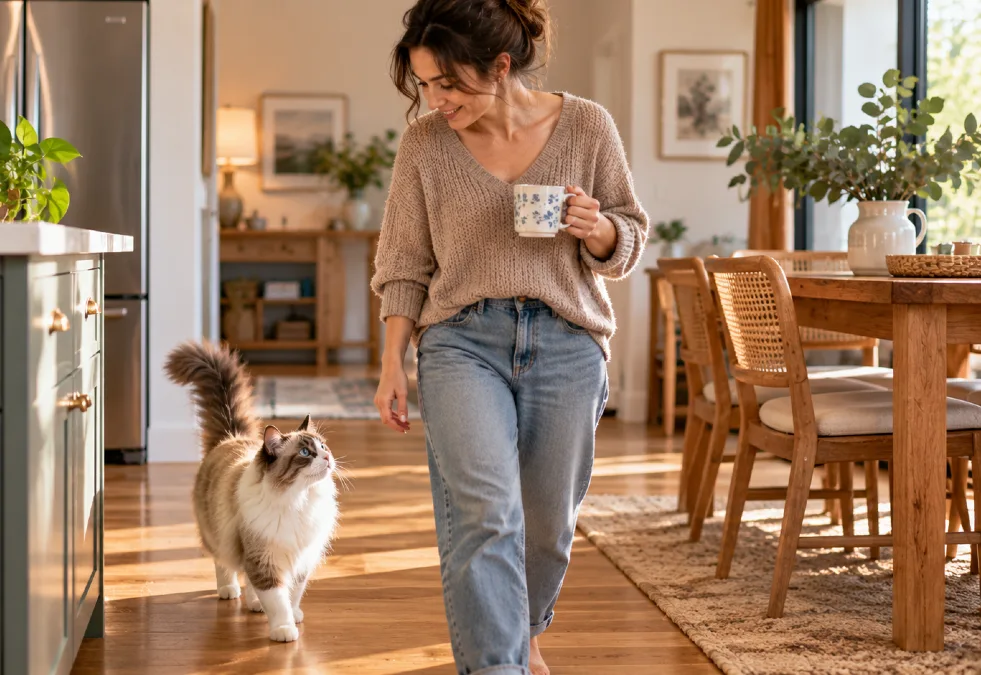
Have you ever noticed your cat appear in the kitchen while you make coffee, move to the office when you start working, and settle near the sofa when you watch television? They seem interested in everything you do, yet they rarely climb onto you.
Part of this behavior may involve curiosity. Cats pay attention to changes in their environment, and your movements often signal that something interesting might happen.
Your daily routine also matters. If you normally feed your cat after entering the kitchen, they may follow you because they expect a meal.
But when the behavior happens outside feeding or play times, social interest may also be involved. Some cats seem to prefer sharing ordinary moments with their people rather than demanding attention.
You can learn more by watching what happens when you sit quietly and offer nothing. Does your cat settle down nearby, or do they keep looking toward the food cupboard?
Neither answer is wrong. Cats have different reasons for following people, and the same cat may have different motives throughout the day.
The best clue comes from watching repeated behavior in different situations. Your cat’s interest in being near you becomes easier to read when you consider their routine, body language, and available choices together.
What Cats Can Teach Us About Quiet Companionship
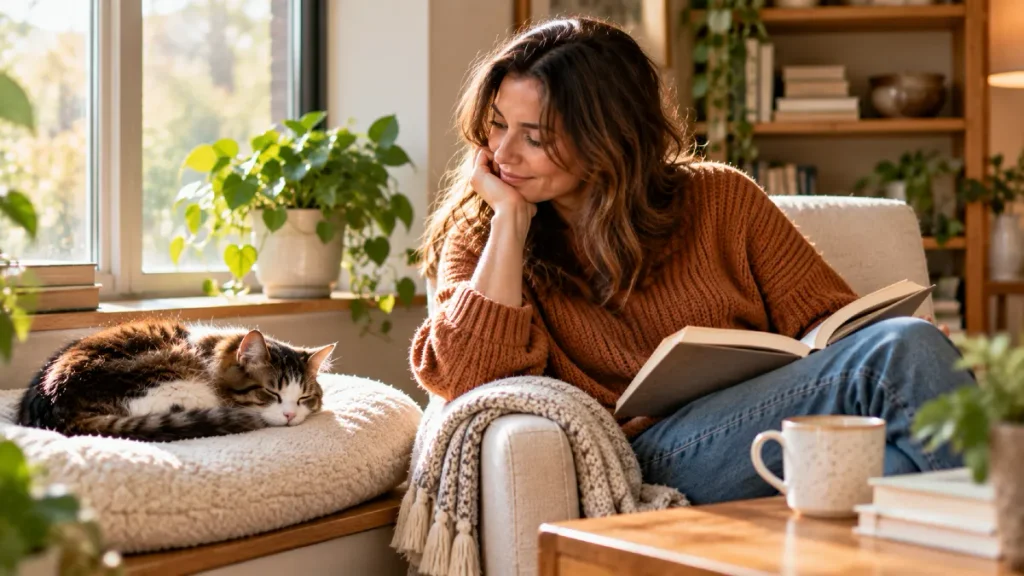
Cats have their own ways of managing social relationships. They don’t always need to interact directly to share the same space comfortably.
You might see two household cats resting in the same room for hours. One sleeps on a chair while the other stretches out on a rug, and neither appears interested in approaching the other.
That can be peaceful coexistence, but it does not always prove that the cats are closely bonded.
The 2024 American Association of Feline Practitioners guidelines on tension between cats explain that cats sharing furniture without touching may be simply tolerating one another. Grooming each other, rubbing together, and choosing close contact provide stronger evidence of a social bond.
This distinction matters when thinking about your own cat. Quietly sharing space with you is encouraging, but it becomes more meaningful when paired with voluntary greetings, relaxed behavior, and friendly interactions.
A cat that sits near you, slowly blinks, sometimes rubs against your legs, and returns throughout the day is showing several positive signs. You don’t need a dramatic display of affection to recognize that the relationship may be comfortable and rewarding.
And remember that every cat is different. Some prefer close physical contact, while others are happiest enjoying a little personal space.
How to Respond When Your Cat Sits Near You Without Touching
The next time your cat settles quietly beside you, resist the urge to immediately pick them up. You might be interrupting the very thing they wanted: a peaceful place to rest.
Instead, let them choose whether the moment becomes an interaction. This gives your cat control over how much attention they receive.
Stay Still and Let Your Cat Set the Distance
If your cat lies down beside your chair, continue what you were doing. There’s no need to move closer or call them over.
This helps keep the moment calm and predictable. Cats often respond better when they can approach people freely instead of being followed or held.
Try a Gentle Slow Blink
When your cat looks at you with soft eyes, try slowly closing and opening your eyes. Then turn your gaze slightly away instead of staring.
A 2020 study in Scientific Reports found that cats responded positively to human slow blinking. The researchers also observed that cats were more likely to approach an unfamiliar person after this type of interaction than after a neutral expression.
Your cat might blink back, look away, or do nothing at all. Each response is fine, so don’t keep trying to get a reaction.
Offer Contact Without Forcing It
If your cat approaches, you can gently offer a relaxed hand. Let them decide whether to sniff it, rub against it, or walk away.
If they choose contact, try brief strokes around the cheeks or chin. Stop if their body becomes tense or they move away.
You can also build a positive routine through play instead of petting. A supervised session with a wand toy, such as a KONG cat teaser, allows you to interact without making cuddles necessary.
Give Your Cat a Comfortable Spot Nearby
If your cat repeatedly chooses a hard floor beside your desk, consider adding a small cat bed or a stable resting platform. A Catit Vesper perch is one example, but a simple washable bed may work just as well.
Place it where your cat already enjoys resting, rather than forcing them to use a new location. Keep an easy path out so they never feel trapped.
The goal isn’t to make your cat sit closer. It is to make their chosen space comfortable and safe.
When Your Cat’s Sudden Need for Space Could Be a Warning

A cat that has always preferred sitting nearby instead of cuddling is usually different from a cat that suddenly stops enjoying touch. That change deserves attention, especially if it happens alongside other unusual behavior.
Cats can hide signs of illness or pain. Sometimes the first clue is a change in their normal daily habits.
For example, a cat that once enjoyed gentle head scratches may begin pulling away every time you reach toward them. Joint pain, dental problems, skin irritation, or another health issue could make contact uncomfortable.
Cats Protection advises owners to watch for changes in activity, appetite, grooming, and social behavior. These signs can matter even when a cat is still eating some food or occasionally playing.
When Keeping Distance Needs Attention
Compare your cat’s current habits with what is normal for them. A recent change is often more useful to notice than a behavior they have shown for years.
| Behavior Change | What to Check | Next Step |
|---|---|---|
| Suddenly avoids petting | Pain or sensitivity | Arrange a vet check |
| Hides much more than usual | Stress or illness | Contact your vet |
| Stops jumping onto furniture | Stiffness or pain | Schedule an exam |
| Eats less and withdraws | Possible illness | Seek prompt vet advice |
| Strains to urinate or passes no urine | Possible urinary blockage | Emergency vet care |
A sudden change should never be dismissed as your cat simply becoming less affectionate. The earlier you notice a possible health problem, the sooner your veterinarian can help.
The Feline Grimace Scale is another resource that can help assess signs of acute pain through facial expressions. It is not a test of happiness, and it does not replace a veterinary examination.
Important: If your cat suddenly avoids touch, appears painful, or behaves very differently, seek veterinary advice rather than trying to encourage more cuddling.