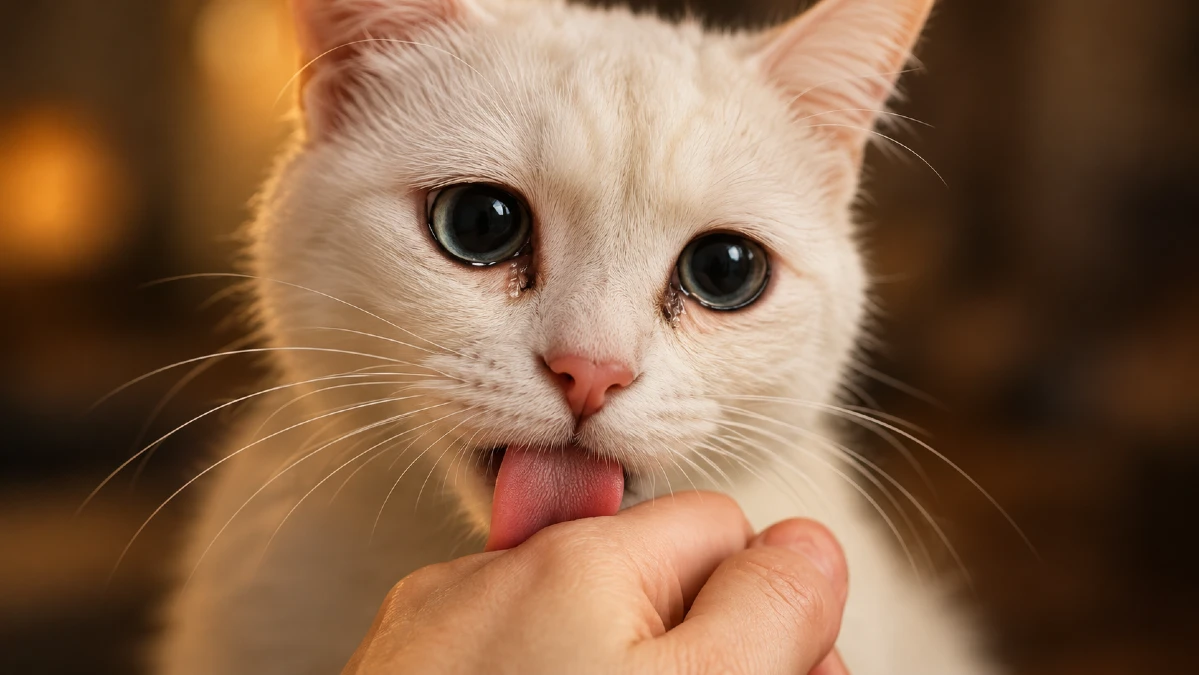
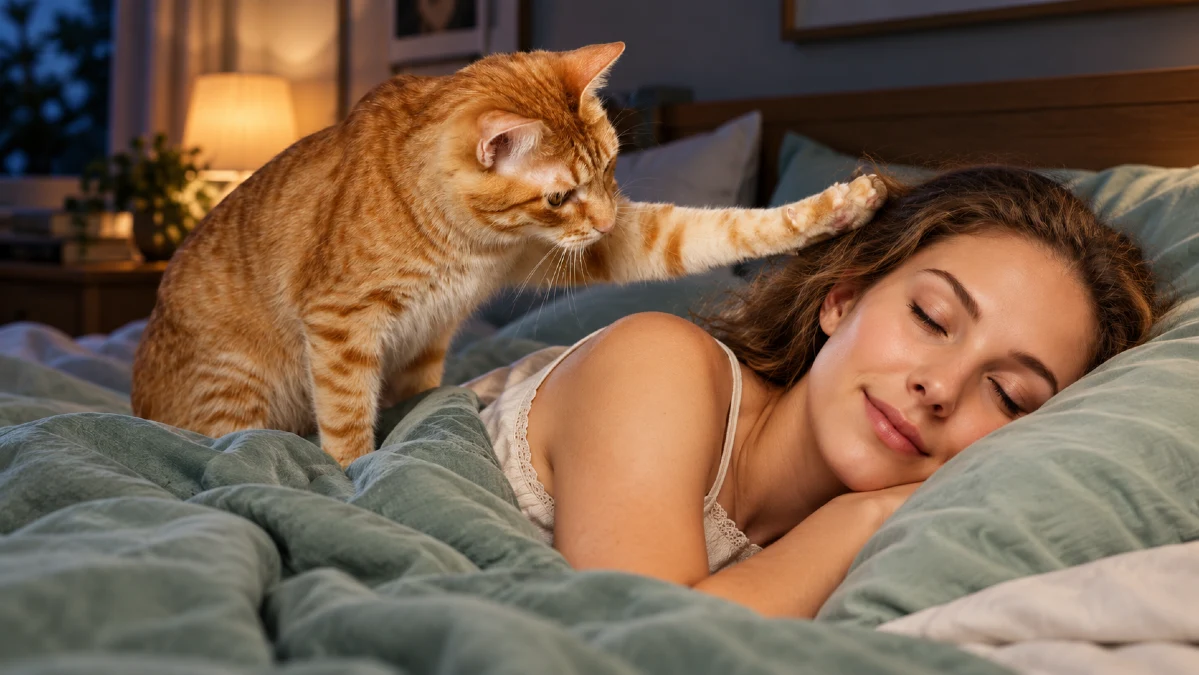
Have you ever woken up in the middle of the night to find your cat touching your face with one tiny paw? Maybe you felt something brush your cheek, opened your eyes, and found your cat staring directly at you. It can feel a little strange, especially when the rest of the house is completely quiet.
Most cat owners assume their pets spend the night curled up somewhere comfortable. But what cats do at night can be surprisingly different from what they do during the day. While you’re sleeping, your cat might explore the house, knead your blankets, watch things you cannot see, or even lick your hair.
Some of these strange cat behaviors come from natural instincts. Others may have more to do with comfort, attention, and the bond your cat shares with you.
Why Your Cat Touches Your Face While You Sleep
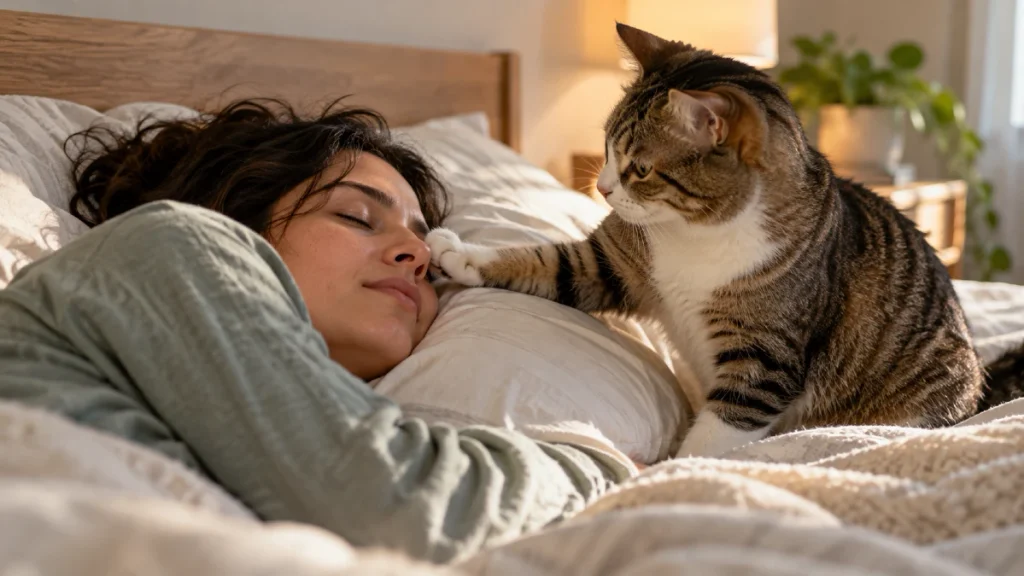
One of the strangest things your cat might do at night is gently place a paw against your face. Sometimes it’s a single soft touch. Other times, your cat keeps tapping your cheek or nose until you finally open your eyes.
You might assume your cat is simply being affectionate. But there are several reasons why cats touch their owners while they’re sleeping, and the meaning often depends on what happens next.
Cats are very aware of movement, sounds, and changes in their surroundings. When you fall asleep, you become quieter and less responsive than usual. Your cat may approach you, sniff your face, or touch you with a paw to get a reaction.
One popular explanation suggests that cats touch sleeping people to check whether they’re still breathing. However, there is no strong scientific evidence that ordinary nighttime face touching is a deliberate health check. Cats may notice breathing and movement, but that does not tell us why a particular cat uses its paw.
What Your Cat Might Be Trying to Tell You
If your cat taps your face and then walks toward the bedroom door, it may want you to follow. If it moves toward the food bowl, hunger could be the reason.
Some cats also learn that touching a sleeping person’s face produces an immediate response. Even if you simply open your eyes or speak, that reaction may be enough to encourage the behavior again.
Cats Protection explains that pawing at an owner’s face in the early morning is a common behavior. It can be linked to attention seeking, feeding routines, or the natural times when cats become more active.
The best way to work out your cat’s reason is to watch what happens before and after the touching.
What Different Types of Face Touching May Mean
A gentle paw can have several explanations. This table can help you decide what to try next.
| What happens | Possible reason | What to try |
|---|---|---|
| Gentle paw on your cheek | Attention or curiosity | Watch what happens next |
| Repeated early morning tapping | Learned feeding routine | Use a set feeding schedule |
| Pawing followed by meowing | Request for interaction | Check basic needs |
| Pawing followed by rubbing | Friendly social contact | Offer calm attention |
| Sudden, persistent touching | Discomfort or unmet need | Check for other changes |
Your cat’s behavior becomes easier to interpret when you look at the whole situation. A single paw tap cannot tell you exactly what your cat is thinking.
If your cat seems relaxed and behaves normally throughout the day, occasional face touching is usually not a reason to worry.
Why Your Cat Suddenly Runs Around the House at Night
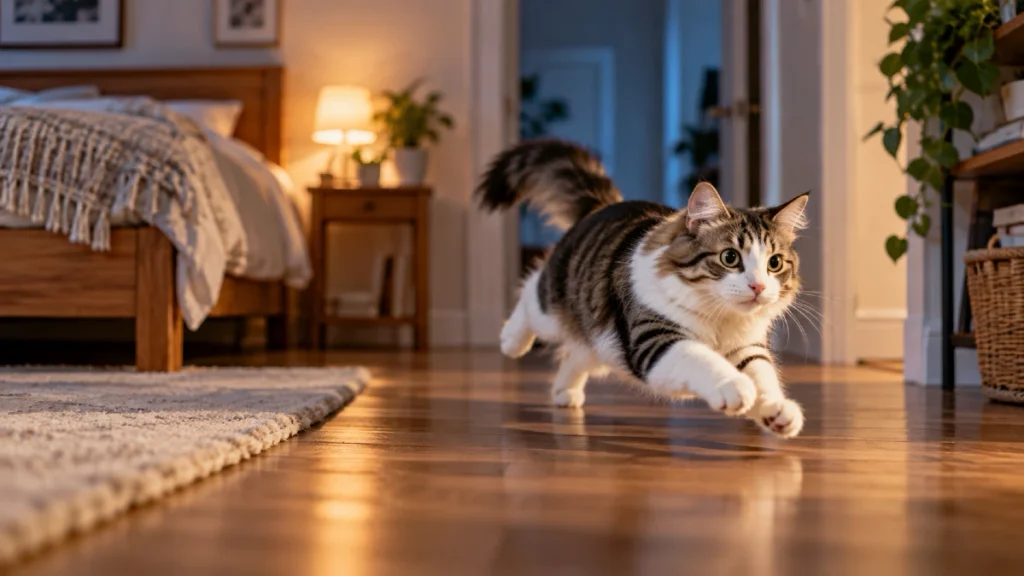
You’re sleeping peacefully when something suddenly races through the hallway. A second later, you hear claws tapping across the floor, followed by a loud jump onto the furniture.
Your cat has apparently decided that the middle of the night is the perfect time to run around the house. These sudden bursts of activity are commonly called cat zoomies.
Cats are generally crepuscular, meaning they’re naturally more active around dawn and dusk. The Merck Veterinary Manual explains that this activity pattern is connected to their hunting behavior.
Even cats that have spent their entire lives indoors can show strong hunting instincts. They may race after toys, chase small movements, or leap onto furniture without any obvious warning.
Why These Sudden Bursts of Energy Happen
Young cats and kittens often have plenty of energy to use. If they’ve spent much of the day sleeping or resting, they may become especially playful later.
Their surroundings can also affect when they become active. A cat living in a quiet home may learn that nighttime is a good time to explore without being interrupted.
Some people describe these runs as nighttime security patrols. Cats do check their surroundings, but there is no good evidence that ordinary zoomies are organized attempts to protect their sleeping owners.
The behavior usually makes more sense when viewed as a mix of natural activity patterns, play, excitement, and stored energy.
What Your Cat’s Nighttime Movement Could Mean
Not every sound after dark means your cat is having zoomies. Different behaviors may call for different responses.
| Behavior | Possible explanation | Helpful response |
|---|---|---|
| Sudden running | Play or burst of energy | Add active playtime |
| Jumping onto furniture | Exploring or climbing | Provide a cat tree |
| Chasing moving shadows | Hunting response | Offer interactive toys |
| Walking around rooms | Normal exploration | Keep pathways safe |
| Repeated loud crying | Need, stress, or illness | Check for changes |
A healthy cat may switch between resting and short periods of activity throughout the night. The important thing is whether the behavior matches its usual pattern.
If your cat suddenly becomes much more restless than normal, especially when combined with other symptoms, contact your veterinarian.
How to Make Nighttime Quieter
Try spending time playing with your cat during the evening. A fishing rod toy allows your cat to chase, jump, and practice natural hunting movements.
Cats Protection recommends interactive play to help manage nighttime activity. Several short play sessions throughout the day can also be useful, especially for young indoor cats.
Finish an evening play session with an appropriate meal or small portion of your cat’s daily food. A regular routine may help your cat settle, although it won’t guarantee uninterrupted sleep.
Why Your Cat Kneads Your Blankets When You’re Sleeping
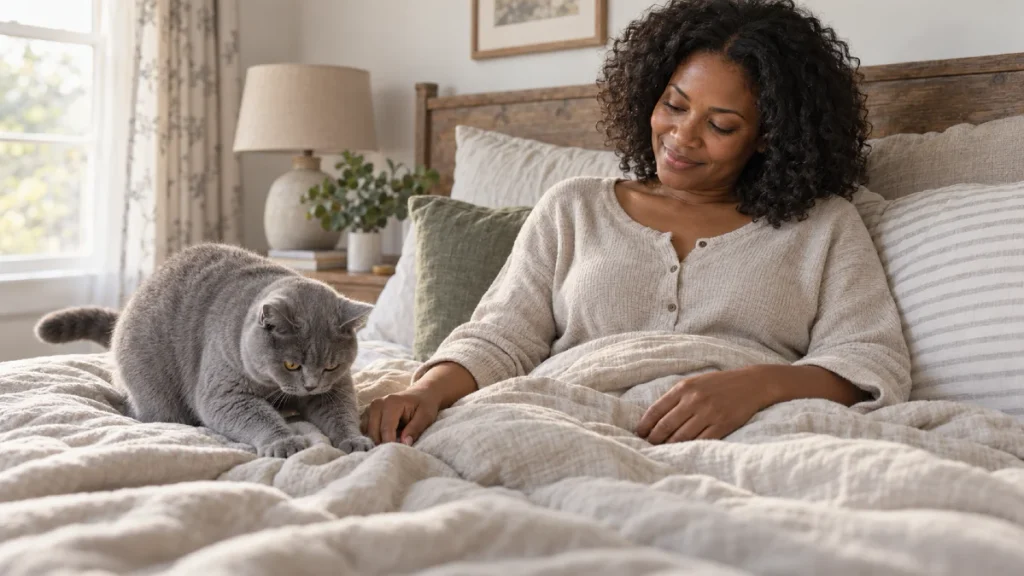
Have you ever felt your cat pressing its paws into your blanket while you’re lying in bed? The movement is usually slow and rhythmic, with one front paw pushing down as the other lifts.
Cat owners often call this behavior making biscuits. It can look funny, but it has roots in an important part of a cat’s early life.
Kittens knead their mother’s belly while nursing. The repeated paw movements help stimulate milk flow, and the behavior becomes linked with the comfort of feeding and staying close to their mother.
Some cats continue kneading long after they become adults. You might notice your cat doing it on soft blankets, pillows, cushions, or even your lap.
Why Your Bed Becomes a Favorite Kneading Spot
Your bed offers several things cats often enjoy. It’s usually soft, warm, and filled with familiar smells.
Cats also have scent glands around their paws. VCA Animal Hospitals explains that kneading may help cats leave scent on surfaces as part of their normal marking behavior.
This means your cat could be adding its scent to a familiar resting area. However, it does not prove that your cat is making a special claim of ownership over you.
Kneading can also happen when a cat is relaxed and preparing to rest. Some cats purr during the movement, while others appear almost sleepy.
When your cat kneads beside you, it may simply feel comfortable in that particular place. Your presence could be one reason the spot feels familiar and safe.
What to Do When Kneading Hurts
Unfortunately, a comfortable cat can still have sharp claws. If your pet kneads directly against your skin, the movement can become painful.
Place a folded blanket between your body and your cat’s paws. You can also provide a soft fleece blanket in a nearby sleeping spot.
Avoid yelling or pushing your cat away roughly. Kneading is normal feline behavior, and gentle redirection is usually a better response.
If your cat suddenly starts kneading much more often than usual while also hiding, eating less, or acting uncomfortable, discuss the change with your veterinarian.
Why Your Cat Stares at Empty Corners in the Dark
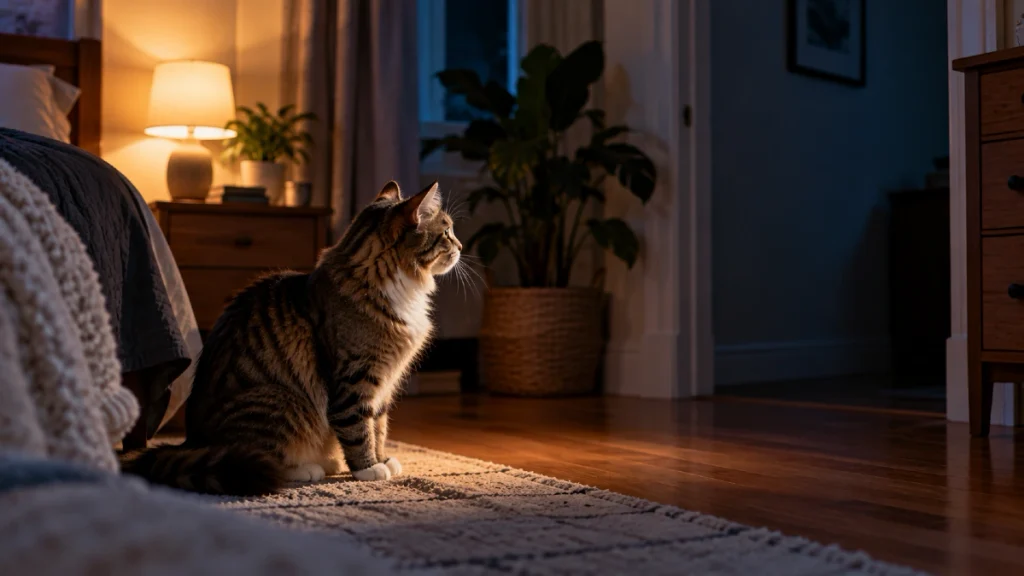
Few things feel stranger than waking up and discovering your cat sitting perfectly still, staring at an empty corner of your bedroom. You look in the same direction but cannot see anything unusual.
Your cat might hold that position for several minutes. Its ears may twitch, its head may tilt, or its eyes may follow something that seems completely invisible.
The explanation is usually connected to the way cats experience their surroundings. Their eyesight and hearing work differently from ours, especially when the room is dim.
Your Cat Can Detect Things You Might Miss
Cats have a reflective layer behind the retina called the tapetum lucidum. This helps their eyes use available light more effectively and contributes to the glowing appearance of their eyes in the dark.
According to the Merck Veterinary Manual, cats can see about six times better than humans in low light. This allows them to notice movement that people may struggle to detect.
However, cats still need some light to see. They cannot see perfectly in complete darkness.
Their hearing provides another advantage. Cats can detect high frequency sounds that fall outside the normal range of human hearing.
A tiny animal moving nearby, an insect, or a faint sound from another room could attract your cat’s attention. You might see nothing unusual while your cat remains focused on what it hears.
Even subtle noises from walls, floors, or household equipment can be interesting to an alert cat.
When Staring Deserves Closer Attention
Most cats occasionally stare at seemingly empty spaces. If your cat remains responsive and returns to normal activities, there may be nothing wrong.
However, a new pattern of prolonged staring combined with confusion, unusual walking, or a reduced response to familiar sounds deserves attention.
Cornell Feline Health Center explains that older cats can develop changes in awareness and behavior. These may include disorientation, altered sleep patterns, and unusual vocal sounds during the night.
If your cat seems confused or repeatedly becomes trapped in corners, arrange a veterinary examination. Do not assume that strange behavior is simply part of getting older.
Why Your Cat Grooms Your Hair While You Sleep
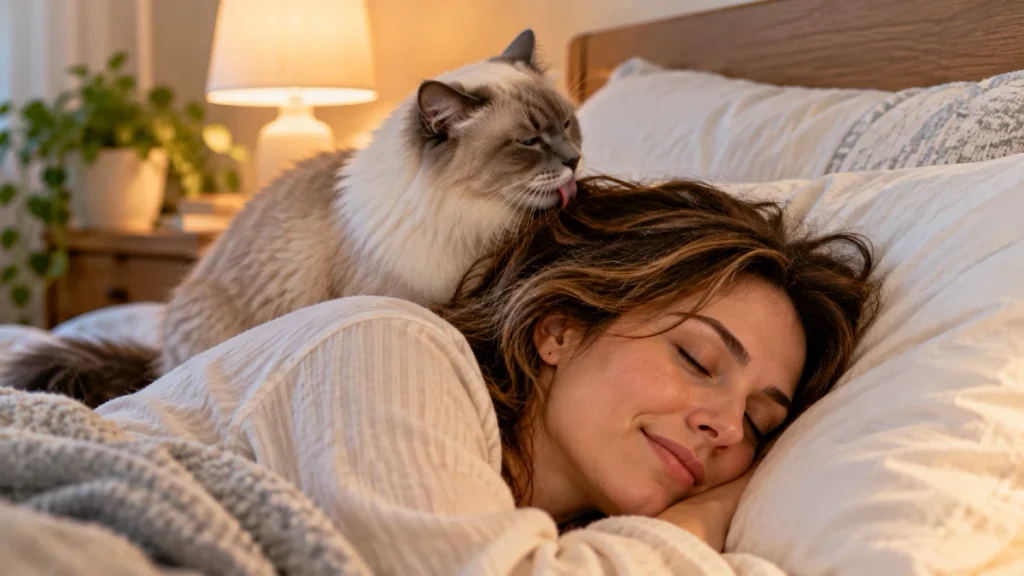
You wake up and notice a damp patch in your hair. Maybe your cat is resting beside your pillow, looking completely innocent.
What happened while you were asleep? Your cat may have spent part of the night licking your hair.
This behavior can seem unusual, especially if your cat spends more time grooming you than you spend grooming yourself. But licking has several roles in feline social behavior.
Cats regularly groom themselves to keep their coats clean. They also sometimes groom other cats, especially those with whom they share a friendly relationship.
This social grooming behavior is known as allogrooming. It can help maintain bonds between cats that are comfortable with one another.
Why Cats Sometimes Groom Their Owners
Your cat may lick your hair for a similar social reason. Because you’re a familiar member of its home, grooming you may be part of the way it interacts with you.
VCA Animal Hospitals explains that cats may lick their owners as a form of affection or social bonding. Licking can also be connected to attention seeking and interesting smells.
Human hair contains scents from shampoos, conditioners, natural oils, and the surrounding environment. Some cats become curious about those smells and investigate them with their mouths.
If your cat gently licks your hair while resting beside you, the behavior could be social grooming. But that isn’t the only possible explanation.
Some cats lick people because the behavior has earned attention in the past. Others may simply enjoy the texture or scent of hair.
What Different Grooming Behaviors Could Mean
To read your cat’s behavior more accurately, consider what it is doing and whether the habit is changing.
| Behavior | Possible meaning | What to watch |
|---|---|---|
| Gentle hair licking | Social grooming or scent interest | Relaxed body language |
| Licking your hands | Affection, taste, or attention | Frequency and setting |
| Kneading while licking | Comfort related behavior | Relaxation or distress |
| Chewing or swallowing hair | Oral interest or possible problem | Repeated swallowing |
| Sudden excessive licking | Stress or medical concern | Other behavior changes |
Gentle licking is different from repeatedly chewing or swallowing hair. The second behavior may require more attention because swallowed strands can create health risks.
Pay attention to whether the behavior is occasional or becoming difficult for your cat to stop.
Why Hair Products Can Be a Problem
One thing owners sometimes overlook is what they put in their hair. Certain scalp treatments, medicated products, and styling products may contain ingredients that are harmful to cats.
PetMD’s veterinary guidance warns against allowing cats to lick skin or hair carrying potentially harmful topical products. Some substances that are safe for people can be dangerous when cats swallow them.
If you use medicated hair or scalp treatments, prevent your cat from licking the treated area. This is especially important with products containing minoxidil, which is highly toxic to cats.
If your cat may have swallowed a harmful product, contact your veterinarian or an animal poison service right away. Do not wait for symptoms to appear.
What Your Cat’s Nighttime Habits Say About Your Bond
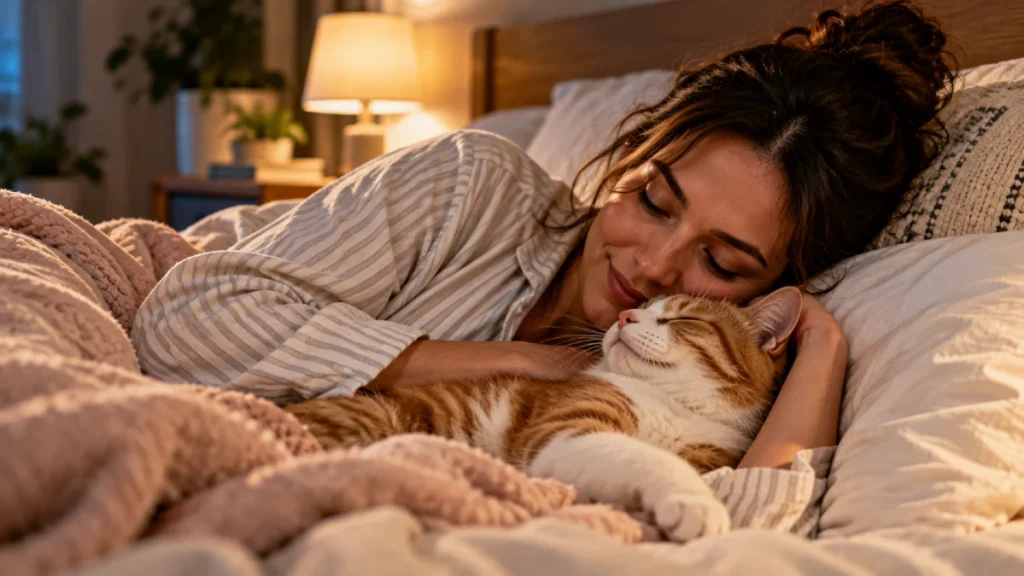
The strange things your cat does while you’re sleeping can sometimes offer clues about how comfortable it feels around you. However, feline behavior rarely has a single meaning.
A cat that regularly chooses to rest near your pillow may enjoy your company. Another cat might prefer sleeping at the foot of the bed, where it has more space.
Both cats can have a strong bond with their owners. Being physically close is one possible sign of trust, but it is not the only one.
Cats have different personalities and comfort levels. Some enjoy frequent physical contact, while others prefer sitting nearby without being touched.
Why Your Cat Chooses to Sleep Near You
Your bedroom may offer warmth, quiet, familiar smells, and comfortable surfaces. If your cat feels safe there, it may return every night.
Sleeping near you can also reflect a social preference. Cats sometimes choose resting places close to people or other animals they know well.
But that does not mean your cat is standing guard over you. It may simply enjoy a peaceful sleeping place with familiar company.
A cat that stays near you while relaxed is showing something useful through its behavior. It feels comfortable enough to remain in that space.
Look at the Whole Cat, Not One Strange Habit
If you want to know how your cat feels, pay attention to its body language throughout the day. One behavior during the night cannot tell the whole story.
A relaxed cat may approach you willingly, rub its face against you, blink slowly, or settle nearby. These actions can be consistent with friendly social behavior.
On the other hand, a cat that suddenly hides, avoids contact, or becomes aggressive may be uncomfortable. Changes like these deserve attention, especially if they happen without an obvious reason.
The Merck Veterinary Manual describes feline social behavior as varied and shaped by the individual cat and its environment. This helps explain why two cats can show affection in very different ways.
Respect your cat’s preferences instead of forcing contact. Letting your pet choose when to approach can help maintain a comfortable relationship.
How to Stop Nighttime Cat Activity Without Punishment
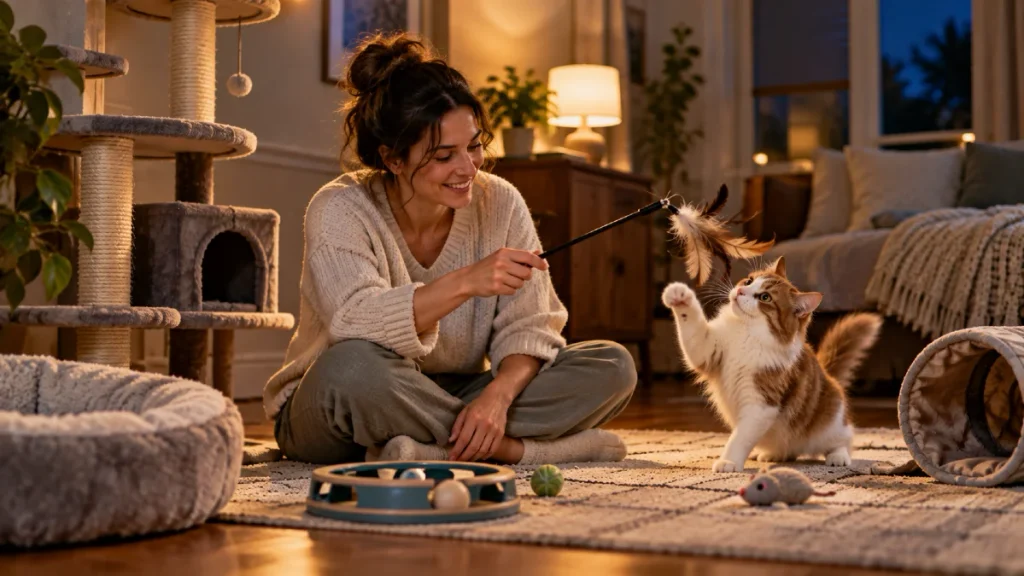
Learning what cats do at night can help you respond to behavior that interrupts your sleep. The goal is not to stop your cat from behaving like a cat.
Instead, you want to create a routine that meets your pet’s needs while allowing everyone in the house to rest.
Cats need chances to play, explore, climb, scratch, and interact with their surroundings. Without enough suitable activity, some cats may become restless when their owners are trying to sleep.
Build a Better Routine Before Bed
Start by setting aside time for interactive play in the evening. Use a fishing rod toy or another safe toy that lets your cat chase and capture a moving object.
Allow your cat to catch the toy during play. This can make the activity more satisfying than repeatedly chasing something it can never reach.
You can also provide food puzzles that require your cat to work for part of its regular food. These offer mental activity without needing you to stay awake and supervise every movement.
Make sure your cat has a comfortable place to sleep. Some cats prefer a raised bed, while others feel more settled in a quiet corner.
If your cat repeatedly wakes you for breakfast, consider whether feeding at the same early hour has become part of its routine. A programmable automatic feeder may help some cats stop linking your waking up with immediate food.
Small Changes That May Help You Sleep
Different nighttime problems may need different solutions. Use this table to choose a starting point.
| Problem | What to change | When to seek help |
|---|---|---|
| Early morning pawing | Review feeding routine | If behavior changes suddenly |
| Frequent zoomies | Add daily play sessions | If paired with distress |
| Nighttime crying | Check needs and comfort | If new or persistent |
| Constant restlessness | Improve enrichment | If sleep patterns change |
| Repeated hair chewing | Prevent access and redirect | If hair is swallowed |
Try one or two changes and observe whether the behavior improves. A steady routine is usually easier for a cat to learn than rules that change every night.
Avoid punishment, shouting, or spraying your cat with water. These responses may increase fear and stress without solving the reason behind the behavior.
When Strange Nighttime Behavior Is a Warning Sign
Occasional nighttime activity is normal. However, sudden changes deserve more attention than habits your cat has shown for years.
Cornell Feline Health Center explains that excessive nighttime vocalization and changes in sleep patterns can sometimes be linked to health conditions in older cats. Pain, thyroid disease, high blood pressure, and age related changes in the brain are among the possible concerns.
Contact your veterinarian if your cat develops:
- Persistent nighttime crying that is new or unusual.
- Sudden confusion or trouble finding familiar places.
- Major changes in eating, drinking, or litter box habits.
- Excessive grooming, hair loss, or irritated skin.
- New restlessness combined with hiding or signs of pain.
- Unusual behavior that continues or becomes more intense.
These signs do not automatically mean your cat has a serious illness. However, a veterinary examination can help identify problems before they become worse.