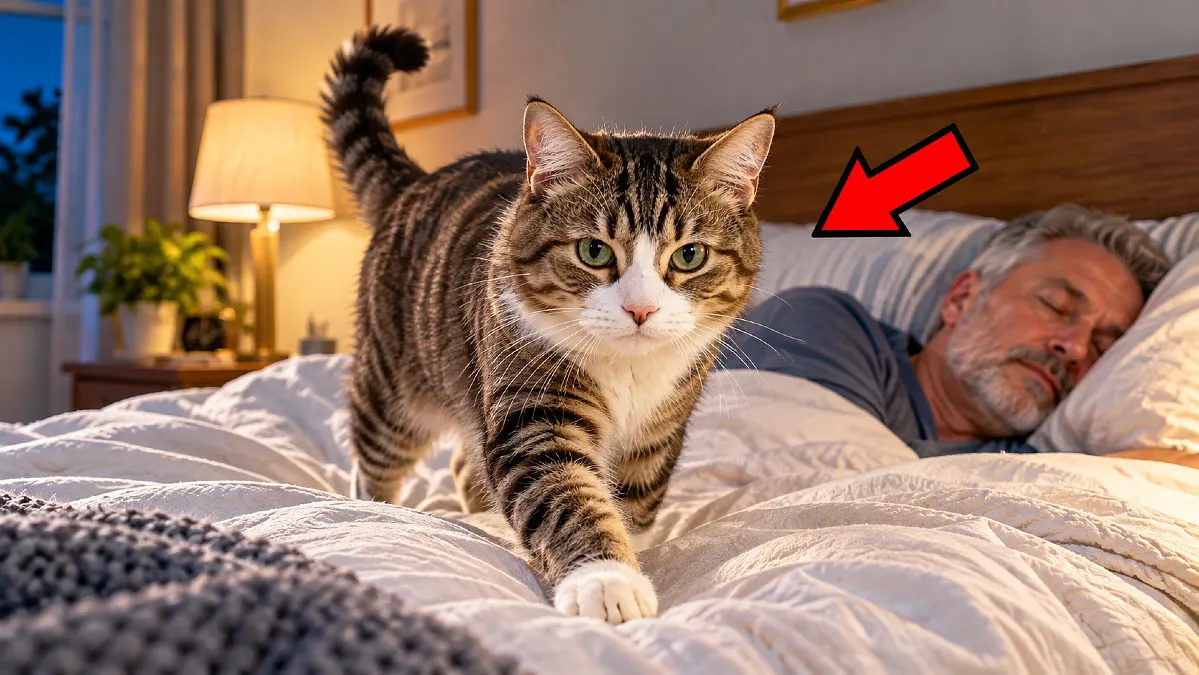
You’re finally getting comfortable in bed when something starts pressing against your chest. Before you can open your eyes, your cat is walking across your stomach, climbing onto your shoulder, or stepping dangerously close to your face.
You love your cat, but being turned into a walking path at 3 a.m. isn’t exactly peaceful. And when this happens almost every night, you naturally start wondering what your cat wants.
If your cat walks on you at night, the behavior may have more than one explanation. Your cat could be searching for warmth, asking for food, seeking attention, or responding to something you haven’t noticed.
Sometimes, the reason goes back to behaviors your cat learned as a tiny kitten. Other times, it’s simply a habit that has become part of their nightly routine.
Here are 6 possible reasons your cat keeps walking across you while you sleep, what those behaviors may mean, and how you can respond without making nighttime interruptions worse.
1. Is Your Cat Checking Whether You’re Still Alive?
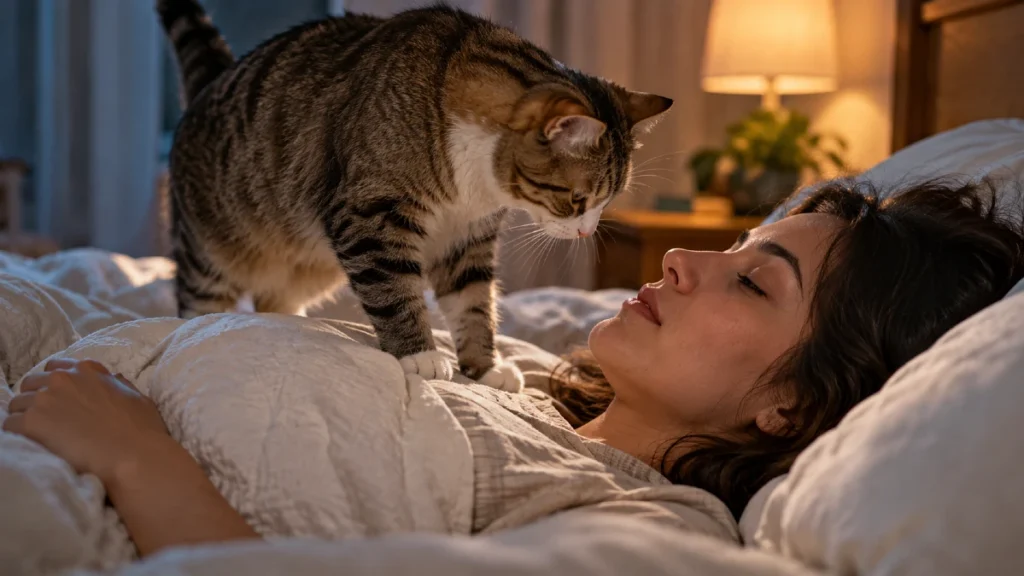
Have you noticed your cat walking directly across your chest or moving unusually close to your face? Of all the empty spaces on your bed, they somehow choose the exact spot where you’re sleeping.
One popular explanation suggests that cats check whether their sleeping owners are still breathing. It’s a comforting thought, but there is no strong scientific evidence that cats routinely perform these survival checks.
What we do know is that cats are naturally observant animals. They notice movement, familiar smells, sounds, and changes in the behavior of people around them.
When you’re sleeping, your normal behavior changes completely. You’re quieter, you move less, and you aren’t responding to your cat the way you normally would.
Your cat may approach because they’re curious about your stillness or want attention. They may also simply be looking for a comfortable place to rest beside someone familiar.
Why Your Chest and Face Attract So Much Attention
Your chest moves gently as you breathe, while your face remains exposed above the blankets. Both areas offer familiar smells, warmth, and easy access for a curious cat.
Cats Protection explains that cats often prefer sleeping near their owners because of warmth and comfort. Some cats also favor the area near your head because it moves less during sleep.
If your cat climbs onto your chest and immediately curls up, they may simply feel comfortable there. However, repeated pawing at your face could mean they’re hoping to wake you.
What to watch: Notice what happens after your cat approaches you. A relaxed cat that settles down is behaving differently from one that repeatedly paws at your face and waits for a reaction.
| What Your Cat Does | Possible Meaning | What to Notice |
|---|---|---|
| Walks across your chest and settles | Warmth or comfort | Relaxed body and quiet resting |
| Sniffs your face | Curiosity or familiarity | Gentle sniffing |
| Taps your face repeatedly | Wants attention | Stops when you wake up |
| Walks over you toward the door | Wants something elsewhere | Looks back or meows |
| Kneads your stomach | Comfort or a familiar habit | Slow, steady paw movements |
| Runs across you and leaves | Play or excitement | Quick movements and sudden bursts of energy |
These clues cannot reveal your cat’s exact thoughts. However, they can help you recognize patterns and make better choices about how to respond.
2. Your Cat May Be Leaving a Familiar Scent on You
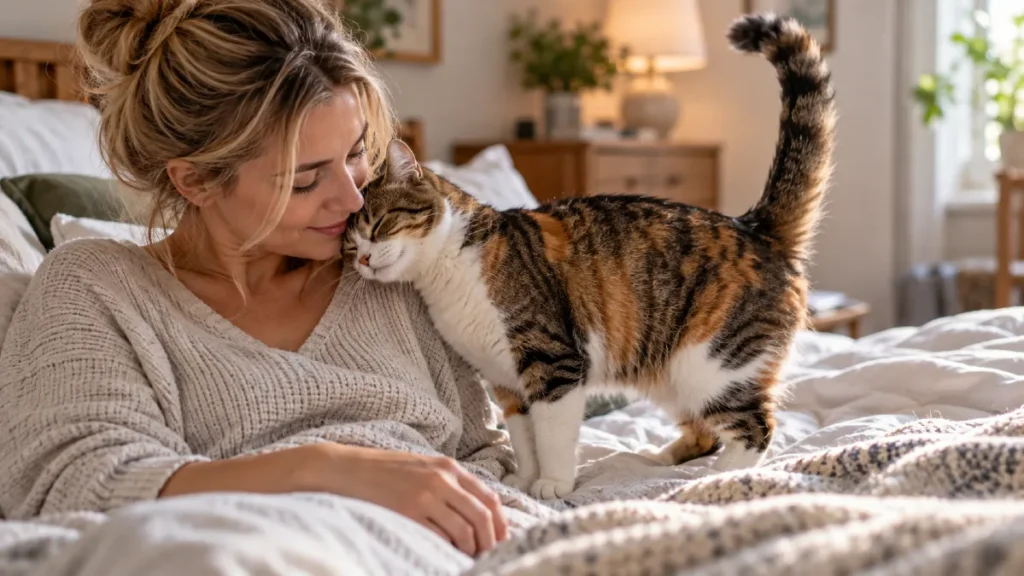
Your cat experiences your bedroom differently from you. While you notice pillows, blankets, and furniture, your cat also pays close attention to the smells covering those objects.
Scent plays an important role in how cats communicate and recognize familiar places. Your clothes, bedding, and even your skin carry smells that your cat may associate with home.
According to Cats Protection, cats have scent glands in several areas of their bodies, including their paws. These glands release chemical signals that other cats may be able to detect.
When a cat scratches or kneads certain surfaces, scent from those glands can be transferred. However, simply walking across your body doesn’t prove that your cat is deliberately marking you.
Why Familiar Smells Can Make Your Cat Feel Secure
Your bedding carries your scent along with other familiar household smells. For a cat that regularly sleeps near you, those smells can make your bed an appealing resting place.
You may notice your cat rubbing their cheeks against your hand before lying down. Sometimes, they press their forehead against your arm or rub along your legs.
These behaviors are known forms of feline scent communication. Cats have facial scent glands, and rubbing can help maintain familiar scent signals in their surroundings.
That doesn’t necessarily mean your cat considers you personal property. Scent communication can also help cats recognize familiar people and places.
Does Your Cat Think You Belong to Them?
It’s tempting to believe that every step across your body is a message of ownership. But feline behavior is rarely explained by one simple motive.
Your cat may rub against you because you’re familiar and comforting. They may also knead your blanket because the movement feels pleasant or helps them settle.
What to do: Let your cat rub or knead if you’re comfortable with it. If their claws become uncomfortable, place a thick blanket between your skin and their paws.
You can also place a familiar blanket inside their own bed. This may encourage your cat to rest nearby without climbing directly onto your body.
3. Your Cat May Have Heard Something You Completely Missed
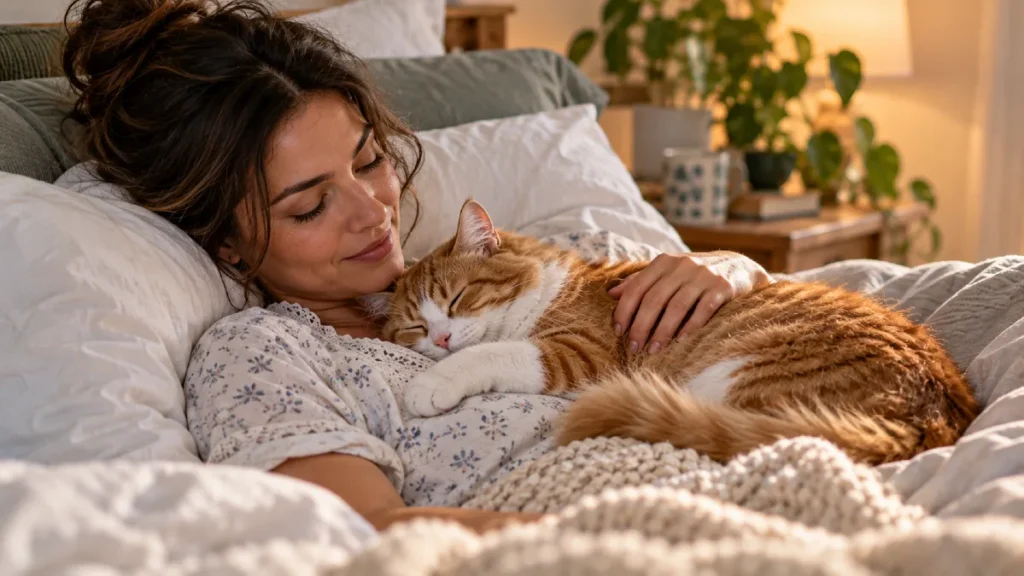
You’re sleeping peacefully when your cat suddenly jumps onto your stomach. Their ears stand upright, their eyes widen, and they stare toward the bedroom door.
You listen carefully but hear absolutely nothing. Before assuming your cat is behaving strangely, remember that feline hearing is much more sensitive than human hearing.
According to VCA Animal Hospitals, cats can detect much higher sound frequencies than people. Their ears are especially useful for noticing small movements and high pitched noises.
Your cat might hear an animal outside, a sound from another room, or a household appliance switching on. These noises may go completely unnoticed while you’re sleeping.
Why Your Cat Suddenly Climbs Onto You
When a sound catches your cat’s attention, they may move to another position to investigate. Sometimes, that means climbing onto your bed and walking straight across you.
Your bed is familiar, comfortable, and often raised above the floor. Moving onto it may give your cat another place to listen or watch what is happening.
However, this doesn’t mean every cat climbs onto its owner for protection. Some cats may simply cross your body while moving around the room.
Pay attention to their ears, tail, and posture. These details can help you tell the difference between curiosity, excitement, and possible fear.
Your Cat’s Body Language Offers Better Clues
A relaxed cat may have a loose body, upright tail, and ears facing forward. A frightened cat may crouch, flatten its ears, or try to escape.
The ASPCA explains that feline body language should be considered as a whole. One sign alone is rarely enough to determine how a cat feels.
| Body Language | What It May Suggest | How You Should Respond |
|---|---|---|
| Ears forward, body relaxed | Curiosity | Let your cat observe |
| Ears turning toward a noise | Listening closely | Check for possible sounds |
| Tail upright with relaxed movement | Comfort or confidence | Stay calm |
| Crouching with flattened ears | Fear or discomfort | Provide a quiet retreat |
| Hissing or growling | Feeling threatened | Give your cat space |
| Sudden running around the room | Excitement or play | Offer suitable activity later |
What to do: Don’t force your cat to stay beside you when they’re alert or frightened. Give them space to investigate or return to a safe resting area.
If your cat repeatedly becomes frightened at night, check for possible disturbances. Outdoor animals, loud equipment, or changes around the home may be contributing to their behavior.
4. Your Body Is One of the Warmest Places in the Bedroom
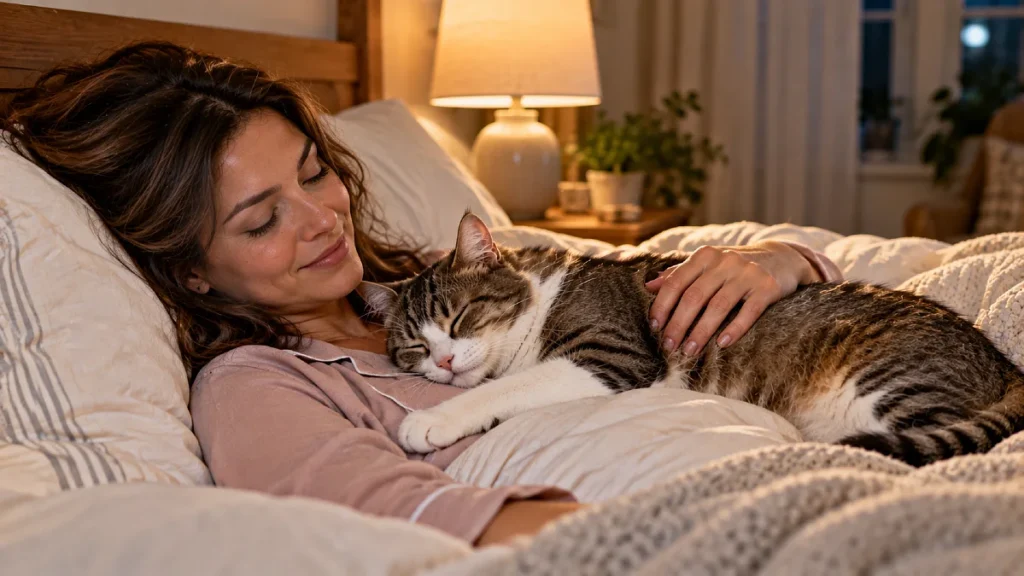
Sometimes, the reason your cat walks all over you is wonderfully simple. You’re warm, your bed is soft, and your cat has decided that you’re a comfortable place to sleep.
Cats naturally seek warm resting areas. That’s why you may find them sleeping in sunny windows, curled against pillows, or stretched across blankets during colder weather.
According to the Merck Veterinary Manual, a normal cat’s body temperature is approximately 100.5°F to 102.5°F. That’s generally higher than the average human body temperature.
Your body provides steady warmth while your cat rests. For some cats, sleeping against you may be more comfortable than lying on a cooler part of the bed.
Why Your Cat Walks Across Several Spots Before Settling
Have you noticed your cat walking across your legs, pausing on your stomach, and then moving toward your chest? The whole process can look strangely planned.
Your cat may simply be searching for a comfortable position. Warmth, blanket texture, available space, and your sleeping posture can all affect where they finally settle.
There is no strong evidence that cats use a precise temperature scanning routine while walking across people. However, their preference for warm resting places is well established.
Some cats prefer sleeping near your feet, while others choose your chest or the pillow beside your head. Each cat can develop its own sleeping preferences.
Why This Happens More Often During Winter
When temperatures fall, warm sleeping places often become more attractive. Your cat may spend longer beside you or return to your bed more frequently during colder nights.
This doesn’t necessarily mean your cat suddenly loves you more in winter. Your body may simply offer a warmer resting place than other areas of the bedroom.
A comfortable cat bed can give them another option. Choose one with soft fabric, enough room to move, and a location away from cold drafts.
You can also consider a heated mat designed specifically for pets. Always follow the manufacturer’s instructions and make sure your cat can move away from the heat.
What to do: Place a soft bed near your sleeping area and add a familiar blanket. Your cat may begin choosing that warm spot instead of walking across your stomach.
5. Your Cat May Be Trying to Wake You Up on Purpose
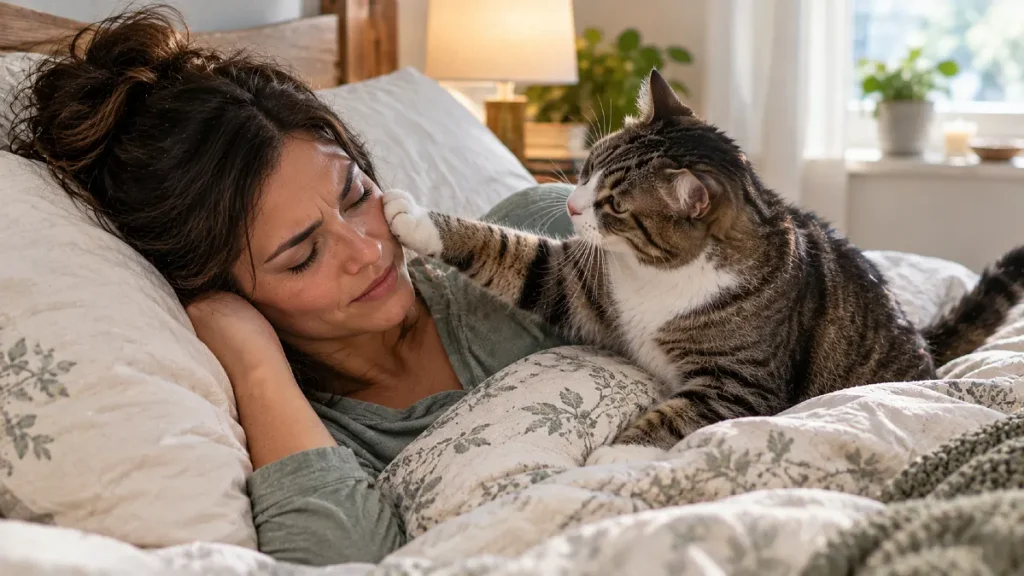
Some cats walk across their owners because they want somewhere comfortable to rest. Others seem determined to wake everyone in the house before the sun comes up.
Your cat might step on your chest, purr beside your ear, or tap your face repeatedly. If you ignore them, they may simply try again.
This behavior can become especially common when cats learn that waking their owners leads to food, attention, or play. Your response may be teaching them what works.
Your Cat’s Natural Clock May Be Different From Yours
Cats are generally crepuscular animals, meaning they tend to be most active around dawn and dusk. These activity patterns are connected to the hunting behavior of their wild ancestors.
While you’re enjoying your last hour of sleep, your cat may already be alert and ready for activity. This can be especially noticeable with kittens and younger cats.
Cats Protection explains that nighttime and early morning activity can be normal feline behavior. However, repeated disruptions can also develop into habits through learned routines.
Your cat isn’t necessarily trying to annoy you. Their preferred activity time may simply overlap with the hours when you want uninterrupted sleep.
Breakfast Might Be the Real Reason
Think about when you normally feed your cat. If breakfast arrives at 6 a.m., your cat may begin seeking attention shortly before that time.
Cats can learn predictable household routines, including feeding schedules. They may connect your alarm, morning movements, or waking up with the arrival of food.
The ASPCA explains that some cats learn to wake their owners when they want breakfast. Giving food immediately after unwanted waking can encourage that behavior to continue.
For example, your cat steps on your pillow and you get up to fill their bowl. If this happens repeatedly, they may learn that walking on you gets results.
Boredom Can Also Play a Role
Cats need chances to explore, chase, climb, and play. When they spend much of the day without enough activity, some may become more active during the night.
Indoor cats can benefit from regular play sessions and activities that encourage natural hunting behaviors. Wand toys, puzzle feeders, and scratching posts provide different forms of stimulation.
VCA Animal Hospitals recommends increasing appropriate daytime and evening activity when dealing with disruptive nighttime behavior. Consistent routines may also help cats settle more easily.
What to do: Provide regular play sessions during the day and evening. Keep meals predictable, and avoid turning every early morning interruption into an extra feeding opportunity.
If breakfast requests are the main problem, a programmable feeder may help. It can provide a scheduled meal without teaching your cat that walking across your face is the way to get food.
6. Your Cat May Be Kneading Because You Feel Like a Safe Place

There’s one nighttime behavior that can be especially meaningful. Your cat climbs onto your stomach, settles into a comfortable position, and begins pressing their front paws against you.
One paw pushes down while the other lifts. The movement continues in a slow rhythm that looks almost like someone working dough.
Cat owners often call this behavior making biscuits. Its proper name is kneading, and it begins very early in a cat’s life.
Why Kittens Learn This Behavior From Their Mothers
Newborn kittens knead against their mother’s belly while nursing. The gentle pushing motion helps stimulate the flow of milk while they feed.
According to Cats Protection, kneading is a natural behavior that can continue into adulthood. However, the exact reasons adult cats continue kneading are not fully known.
Many adult cats knead blankets, cushions, soft beds, and people. You may notice the behavior most often when your cat is preparing to settle down.
For some cats, kneading appears to be connected with comfort and relaxation. Others may knead while arranging a soft surface before lying down.
Does Your Cat Think You’re Its Mother?
It’s a touching thought that your adult cat remembers its mother every time it kneads on you. However, there is no proof that cats consciously replay those early nursing memories.
A more careful explanation is that kneading is a familiar behavior that may remain linked with comfort. Your warmth, soft clothing, and familiar presence can make you an appealing resting spot.
When your cat chooses to knead on your stomach, they may feel relaxed enough to settle beside you. That can be a positive sign within your relationship.
Still, kneading alone cannot tell you exactly what your cat feels. Their posture, behavior, and overall health provide more useful clues.
Why Some Cats Purr While Kneading
Many cats purr when they’re relaxed, comfortable, or receiving gentle affection. You may notice your cat kneading with half closed eyes and a loose, restful body.
However, purring is not always a sign of happiness. Cats may also purr when they’re stressed, uncomfortable, or trying to soothe themselves.
A cat that kneads peacefully before falling asleep is probably behaving normally. Sudden changes in kneading, especially with other unusual symptoms, deserve closer attention.
What If the Kneading Hurts?
Even affectionate kneading can become painful when sharp claws press into your skin. This is especially uncomfortable if your cat chooses your stomach or chest.
Avoid shouting at your cat or punishing the behavior. Instead, place a thick blanket between you and their paws or gently guide them onto a cushion.
You can also keep your cat’s claws properly trimmed. Ask your veterinarian or groomer for guidance if you’re unsure how to do this safely.
What to do: Allow gentle kneading when it’s comfortable for both of you. If you need space, calmly guide your cat toward a soft blanket or another suitable resting place.
How to Stop Your Cat Walking on You at Night Without Upsetting Them
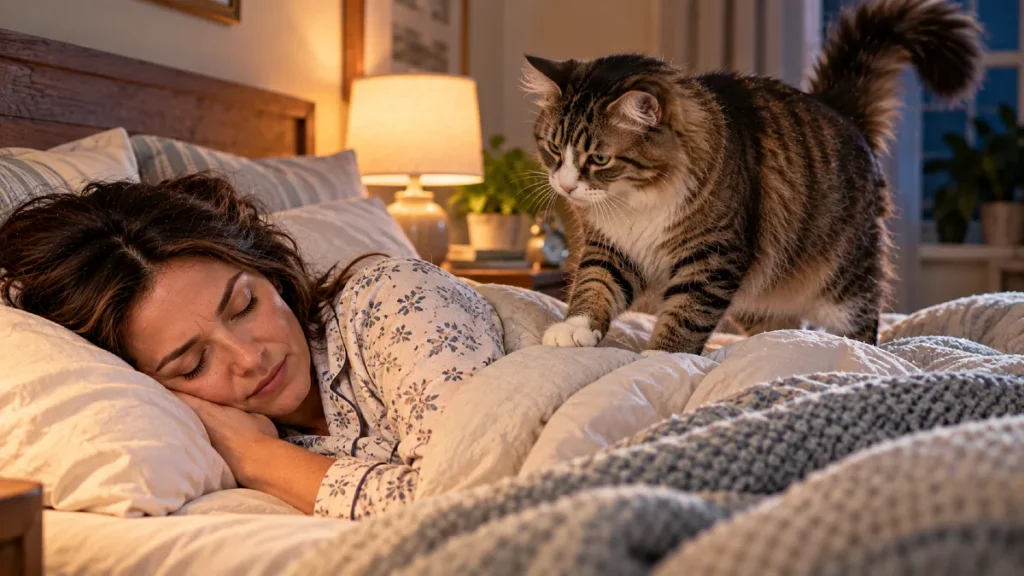
You can love your cat deeply and still want a peaceful night’s sleep. The good news is that many nighttime habits can improve with patience and consistent routines.
The first step is identifying what your cat wants. A cat searching for warmth needs a different solution from one repeatedly waking you for breakfast.
Once you recognize the likely reason, you can make small changes that meet your cat’s needs. These changes should also help you protect your own sleep.
Give Your Cat More Activity Before Bed
Start by offering regular play sessions during the day. Short games with a wand toy can encourage your cat to chase, jump, and use natural hunting behaviors.
Let your cat catch the toy occasionally so the game feels rewarding. Put away toys with strings or loose parts when you’re finished supervising play.
An evening play session may help some cats settle more comfortably. However, play alone may not solve every nighttime problem, especially when food requests have become a habit.
Keep Breakfast at a Predictable Time
If your cat wakes you for breakfast, avoid feeding them earlier every time they demand it. Otherwise, they may learn that repeated nighttime interruptions are effective.
Try keeping meals on a predictable schedule that suits your cat’s needs. A programmable feeder may be useful when early morning feeding is the main problem.
Don’t reduce your cat’s food without veterinary advice. The goal is to change the feeding routine, not leave your cat hungry.
Make Their Own Bed More Appealing
Your cat may ignore an expensive pet bed if it doesn’t feel comfortable. A simple, washable bed in a familiar location may be more appealing.
Try placing it near your bed, away from cold drafts and household noise. Adding a blanket that carries familiar smells may help your cat feel comfortable.
Some cats prefer raised resting areas, while others enjoy enclosed beds. Give your cat a choice rather than forcing them into one sleeping spot.
A Simple Bedtime Routine Worth Trying
| Time or Situation | What You Can Do | Why It May Help |
|---|---|---|
| During the day | Offer short interactive play sessions | Provides healthy activity |
| Early evening | Provide a puzzle feeder or supervised play | Encourages mental stimulation |
| Before bedtime | Play and offer a scheduled meal if appropriate | Creates a predictable routine |
| At bedtime | Provide a warm and comfortable cat bed | Offers an alternative sleeping area |
| When your cat wakes you | Avoid rewarding repeated demands with food or play | Helps prevent unwanted habits |
| Early morning | Keep breakfast at a consistent time | Reduces mixed feeding signals |