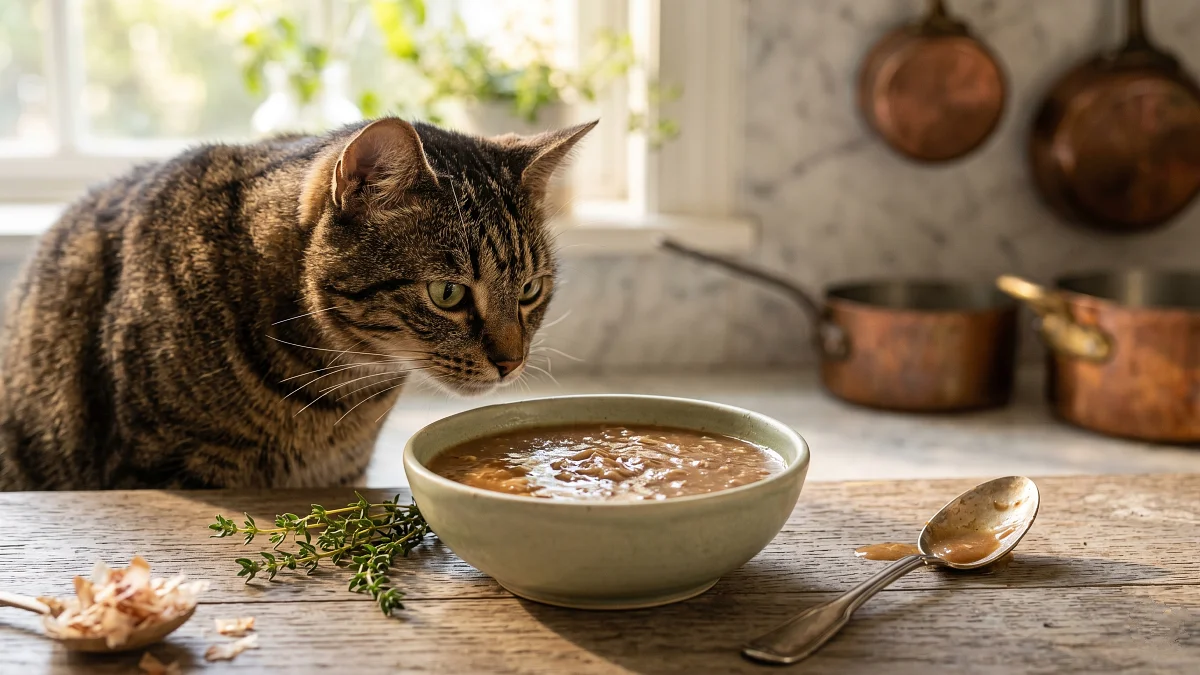
Picture a feline meticulously sniffing a bowl of premium kibble, only to turn tail and walk away, leaving an exasperated caretaker staring at an untouched meal. This familiar standoff often ends with a frantic search for the perfect meal topper.
Felines are notoriously selective, and their low naturally occurring thirst drive makes hydration a constant challenge for conscientious owners. Learning how to make cat gravy at home bridges the gap between culinary appeal and essential moisture intake.
By mastering homemade variations, you take complete control over the ingredient quality, tailoring the flavor profile to even the most demanding palate while ensuring a safe, healthy addition to their daily regimen.
Treat Responsibly: These recipes are for supplemental treats only and are not formulated as complete or balanced meals. Treats and toppers should account for no more than 10% of your cat’s total daily caloric intake.
A Quick Guide to Safe Treat Ingredients
Before preparing homemade cat gravy, it is critical to understand which ingredients support feline health and which pose severe risks.
Feline Safe Treats Guide
Chicken Broth
Unsalted, homemade, or pet-specific broths are excellent for hydration. Never use broths containing onions or garlic, as these are highly toxic to felines.
Canned Tuna
Safe in moderation when packed in water, not oil. High mercury content means this should be an occasional treat, not a daily staple.
Cornstarch & Arrowroot
Safe to use in very small quantities strictly as a thickening agent.
Onions and Garlic
Extremely toxic to cats in all forms (powder, raw, cooked). They cause oxidative damage to red blood cells. Always double-check commercial broths for these hidden ingredients.
Plain Pumpkin Puree
Safe and beneficial for feline digestion. Ensure it is 100% pure pumpkin, not pumpkin pie filling, which contains toxic spices and excess sugar.
1. The Whisker-Licking Chicken Nectar
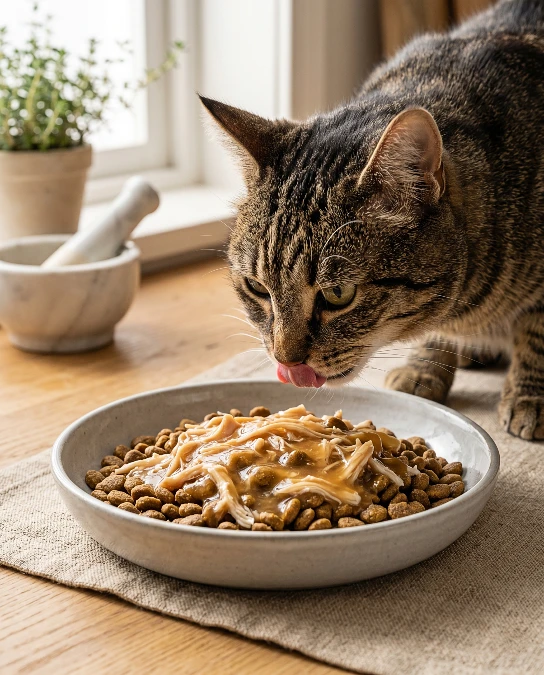
This classic poultry gravy is designed for everyday hydration and coaxing finicky eaters to finish their dry food. The reliance on lean chicken provides a high-protein, low-fat liquid that appeals to the feline palate without overwhelming their digestive system.
Ingredients
Yield: Approximately 1 cup (16 tablespoons)
- 1 cup plain, unsalted chicken broth (strictly no onion or garlic)
- 1/4 cup cooked, unseasoned chicken breast (finely shredded)
- 1 tablespoon water
- 1 teaspoon cornstarch
Instructions
- Pour the unsalted chicken broth into a small saucepan and place over medium heat until it reaches a gentle simmer.
- Mix the cornstarch and cold water in a separate small bowl until a smooth slurry forms.
- Whisk the cornstarch slurry slowly into the simmering broth.
- Reduce the heat to low and stir continuously for 2 minutes until the liquid thickens into a gravy consistency.
- Remove from heat, stir in the finely shredded chicken breast, and allow the mixture to cool completely to room temperature before serving.
Estimated Calorie Breakdown
Full Batch Breakdown:
| Ingredient | Estimated Calories (Full Batch) |
| Unsalted Chicken Broth (1 cup) | ~15 kcal |
| Cooked Chicken Breast (1/4 cup) | ~55 kcal |
| Cornstarch (1 tsp) | ~10 kcal |
| TOTAL (Full Batch) | ~80 kcal |
This recipe makes approximately 16 tablespoons of gravy.
Per-Treat Summary:
| Nutrient | Amount (per 1 tbsp) | Notes |
| Calories | ~5 kcal | Ultra-low calorie topper |
All caloric figures are approximations. Actual values vary by ingredient brand and exact measurements.
Recipe-Specific Fun-Tip: For cats with dental issues who struggle with shredded meat, use an immersion blender after the gravy cools to puree the chicken entirely into a smooth, drinkable bisque.
2. The “Midnight Zoomies” Tuna Elixir
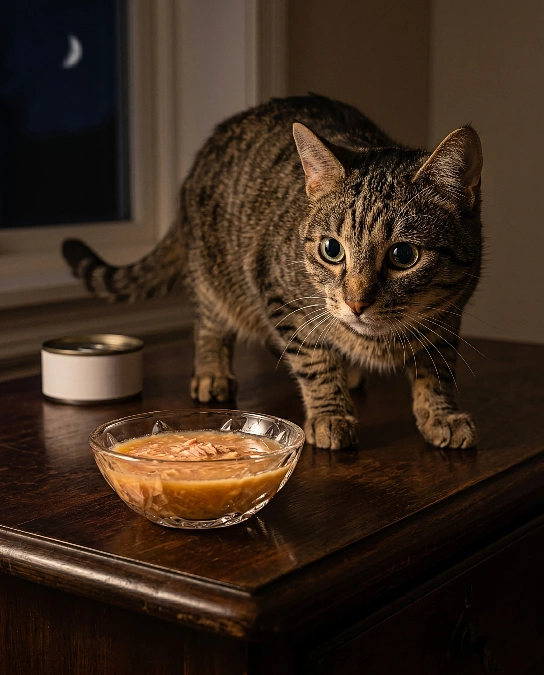
Harnessing the pungent, irresistible aroma of fish, this gravy is the ultimate high-value reward for cats who turn their noses up at poultry. It utilizes the natural juices from canned tuna, offering a burst of flavor and a boost of Omega-3 fatty acids for skin and coat health.
Ingredients
Yield: Approximately 1/2 cup (8 tablespoons)
- 1/2 can (2.5 oz) tuna in water (no salt added)
- 1/4 cup water (or plain, unsalted fish broth)
- 1/2 teaspoon arrowroot powder
- 1 teaspoon tuna water (reserved from the can)
Instructions
- Drain the tuna, reserving 1 teaspoon of the liquid in a small bowl.
- Flake the drained tuna into a small saucepan and add the 1/4 cup of water.
- Bring the tuna and water to a light simmer over medium-low heat.
- Whisk the arrowroot powder into the reserved tuna water until fully dissolved.
- Stir the arrowroot mixture into the saucepan, cooking for 1 minute until slightly thickened, then remove from heat to cool completely.
Estimated Calorie Breakdown
Full Batch Breakdown:
| Ingredient | Estimated Calories (Full Batch) |
| Tuna in Water (2.5 oz) | ~60 kcal |
| Arrowroot Powder (1/2 tsp) | ~5 kcal |
| TOTAL (Full Batch) | ~65 kcal |
This recipe makes approximately 8 tablespoons of gravy.
Per-Treat Summary:
| Nutrient | Amount (per 1 tbsp) | Notes |
| Calories | ~8 kcal | High aroma, ideal for picky eaters |
All caloric figures are approximations. Actual values vary by ingredient brand and exact measurements.
Recipe-Specific Fun-Tip: Freeze leftover tuna elixir in small silicone molds to create savory “tuna ice cubes” that can be dropped into a cat’s water fountain during hot summer months to encourage hydration.
3. The Senior Slurp Bone Broth Blend
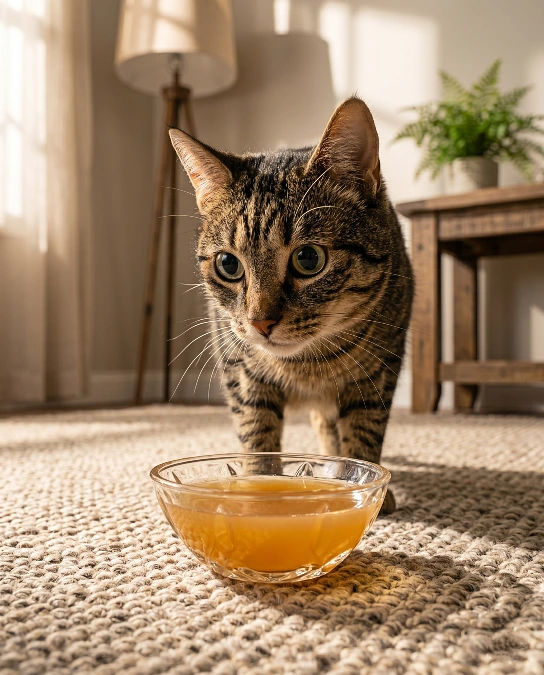
Tailored for older felines requiring extra joint support and gentle digestion, this unthickened, nutrient-dense broth utilizes the natural gelatin found in bone marrow. The addition of pumpkin puree adds a mild dose of fiber to support aging digestive tracts.
Ingredients
Yield: Approximately 1.5 cups (24 tablespoons)
- 1 cup plain, unsalted beef bone broth (pet-safe, no onions/garlic)
- 2 tablespoons plain pumpkin puree (not pie filling)
- 1/4 cup plain water
Instructions
- Combine the bone broth and plain water in a saucepan over low heat.
- Add the plain pumpkin puree to the liquid.
- Whisk the mixture continuously for 3 to 4 minutes until the pumpkin dissolves entirely into the broth.
- Remove from heat immediately, as boiling is not required.
- Let the mixture cool to room temperature; it will naturally thicken slightly as the gelatin in the bone broth cools.
Estimated Calorie Breakdown
Full Batch Breakdown:
| Ingredient | Estimated Calories (Full Batch) |
| Unsalted Bone Broth (1 cup) | ~40 kcal |
| Plain Pumpkin Puree (2 tbsp) | ~10 kcal |
| TOTAL (Full Batch) | ~50 kcal |
This recipe makes approximately 24 tablespoons of gravy.
Per-Treat Summary:
| Nutrient | Amount (per 1 tbsp) | Notes |
| Calories | ~2 kcal | Highly hydrating, gentle on stomachs |
All caloric figures are approximations. Actual values vary by ingredient brand and exact measurements.
Recipe-Specific Fun-Tip: Because this recipe omits starch thickeners, it is perfect for warming slightly (test temperature on your wrist) before pouring over food, enhancing the aroma for senior cats with diminished senses of smell.
4. The “Picky Paws” Turkey and Egg Yolk Emulsion
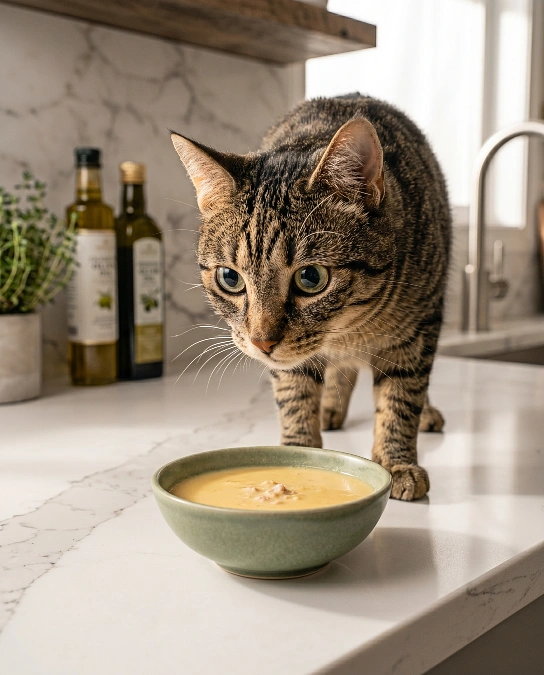
Utilizing the natural emulsifying properties of egg yolks, this rich, starch-free gravy offers a velvety texture ideal for felines with grain or starch sensitivities.
Lean ground turkey provides an easily digestible protein base, while the egg yolk delivers essential fatty acids and biotin to support a healthy, gleaming coat.
Ingredients
Yield: Approximately 3/4 cup (12 tablespoons)
- 1/2 cup plain, unsalted turkey broth (strictly no onion or garlic)
- 1/4 cup cooked, unseasoned ground turkey (very finely crumbled)
- 1 large egg yolk (cooked hard and mashed)
Instructions
- Pour the unsalted turkey broth into a small saucepan and heat over low until it reaches a lukewarm temperature.
- Add the finely crumbled, unseasoned ground turkey to the warmed broth.
- Place the hard-cooked egg yolk into a small separate bowl and mash it thoroughly with a fork until it resembles a fine powder.
- Whisk two tablespoons of the warm turkey broth into the mashed yolk to create a smooth, lump-free paste.
- Stir the egg yolk paste back into the main saucepan, whisking gently for 1 minute until the mixture thickens into a creamy emulsion, then remove from heat to cool completely before serving.
Estimated Calorie Breakdown
Full Batch Breakdown:
| Ingredient | Estimated Calories (Full Batch) |
| Unsalted Turkey Broth (1/2 cup) | ~8 kcal |
| Cooked Ground Turkey (1/4 cup) | ~60 kcal |
| Hard-Cooked Egg Yolk (1 large) | ~55 kcal |
| TOTAL (Full Batch) | ~123 kcal |
This recipe makes approximately 12 tablespoons of gravy.
Per-Treat Summary:
| Nutrient | Amount (per 1 tbsp) | Notes |
| Calories | ~10 kcal | Rich, nutrient-dense topper |
All caloric figures are approximations. Actual values vary by ingredient brand and exact measurements.
Recipe-Specific Fun-Tip: To streamline preparation, utilize the yolk from a plain, hard-boiled egg prepared during your own meal prep routine, ensuring absolutely no salt, pepper, or other seasonings have touched the portion intended for the feline’s gravy.
How to Store Your Homemade Gravies
Proper storage is critical to prevent bacterial growth and ensure these savory toppers remain safe for feline consumption.
- Refrigerator Storage: Homemade gravy lacks the commercial preservatives found in store-bought pouches. Store cooled gravy in a sterilized, airtight glass jar or container in the refrigerator for a maximum of 3 to 4 days.
- Freezer Storage: For long-term use, pour cooled gravy into a silicone ice cube tray. Once frozen solid, pop the gravy cubes out and transfer them to an airtight, freezer-safe bag for up to 2 months.
- Safe Thawing: Thaw frozen gravy cubes in the refrigerator overnight. Never serve piping hot gravy; if warming a chilled batch to enhance the aroma, stir thoroughly and test the temperature to ensure it is only lukewarm.
- Signs of Spoilage: Discard immediately if you notice an overly sour odor, visible mold, or a drastic separation of liquid that does not resolve with stirring. When in doubt, throw it out.